
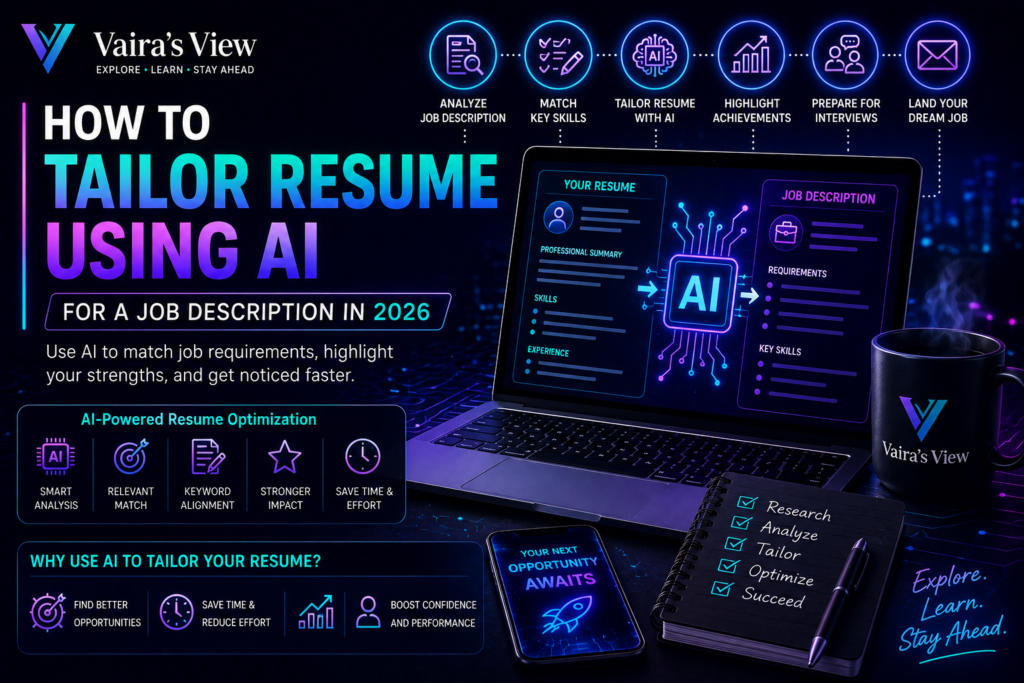
Learning how to tailor resume using AI can make your application more focused, relevant and easier to prepare.
In 2026, using AI to customize your resume for a job description is essential. In 2026, customizing resumes for job descriptions with AI is a must.
Customizing a resume means that you don’t have to duplicate the information on your entire career for each job you apply.
It is important to ensure that this experience, skills and/or achievements that you already have are clearly reflected in the application.
AI can help with this in 2026, making it much quicker.
AI can assist you in analyzing various job postings and match them with your CV to find a good fit, show you when you have real gaps, help word your CV, and prioritize the experience you want and are needed for each posting.
The general guideline is to:
Never have an experience that you don’t have to improve with AI to make it more relevant and clear.
It is a guide that will explain for you how you can modify your resume based on a job description, but without any of the claims being false.
1. How to Tailor Resume Using AI: Begin With the Job Description
Numerous individuals start modifying their resume as soon as they start looking for a job.
The way to go is to get a good grasp of what the role is.
When looking for an ideal candidate to fill a position, be sure to review the job description and look for:
- core responsibilities
- mandatory requirements
- preferred skills
- technologies
- certifications
- leadership expectations
- industry knowledge
- likely business outcomes
This information can be organised with the help of AI.
Prompt
Inspect this job description and break it down into six partitions: Key Duties, Must Skills, Nice to Have Skills, Technologies, Outcomes and potential interview questions. Please don’t include anything not mentioned or justifiable in the job description.
This will provide you with a better understanding of what the employer’s priorities are.
2. Review and Compare Your Current Resume With the Job Description
After you are familiar with the job, look through your resume to see if you have any matching qualifications to those listed in the job.
The intent is NOT to ask:
“Will the baker and the king be suitable for each other?”
Instead, ask:
What will be important to keep in mind from my true experience in this position?
Prompt
I have attached my CV here to compare with the job description. Structuralize the findings in to good matches, partial matches and real gaps. Provide information that is contained in my resume. Don’t make up experience, accomplishments or technologies.
This comparison should aid you in determining which should be “focussed.
3. Identify the Keywords That You Believe Are Most Essential for Your Website
Job descriptions may have numerous keywords but not all of them are equally important.
Some may give or provide an outline of core responsibilities.
Some may be optional skills, others may be just random skills.
Give AI a list of them and have it prioritize them.
Prompt
Hone in on the most critical keywords and phrases in this job description. Classify them as High priority, Medium priority and Optionals. Skills, technologies, responsibilities, domain terms and certifications.
Then do a comparison of those keywords to your resume.
Use only keywords that have a meaning to your experience.
Don’t just throw a technology at the job if it’s mentioned in the job description.
4. Locate Pertinent Experience That Is Hidden in Your Resume
At times, the right experience is listed, but in a very low position in the resume and/or is not well defined.
AI can be used to determine the areas.
Prompt
Check out my CV with this job description. Look for and recognize current experiences that are relevant but under-emphasized. Propose where they might be more apparent, but not altered, based on facts.
This can assist you in determining whether or not you should:
- Promote a project up.Raise a project up.
- expand one bullet
- Make a short paragraph of a nonrelated bullet.Make a short unrelated bullet.
- reorder skills
- Update the professional summary (skills, interests, and career interests).
- highlight a certification
This does NOT change your history.
You’re placing a focus on the something.You’re shifting your focus to the something.
5. Add a Cover Letter.7. Incorporate a Cover Letter
Your professional summary is among the most easiest portion of resume to customize.
A generic summary might give a good description of your background, but not be able to relate to the position.
Provide AI with:
- your existing summary
- your resume
- the job description
Then ask:
Rewrite/rewrite my professional summary based on information on my resume. Be brief, informative and on-topic. The introducer of achievements, titles, technologies or experience must not be one that I have not given.
Your introduction should concisely explain in a strong summary why your information is pertinent.
6. Make an Outline of Your Cover Letter.8. Rewrite Your Skills Section
The skill order may cause the order of your skills to be the first thing that recruiters see.
For specialized roles, such as those that are cloud architecture centric, the cloud skills should be listed first, in front of other skills that are unrelated to the cloud.
Ask
Using this job description, make a suggestion for the order of the skills that are currently included in my resume. Never introduce any skills.
This is a straightforward change which makes the resume seem quite more aimed.
7. Lastly, Make Improvements to Resume Bullet Points Without Having to Create Results
Weak bullets can be strengthened with the help of AI.
Assume that the first bullet you have is:
Collaborated with business and technical teams in the solution design.
This could be true, but it’s unclear.
You can ask:
Using only the information that I give you, make three stronger versions of this bullet. Clarify and use action language – do not include numbers, technologies, outcomes or responsibilities.
The aim is to improve communication, NOT to over-exaggerate it.
8. Prioritize Relevant Projects
When you have multiple projects, you don’t require the same amount of space for each project.
One project can be of a lot more value than another at a particular job opening.
Ask
Check these Project Descriptions with the job description. List them in order of relevance and give reasons for this. Do NOT change any project facts.
After that, you can prioritize your projects, and focus more details on the ones you feel are more significant.
9. Eliminate Less Relevant Content.Remove Less Relevant Content, #9
Emphasis is not the only thing tailoring is about.
Sometimes it’s to take away the distractions.
Your resume could include information that is older or not relevant to the job you’re applying for, distracting from the experience that’s most relevant.
Ask
Look for parts of or bullets of my resume that are not pertinent to this position. Propose changes that can be made to the resume without impacting valuable information.
This can be helpful to maintain the concentration of the resume.
10. Carefully Match Responsibility Language
The wordings of job descriptions may be different to your resume.
For instance, you might include on your resume:
Collaborated with client groups to establish needs.
In the job description you might read:
Perform Stakeholder Discovery & Requirements Analysis.
If this is indeed the same type of work, AI can assist in aligning the language with each other.
Prompt
Do a word for word comparison of my resume with the wording in this job description. Recommend only changes to terminology where use of the new term actually means the same thing as the old one. Please don’t give me a broader experience than that!
It is an excellent way of aligning without distortion.
11. Make Sure That Your Resume Demonstrates Evidence
A resume may have a lot of words, and a very few of those words are going to be keywords, but without proof there’s not going to be much strength in the resume.
Have AI check to make sure your claims are supported.
Prompt
Look at this resume and pick out statements that appear unsubstantiated, vague or generic. For every one explain what kind of real evidence would make the statement stronger.
These are some examples of helpful evidence which might consist of:
- scope
- responsibility
- technology used
- problem solved
- stakeholder interaction
- measurable result
- delivery outcome
Include evidence that you can substantiate.
12. Become a Trained AI Gap Finder
Not all holes are bad.
It can just inform you where you ought to prepare.
Ask
This job description should be compared to my CV and it is only acceptable to state real missing areas. Divide the gaps into critical gaps, learnable gaps and optional gaps.
This can assist you to determine if:
- to apply anyway
- to create an account.to make a description.
- to acquire knowledge in advance to an interview
- To avoid putting too much emphasis on the fit
It’s important to be aware of your weaknesses and make your application more credible.
13. Avoid Attempting 100% Match of the Job Description
One of the typical errors is to squeeze all of the requirements into the resume.
This can make the document unnatural, and can lead to incorrect claims being made.
Instead, focus on:
- core responsibilities
- essential skills
- transferable experience
- relevant domain knowledge
- credible achievements
It’s okay if you’re not handsome.
It’s important to appear relevant and believable.
14. Draft an Applicant Tracker (AT) Screen Shot
After you’ve spotted the critical changes, make anew resume for that particular job.
Be sure to give the file a descriptive name like:
FirstName_LastName_Role_Company.pdf
Do not delete or move any changes from a master resume.
Then take and make copies specific to them.
This will make it easier for you to keep track of which employer you sent to each piece of information.
15. AI Final Accuracy Check: Add a Final Accuracy Check Using AI
Ask AI for expertise in resuming a job application before sending it out for review, to see if anything is exaggerated.
Prompt
Critically evaluate this personalized CV to my own CV and the job posting. Look for any statement which seems to be a new experience, greater responsibility or unearned success. For now don’t rewrite anything.
One of the most valuable final inspections.
It can identify changes which may not have been apparent in the editing stage but may have impacted the meaning.
16. Take Out the Unnecessary.18. Make Sense of the Meaning
Tailored resume should be easily readable even.
Ask
Check this CV for clarity and repetition of information; for over-complicated wording. Propose less complicated solutions, without altering the facts.
Look especially for:
- long sentences
- repeated skills
- vague phrases
- unnecessary jargon
- excessive adjectives
Impressive-sounding language doesn’t typically work well in relation to clear language.
17. Be Ready for Interview Questions, Based on the Tailored Resume
Any part of your resume which you highlight could be a question in the interview.
Use AI to prepare.
Prompt
Utilizing this customized resume and job description, list 15 questions that I am likely to be asked during an interview. Pay special attention to the experience(s) that I have highlighted.
Next, come up with your own examples and practice answering them.
This is a helpful link between the tailoring of your resume and preparation for an interview.
18. Maintain a List of All the Resumes You Have Customized
When applying for several jobs, it’s easy to lose track of which one(s) you applied to.
Track:
- company
- role
- application date
- resume version
- important keywords
- recruiter
- interview stage
It doesn’t need to be complicated, just a simple spreadsheet will suffice.
This can be particularly helpful when a recruiter calls you a couple of weeks later.
19. AI Resumes: A Simple Workflow for Creating Them.21. How to Use AI to Create Resumes
There’s no need for any complicated process.
Use this sequence:
Step 1 — Analyze
Have a clear written job description.Be familiar with the job description.
Step 2 — Compare
Compare with current resume.
Step 3 — Prioritize
Determine the key elements and/or phrases.
Step 4 — Emphasize
Transfer the appropriate skills and knowledge.
Step 5 — Refine
Make better summaries and bullet points – do not alter facts.
Step 6 — Remove Distractions
Cut down on additional content that isn’t as relevant.
Step 7 — Verify
Repeat all the claims with your actual experience.
Step 8 — Save
Make a new resume for the job application.
Step 9 — Prepare
Practice is likely interview questions focusing on emphasises.
This approach helps to maintain the assistant role of AI and prevent it from taking over from humans as the sole content creator.
20. A Sample of a Resume for Company A Job Application
If you wish to have one prompt that’s reusable, try this:
Will send my CV and a job description. I need someone to assist me with resumes that ensures no factual errors and is appropriate to the job.
The first step is to determine what are the key criteria in the job description.
Then be able to compare them to my resume and divide them up into good matches, partial matches and true holes.
Propose how the focus of some existing experiences, skills and projects are increased.
Only recommend changes in words where they do not alter the meaning, and still 100% match my experience.
Never make up technologies, accomplishments, functions, job positions, numbers, certificates or business results.
Last but not least, look for any portion of the customized resume that might be misleadingly great or unbacked.
This provides a definite limit from the outset for AI.
What AI Should Never Add to a Resume
AI should never be used to create a resume, here are some things it shouldn’t add:
Never let AI come up with ideas –Never let AI think up ideas:
- employers
- job titles
- projects
- technologies
- certifications
- degrees
- years of experience
- leadership responsibilities
- team sizes
- revenue figures
- customer names
- business outcomes
- performance numbers
If the information is not a part of the event, then it shouldn’t be there.
Protect Confidential Information
When using AI to share resumes and job-related documents, be mindful to avoid sharing documents that could be classified as malware.
Take away or prevent exposure to:
- confidential customer names
- internal project information
- passwords
- proprietary code
- financial information
- sensitive personal information
- internal company documents
Only use relevant information in completing the task.
How This Relates to a Larger AI Job Search
What this has to do with a broader AI job search. How this relates to a larger AI job search.
How to Use AI for Job Search in 2026: Resume, LinkedIn, Applications and Interviews
Best AI Tools for Job Seekers in 2026: 10 Tools to Find, Apply and Prepare for Jobs
25 Best ChatGPT Prompts for Job Seekers in 2026: Resume, LinkedIn & Interviews
Tailing isn’t the only aspect of the job search process.
AI can be leveraged in many other ways, such as:
- job discovery
- company research
- LinkedIn optimization
- interview preparation
- application tracking
- recruiter communication
- follow-up messages
To view a wider workflow, click on:
In this lesson, students will learn how to leverage AI to assist in their job search journey for 2026, which includes creating a resume, optimizing their LinkedIn profile, preparing applications, and preparing for interviews.
Or you can check out:
Best AI Tools for Job Seekers in 2026: 10 Tools to Find, Apply and Prepare for Jobs is an incredible list of tools that will help you to find, apply and prepare for jobs in 2026.
For prompts that are already written:
25 Best ChatGPT Prompts for Job Seekers in 2026: Resume, LinkedIn & Interviews: These are the top 25 ChatGPT prompts for job seekers in 2026 that you should utilize when looking for a new job.
These articles are designed to complement each other and serve as a valuable toolkit to aid in job searching, supported by artificial intelligence.
Final Thoughts
Tailoring resumes is a much quicker process with the help of AI.
But when the result is the same, it will help to make it faster.
Not a single resume that copies all the keywords used in a job posting is the finest custom cover letter.
It’s the one that assists the employer realize where you have the true experience they are looking for.
Use AI to:
- understand the role
- find relevant experience
- improve clarity
- prioritize important skills
- reduce irrelevant content
- prepare for interviews
However, do not lose the title of any of the claims.
This does not mean your resume is going to sound like it is made up by AI, it just means it will sound stronger because it’s clearer.