
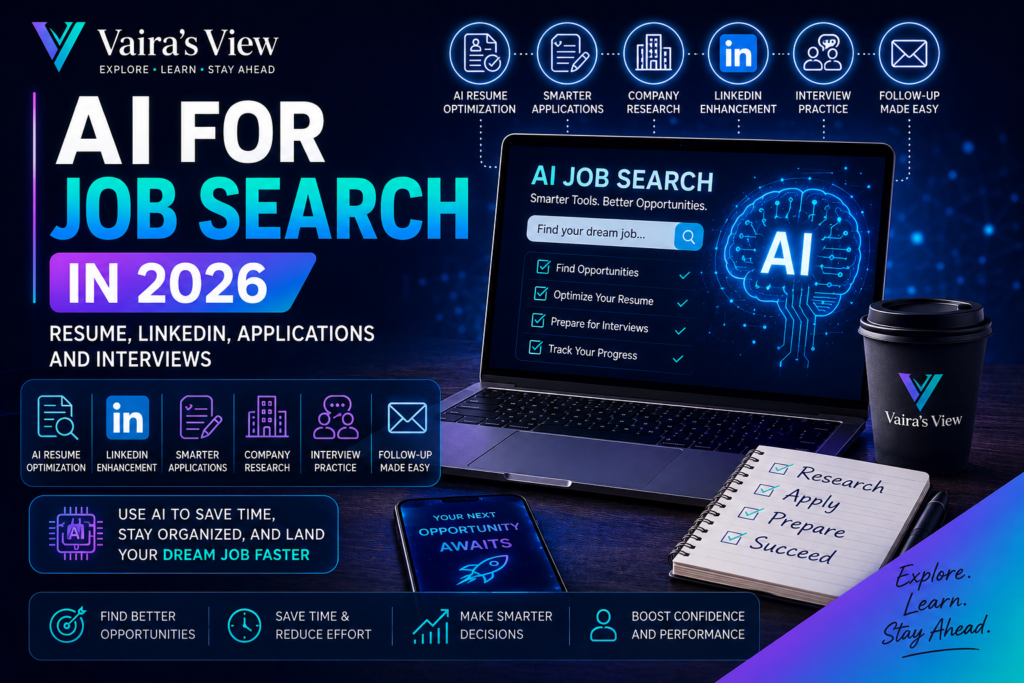
Learn how to leverage AI to navigate your job search in 2026, from resumes to LinkedIn, applications and interviews.
In 2026, AI for job search isn’t just about writing resumes or cover letters for you and sending them out to potential employers. In 2026, AI-powered tools for job search won’t be limited to crafting resumes and cover letters for you and sending them to prospective employers. AI for job search can support almost every stage of the process.
AI can assist in virtually all aspects of your job search, from identifying relevant job postings to deciphering job descriptions, optimising your resume, enhancing your LinkedIn profile, researching companies, drafting cover letters, simulating interviews and drafting follow-up messages.
The key difference is in its usage.
AI should help you to be more organized, analyze, and communicate your real experience more better. Should never be used for creating qualifications, projects or responsibilities or achievements.
In this e-guide, we will discuss how AI can be applied to your job search in a useful manner while maintaining the authenticity and personal touch of your job applications.
1. Why AI Is Making Job Searching More Efficient
The traditional job search process can be tedious, and can take up hours of boring time.
You may need to:
- Look through 1000s of positions.
- compare job descriptions
- research companies
- update your resume
- prepare cover letters
- contact recruiters
- track applications
- practise interview questions
- send follow-up messages
There is some of that manual effort that can be cut down with AI.
AI for job search can reduce some of this repetitive manual work.
It would not supplant your decision making process, but rather serve as an assistant that enhances your decision making process.
The aim is NOT to apply for more.
The aim is to find out more opportunities and to develop better applications.
2. Use AI to Find Better-Fitting Jobs
The number one most common job search error is sending out resumes for any position with a familiar job title.
The skills necessary for two jobs with the same title (Solution Architect, Product Manager and Data Analyst) might be entirely different.
One useful application of AI for job search is evaluating whether a role fits your experience.
Preemptively read the job description with AI to have a head start when applying.
Copy and paste the job description into your AI assistant and then ask it:
This job description is similar to what I do. Break down the needs into strong match, partial match and gap. Never take it for granted that I have experience that I haven’t told you about.
You can then have it tell you what:
- mandatory requirements
- optional skills
- technical requirements
- leadership expectations
- industry knowledge
- certifications
- likely interview topics
This allows you to have a clearer idea of whether or not it’s something worth going for.
A more effective decision rule
It is not mandatory to fulfil all the requirements.
On the other hand, you should seek jobs in which you have:
- Very close conjunction to the main tasks
- Has sufficient transferable experience to make up for any gaps
- Is capable of learning missing skills in a realistic manner
- A true passion for the job
AI can aid with that analysis, but it’s up to you to make the final decision.
3. Use AI to Interpret Complex Job Descriptions
There are some jobs that have specific job descriptions.
Others include lengthy lists of technologies, responsibilities and corporate buzzwords that are hard to decipher what it is the employer is looking for.
Get help from AI to make the role easier to understand.
For example:
Break this job description down into five parts: Business Aim, Daily Duties, Essential Skills, Additional Skills and potential interview questions.
You can also ask:
From this job description, what seem to be the three most critical results they seek from the individual that is hired?
This can provide an indication as to whether the business is looking to acquire:
- a technical specialist
- a customer-facing consultant
- a team leader
- a problem solver
- an architect
- a delivery manager
- a domain expert
When the true purpose of the role is clear, it’s not so difficult to customize your application.
4. Make Your Resume Look Great – But Don’t Make Up Experience
While AI is quite helpful for editing resumes, it’s also among the simplest places that it can be used improperly.
Never use these types of prompts:
Create an outstanding resume.
It can lead to a general style of language and/or overachievement.
Rather, give your real-life experience first.
For example:
In this project I did the following: Create two short resume bullets. Please do not include Technologies, Numbers, Responsibilities or Accomplishments that I didn’t provide.
This helps to keep the output in check with reality.
AI can contribute to an improvement in:
- clarity
- sentence structure
- action verbs
- repetition
- formatting
- relevance
- keyword alignment
It shouldn’t have the ability to make:
- fake revenue figures
- invented team sizes
- fictional leadership responsibilities
- The new technologies you’ve never used.New technologies you have not used before.
- The certifications you have that you would like to have.
- Neither of the projects actually came to pass.
Don’t overstate anything in the resume.
AI for job search can also help improve the clarity and relevance of your resume.
It requires tangible proof of what it’s you really did.
5. Focus Your Resume for Significant Jobs
It’s easy to use the same resume for all the companies you apply to, but it might not resonate with the information that’s most relevant to them.
AI can provide you with insightful suggestions on making small and honest changes.
Give a copy of your resume and the job posting and ask:
Identify and suggest other experiences in my resume that should be highlighted for this position. Don’t produce a new experience or change facts.
You may adjust:
- professional summary
- order of skills
- project emphasis
- achievement wording
- keywords
- certification placement
Typically, you don’t have to modify your entire resume for each position.
Do what you can for a position that’s really important.
6. Use AI to Optimize Your LinkedIn Profile
When recruiters check out LinkedIn, they tend to look at the profile before or after the resume.
Your profile should be easy to comprehend:
- what you do
- Your strengths and abilities.Your talents or strengths.
- What industries do you know of?What are some industries you know?
- who you’re looking to play roles for
- What experience will help to accomplish those goals
AI can be used to enhance your headline and About section.
Try:
I would like to update my LinkedIn ‘About’ section by making it clear and precise what my strengths are, my experience and target direction. Ensure that all of the facts are true and no language used is hyperbole.
To get a good headline, you should ask:
Propose five short and sweet headline ideas for LinkedIn, based on these skills, certifications and target roles.
Focus especially on:
- headline
- About section
- recent experience
- key projects
- certifications
- skills
- featured work
Do not stuff key terms in your profile.
Using AI for job search also includes improving how you present yourself on LinkedIn.
Specificity beats the “visionary leader” “results-driven professional” and “innovative change agent” types of phrases.
7. Conduct Due Diligence on Companies Before Applying
There are a lot of job seekers who begin their research of a company only once they get an interview call.
It may serve to be beneficial earlier on.
Before applying, research:
- The activities that are carried out by the company.
- The provision of major products/service.
- target customers
- recent developments
- competitors
- business challenges
- technology strategy
- company culture
Use reliable sources to check current or important facts, as AI can help to structure research.
A useful prompt is:
Draw up a checklist of information about this employer. Distinguish between what I need to check on the official website, what I can find in the news and on LinkedIn and other trusted sites.
This helps you to not only avoid a single AI summary, but also avoid the issue of having multiple AI-generated summaries.
8. Use AI to Craft Better Application Messages
A recruiter message may be more crucial than a cover letter at times.
AI can assist you to enhance:
- recruiter replies
- networking messages
- follow-ups
- referral requests
- application emails
- thank-you notes
Write your own message first!
Then ask:
Enhance clarity and professionalism and retain natural tone in this message. Don’t come across as too formal or promotional.
This will usually yield more effective results than requesting an AI to compose a message based on nothing given.
Avoid using elaborate messages in network use.
A good message will include an explanation of:
- who you are
- The reasons for your call with the person
- the things that you share with someone else
- The information you are seeking.The information you are looking for.
Don’t send long introductions to strangers that are created with an artificial intelligence.
Professional networking is more successful when messages are more “human.
9. Practice an Interview Using AI
Interview preparation is another great application of AI, as it enables you to practice your interviews over and over without the need for another person.
AI for job search can be especially useful for interview practice.
Give the description of the job and ask:
Interviewer for this position. Do not ask more than one question at any one time. Following each answer make a judgement on clarity, evidence, relevance and structure.
You can practise:
- behavioural questions
- technical questions
- leadership scenarios
- architecture discussions
- customer situations
- conflict management
- career motivation
- salary conversations
- Use of real examples
AI can assist you with structuring your answer according to a structure, for example STAR:
Situation – Task – Action – Result
However, the example itself should be reflective of your real-life experiences.
Ask:
Guide me through this real experience to make it brief using the STAR answer. Don’t make up information.
For exactly that reason, it’s safer to let AI assist you in generating an ideal response than to rely on the response generated from scratch.
10. Practise Difficult Interview Questions
Many candidates put in most of their time on preparing the questions which they find comfortable and neglect the uncomfortable questions.
Here are some questions that can be practised with the help of AI:
- What are the reasons for your resignation?
- Why do you think you’re the best person for the job?
- What’s your least favorite thing about yourself?
- Share with me about a project that you did not complete successfully.
- Tell about a disagreement with a friend that you have experienced.
- What are the reasons behind your career change?
- What is the reason for the skills deficiency?
- How much money do you think you’re worth?
Probe the AI with questions about ambiguous responses.
For example:
Become a strategic skeptical hiring manager and ask me questions. When I’m not very specific, give me a follow-up question and require specific evidence.
This can help to make your practice more realistic.
11. Create an Individual Interview Study Plan Using AI
In an interview that will discuss a large amount of technologies or business fields, it is possible that the preparation will be overwhelming.
Give AI:
- the job description
- the interview date
- the topics that you are familiar with
- the subjects your need to edit:
Then ask:
Develop a plan for preparation for the interview. Focus on the most frequently asked questions on the interview and limit the study time to 60 minutes a day.
If you don’t have a plan you may spend too much time on issues that are not important.
12. Application Management Using AI
After multiple applications, it’s easy to get the list of companies out of your head:
- when you applied
- The type of resume (Traditional, Modern, or Functional)
- recruiter names
- interview stages
- follow-up dates
- salary discussions
- next actions
Any spreadsheet, career-management software, or other system can be used to keep track.
AI can be used to summarize notes.
For example:
Convert these interview notes into three parts: What went well; any concerns and what actions will be taken before the next round.
Log it also provides a record of what applications are getting a response.
13. AI in Professional Follow-Up
Many candidates either don’t send anything or they send an interview letter that has a very generic feel to it.
AI can aid you in writing a concise follow-up based on the actual content discussed.
Provide:
- interviewer’s name
- role
- major discussion points
- all things you have said you will send
Then ask:
Write a brief thank you letter on the basis of these notes. Talk about the discussion in a natural way, and don’t include facts or details that I didn’t include.
Check the message for accuracy before you send it.
But a follow-up should still be done in your own voice.
14. Create an AI-Enhanced Job Search Strategy
Don’t have to have 10 AI tools on at the same time.
Typically a simple flow is sufficient.
Step 1: Discover
Look for appropriate positions on job sites, professional networks and company career sites.
Step 2: Evaluate
Utilize AI to match your job experience with the job requirements.
Step 3: Research
Have knowledge of the company, role and industry.
Step 4: Tailor
Do some minor and honest updates to your resume and application.
Step 5: Apply
Manuscript outlining an application that proposes a clear goal and action plans.
Step 6: Track
Note the date that the application was made and followed up.
Step 7: Prepare
AI Mock Interviews and Study Plans by the Job.
Step 8: Follow up
Send professional text messages when you have business text messaging.
A structured AI for job search workflow can help you stay organized.
This system is of more value than relying on AI to create additional applications.
15. What AI Should Not Do in Your Job Search
While AI can streamline the job search process, it also has its limits.
Avoid using AI to come up with ideas:
- employers
- projects
- qualifications
- certifications
- salaries
- job titles
- years of experience
- team sizes
- business results
- technical expertise
Never let AI give answers to application questions without carefully reviewing the answer.
But be careful to not upload private documents, information from your employer or confidential personal information to a tool without knowing how this information will be treated.
An attractive looking application is not as important as your credibility.
16. How to Avoid Sounding AI-Generated
The simplest method to sound natural is to provide AI with your very own material initially.
Instead of:
Write about me: About section.
Use:
Here is how I came up with my career path and experience in the industry. Group them into an easy-to-understand LinkedIn About section. Maintain natural tone; do not embellish with any words or phrases.
Instead of:
Conduct an interview and write an interview answer.
Use:
That’s what really occurred. Help me to make it concise and structured.
The source is the place of the experience, your experience is the source.
AI shouldn’t be used to tell the story, it should enhance it.
17. A 30-Minute AI Job-Search Routine
There’s no need of spending a number of hours each day looking for work.
Do this guided exercise:
10 minutes — Find opportunities
Find one or two roles you can really envision yourself in that are aligned with your direction.
5 minutes — Evaluate
Match up the qualifications with your experience.
5 minutes — Tailor
Do necessary changes in your application.
5 minutes — Network
Send one well thought out message or contact an existing contact.
5 minutes — Practise
Answer 1 of the interview questions.
This AI for job search routine focuses on quality rather than volume.
If you spend 30 minutes each day on a narrow focus then you can be more productive than sending out a dozen applications in a rush.
18. AI for Job Searching Works With the Right Tools
There are various tools that can help various aspects of the job search process.
There are those that are good for research, there are those that are good for writing, there are those that are good for tracking application, there are those that are good for communication and those that are good for an interview.
For a wider choice of available options read:
Best AI Tools for Job Seekers in 2026: 10 Tools to Find, Apply and Prepare for Jobs
As job trends evolve, the demand for new tools to assist job seekers is growing, and AI is poised to become a vital resource.With job trends changing, so are the tools required to find, apply, and prepare for jobs, and AI will be a key to it.
This companion-volume examines various tools that can help the job search process.
19. Final Thoughts
In 2026, AI has the potential to assist job-seekers in improving their efficiency, preparation, and decision-making in the job search process.
AI will not replace what employers will end up looking for, however:
- relevant skills
- credible experience
- communication
- judgement
- preparation
- professionalism
- persistence
The best way to do it is not to automate the entire job search process.
Use AI selectively.
Leverage it to analyze information, to structure ideas and thoughts, to enhance communication and to rehearse tough moments.
AI for job search works best when it supports, rather than replaces, your judgement.
Then add those abilities to something that you can’t get AI to make for you:
Your true experience, your judgment and what you can add with it.
Pingback: Tailor Resume Using AI in 2026: Best Powerful Tips
Pingback: 10 Fastest-Growing AI Jobs in Finance for 2027: Skills, Salaries & Career Paths
Pingback: AI in Banking 2027: 10 Proven Ways Artificial Intelligence Is Changing Finance