
Table of Contents
AI in Banking 2027 will be less about whether financial institutions should use artificial intelligence and more about where AI should be trusted, where human oversight is essential, and how banks can redesign work around both.
That distinction matters.
Banking is not a simple digital business. A recommendation on a shopping website may influence a purchase. In banking, automated decisions can affect credit, blocked payments, fraud investigations, customer accounts, investment decisions, suspicious-transaction escalations, and regulatory obligations.
This is why the next stage of AI in banking will not simply be about making systems smarter.
It will be about making banking workflows smarter without losing accountability.
The shift is already underway.
Banks are exploring generative AI across customer operations, software development, risk, compliance, financial crime, knowledge management, and employee productivity.
McKinsey estimates that generative AI could unlock $200 billion to $340 billion in annual value for banking, largely through productivity improvements and operational transformation.
At the same time, regulators and central banks are paying close attention because financial institutions manage sensitive information, interconnected systems, and decisions with real economic consequences.
The Bank for International Settlements has also examined how artificial intelligence may transform financial intermediation, payments, asset management, and financial stability.
So, what could banking look like in 2027?
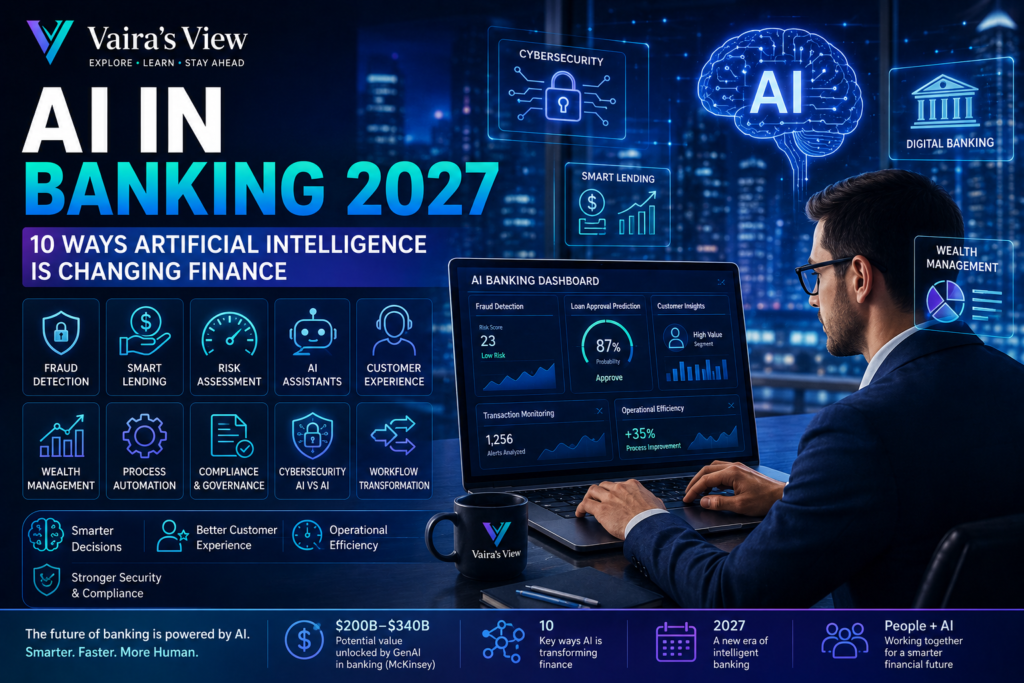
Here are 10 major changes that could define AI in Banking 2027.
1. AI Fraud Detection Will Move From Rules to Context
Banks have used fraud-detection rules for years.
Traditional systems may flag a transaction because:
- the amount is unusually high
- a card is used in a new country
- multiple login attempts fail
- money is sent to an unfamiliar beneficiary
- activity occurs at an unusual time
These rules are useful.
But fraud is rarely predictable enough to fit perfectly into predefined rules.
A customer who normally spends CHF 50 to CHF 100 may suddenly spend CHF 3,000 while traveling. That transaction may look suspicious, but it could be legitimate.
Another customer may make ten individually normal transactions that collectively form a suspicious pattern.
This is where AI can make a major difference.
Instead of asking:
Does this transaction match a fraud rule?
a more advanced system can ask:
Does this activity make sense given the customer’s transaction history, device, location, account behavior, and relationship patterns?
That shift from rule-based detection to context-based detection could be one of the most important developments in AI in Banking 2027.
Where AI Can Help
AI and machine learning can support:
- card fraud detection
- payment fraud analysis
- account takeover detection
- identity fraud
- suspicious login analysis
- merchant fraud
- mule-account detection
- behavioral anomaly detection
The goal should not simply be generating more alerts.
The goal should be:
better detection with fewer legitimate customers being blocked unnecessarily.
2. Financial Crime Teams Could Move Beyond Alert Factories
Anti-Money Laundering teams face a long-standing problem.
Technology can generate large numbers of alerts, but every alert still requires context.
An investigator may need to review:
- transactions
- counterparties
- customer profiles
- KYC records
- previous cases
- supporting documents
- ownership structures
- sanctions or screening information
This can take time.
AI could change the investigator’s starting point.
Instead of opening a case and manually collecting all the information, an AI-assisted investigation could begin with:
- why the case was flagged
- what changed in the customer’s behavior
- which transactions appear unusual
- which counterparties deserve attention
- which previous cases may be relevant
- what information is still missing
Where AI Can Help
AI could support:
- transaction-monitoring analysis
- sanctions investigations
- KYC reviews
- network analysis
- case prioritization
- document summarization
- suspicious-activity investigations
The key boundary is accountability.
AI can:
- gather evidence
- prioritize information
- summarize cases
- identify patterns
But a high-risk system should not make consequential decisions without appropriate human oversight.
A practical model for 2027 could be:
AI researches → human investigator challenges the analysis → human approves the decision.
For a deeper look at how AI could reshape specific banking roles, see our guide: Will AI Replace Banking Jobs?
3. Credit Risk Could Become More Dynamic
Traditional lending decisions often rely on a snapshot of the borrower at a specific point in time.
A credit assessment may consider:
- income
- debt
- financial statements
- repayment history
- collateral
- cash flow
- industry conditions
The decision is then based on the information available during that assessment.
AI creates the possibility of a more dynamic risk model.
A borrower’s credit quality can change because:
- revenue declines
- expenses rise
- payment behavior changes
- cash flow weakens
- a major customer leaves
- the industry deteriorates
- new risks appear in financial statements
AI systems could identify early signals before the next scheduled review.
This does not mean replacing credit professionals.
It means changing their focus.
The future credit analyst may spend less time searching for information and more time asking:
What changed?
Why did it change?
Can I trust this signal?
What information might the model be missing?
That last question is especially important.
Numbers do not always tell the full story.
A relationship manager may know why a client’s cash flow temporarily weakened. AI may detect the deterioration, while the banker provides the context.
The most effective lending model may therefore combine:
Data + AI + Human Context
4. Internal AI Assistants Could Become the Interface to Bank Knowledge
One of the least glamorous but most expensive problems inside large financial institutions is:
finding information.
An employee may know that the answer exists but not know where to find it.
It could be stored in:
- an internal policy
- a product document
- an email
- a procedure
- a knowledge base
- a customer system
- a regulatory document
- a technical manual
Today, employees often switch between multiple systems and search manually.
By 2027, the user interface to bank knowledge may become conversational.
Instead of searching through documents, an employee might ask:
- What documents are required for this type of client?
- What changed in this policy?
- Summarize this client’s portfolio before my meeting.
- Show me the source supporting this answer.
The last question is critical.
A banking assistant should not only provide an answer.
It should also provide:
- supporting evidence
- source documents
- confidence information
- approval requirements
- auditability
That is very different from a generic chatbot.
The future internal banking assistant could become a trusted knowledge layer across the organization.
5. Customer Service Could Become Intent-Driven Instead of Menu-Driven
Digital banking often forces customers to think like software.
They need to:
- choose a menu
- find a category
- select an option
- move between multiple screens
AI gives banks the opportunity to reverse that relationship.
Instead of forcing customers to understand the bank’s interface, the bank can try to understand the customer’s intent.
A customer might say:
I was charged twice for the same purchase yesterday.
A modern banking assistant could potentially:
- identify the relevant transactions
- compare the amounts and merchants
- explain what happened
- identify the correct dispute process
- prepare the next action
- ask the customer for confirmation if required
The value is not simply having a conversation.
The value is connecting that conversation to a controlled banking workflow.
By 2027, strong banking assistants could become:
- context-aware
- account-aware
- transaction-aware
- multilingual
- permission-controlled
- workflow-enabled
The customer journey could gradually shift from:
navigation
to:
conversation + action
6. Wealth Management Could Follow a “Human Advice, AI Preparation” Model
A common assumption is that AI in wealth management will replace human advisers.
That may miss the more practical opportunity.
A large amount of an adviser’s work happens before the client meeting.
An adviser may need to understand:
- portfolio changes
- recent transactions
- performance
- risk exposure
- cash positions
- investment objectives
- market developments
- previous client discussions
AI can prepare much of that information.
Imagine an adviser beginning the day with a concise briefing:
Client Brief
Portfolio change: Equity exposure increased by 6% since the previous review.
Liquidity: Cash levels are below the client’s normal range.
Risk: Technology-sector concentration has increased.
Activity: Several large transactions occurred since the previous meeting.
Client context: The client previously mentioned a potential property purchase within 18 months.
The adviser still owns the relationship.
The adviser still understands the client.
The adviser still decides what matters.
But the preparation becomes faster.
This distinction is important because AI cannot easily recreate one of the most valuable assets in wealth management:
trust built over years.
The 2027 model may therefore be less:
AI adviser
and more:
AI-prepared human adviser
7. Banking Automation Could Move From “Do This Task” to “Complete This Outcome”
Traditional automation works extremely well for deterministic processes.
For example:
If A happens, do B.
AI agents introduce another possibility.
Instead of performing one step, an agent may be able to complete multiple controlled steps toward an outcome.
Imagine an operations employee asking:
Investigate why this payment failed and prepare the case for review.
A controlled AI agent might:
- locate the transaction
- retrieve the payment status
- review the account
- identify the probable error
- find the relevant procedure
- prepare a case summary
- recommend next steps
- stop when human authorization is required
Step eight is the most important.
The near-term future of agentic banking is unlikely to be unlimited autonomy.
It is more likely to be bounded autonomy.
Banks will need to define:
- what an agent can read
- what an agent can modify
- which actions it can perform
- when it must stop
- when human approval is mandatory
- how every action is logged
- how actions are audited
In other words:
AI agents will need job descriptions too.
8. Compliance Could Shift From Reviewing Workflows to Governing AI Workflows
Today’s AI-governance discussions often focus on individual models.
Questions include:
- Is the model accurate?
- Is it explainable?
- Was the data appropriate?
- Are outputs monitored?
Those questions remain important.
But agentic systems introduce a new governance challenge.
A large bank could eventually operate hundreds or thousands of AI-enabled workflows.
Compliance and risk teams may therefore need to ask not only:
Is this model safe?
but also:
What is this AI allowed to do?
Future AI governance could include:
- role-based permissions
- model inventories
- approved data sources
- action limits
- escalation rules
- human approval thresholds
- complete audit trails
- periodic performance reviews
- incident-management processes
The governance question will evolve from:
Do we have an AI policy?
to:
Can we prove that important AI actions are controlled?
The Bank for International Settlements has highlighted governance, financial stability, data, and regulatory considerations around AI in financial services.
This could become one of the most important banking capabilities of the next decade.
9. Cybersecurity Could Become an AI-vs-AI Battle
AI gives security teams powerful new capabilities.
Unfortunately, attackers can use many of the same advances.
AI could help banks with:
- anomaly detection
- phishing identification
- suspicious-login analysis
- malware detection
- behavioral analytics
- incident prioritization
- identity protection
At the same time, AI systems create new attack surfaces.
Potential risks include:
- prompt injection
- unauthorized data extraction
- manipulated context
- compromised integrations
- excessive agent permissions
- model misuse
- third-party AI risk
The risk becomes even greater when AI systems can perform actions rather than simply answer questions.
If a chatbot gives an incorrect answer, the result may be poor information.
If an agent with excessive permissions takes the wrong action, the consequences can be much more serious.
Banks will therefore need to treat AI security as part of architecture, not as an afterthought.
A useful principle is:
The more an AI system can do, the less it should be allowed to do by default.
10. AI Could Redesign Banking Workflows, Not Just Banking Jobs
The simplest prediction about AI is:
AI will replace banking jobs.
Reality is likely to be more complicated.
Jobs are collections of tasks.
Some tasks may be automated.
Some may become faster.
Some may barely change.
Consider a compliance officer.
AI can:
- summarize documents
- prioritize cases
- detect patterns
- retrieve regulations
But someone still needs to:
- interpret requirements
- challenge conclusions
- approve controls
- accept accountability
Now consider a relationship manager.
AI can:
- prepare meetings
- analyze portfolios
- identify opportunities
But relationship management still depends on:
- trust
- communication
- negotiation
- understanding client needs
The most resilient banking professionals may combine three capabilities.
Domain Expertise
Understand banking, products, regulation, clients, or risk deeply.
AI Literacy
Understand what AI can and cannot do.
Human Judgment
Recognize when the machine may be wrong.
This may be one of the most useful career lessons from AI in Banking 2027.
Professionals may not lose opportunities simply because AI exists.
They may lose opportunities to other professionals who know how to use AI better.
For more career-focused guidance, read AI Jobs in Finance.
The 3 Stages of AI Adoption in Banking
AI adoption in banking can be thought of in three stages.
| Stage | What AI Does | Human Role |
|---|---|---|
| Assistant | Answers questions and summarizes information | Human performs the work |
| Copilot | Analyzes information and recommends actions | Human reviews and executes |
| Agent | Performs controlled steps toward an outcome | Human monitors and approves critical actions |
The most important shift by 2027 may be from copilot toward carefully controlled agents.
That does not mean banks should automate everything.
It means banks need to understand where automation adds value and where human control must remain.
What Banking Professionals Should Learn Before 2027
Not everyone working in banking needs to become a data scientist.
But AI literacy is becoming increasingly important.
The World Economic Forum Future of Jobs Report 2025 identifies AI, big data, and other technology skills among major forces reshaping jobs through 2030.
1. Understand AI Capabilities and Limitations
Learn the basics of:
- machine learning
- generative AI
- large language models
- retrieval-augmented generation
- AI agents
- hallucinations
- model limitations
You do not need advanced mathematics for every banking role.
But you should understand enough to challenge an AI-generated answer.
2. Understand Data
AI depends on data.
Banking professionals should understand:
- data quality
- lineage
- privacy
- structured vs. unstructured data
- analytics
- databases
- access controls
3. Protect Your Domain Expertise
AI knowledge becomes most valuable when combined with expertise in something important.
Examples include:
- wealth management
- lending
- payments
- compliance
- risk
- financial crime
- cybersecurity
- investment management
- banking operations
4. Learn AI Governance
Safe AI deployment may become as important as knowing how to use the technology.
Understand:
- human oversight
- model risk
- explainability
- privacy
- bias
- auditability
- access control
- accountability
5. Develop Skills That AI Cannot Easily Replicate
Technology is only part of the answer.
Skills such as:
- judgment
- communication
- leadership
- negotiation
- empathy
- relationship management
remain important in banking, particularly where decisions have significant consequences.
If you are planning a career transition, our AI for Job Search guide explains how AI can support job research, applications, and interview preparation.
What Banks Must Get Right Before Scaling AI
Banks should avoid treating every impressive AI demonstration as a transformation project.
A demonstration can be easy.
A production-grade banking system is much harder.
Data Quality
AI cannot compensate for unreliable data.
Integration
If AI is not integrated into the actual workflow, it becomes another application employees must manage.
Security
Sensitive banking information requires strong identity, authorization, monitoring, and data-protection controls.
Governance
Every important AI system should have:
- an identified owner
- clear accountability
- approved use cases
- defined permissions
- monitoring
Measurement
AI projects need measurable outcomes.
Not:
We deployed AI.
But:
Investigation time fell by 30% without exceeding the approved quality or risk threshold.
Human Oversight
Banks should define the level of human involvement based on the consequences of each decision.
The higher the potential impact, the stronger the oversight should be.
AI in Banking and the Future of Banking Careers
AI adoption could create as many career questions as technology questions.
Some repetitive tasks may disappear.
Other roles may become more analytical, supervisory, advisory, or governance-focused.
Potential growth areas include:
- AI solution architecture
- AI governance
- responsible AI
- AI model risk
- financial-crime AI
- intelligent automation
- AI cybersecurity
- banking data engineering
- AI product management
- AI compliance
If you want a detailed role-by-role analysis, read Will AI Replace Banking Jobs? 15 Finance Careers Changing by 2030.
You can also explore AI Jobs in Finance for emerging career paths in financial services.
Frequently Asked Questions
What Is AI in Banking 2027?
AI in Banking 2027 describes the expected evolution of artificial intelligence in financial services, from chatbots and copilots toward more integrated, controlled AI agents and automated workflows.
How Will AI Change Banks by 2027?
The biggest change is likely to be deeper integration into banking workflows. AI may analyze information, prepare cases, recommend actions, and perform limited approved steps while humans retain oversight.
Will AI Replace Bankers?
AI may replace some highly repetitive jobs or individual positions, but many banking careers are more likely to be transformed than eliminated. Roles involving judgment, accountability, relationships, and regulatory responsibility remain difficult to automate completely.
How Can AI Help Prevent Banking Fraud?
AI can analyze transaction behavior, devices, locations, account relationships, and historical activity to detect patterns that may not be visible through simple rules.
What Can AI Do for AML Teams?
AI can support alert prioritization, network analysis, case summarization, transaction review, and investigation preparation. Human investigators remain important for escalation and consequential decisions.
What Is Agentic AI in Banking?
Agentic AI goes beyond answering questions and can perform a sequence of approved actions toward an objective. In banking, these systems require strict permissions, monitoring, auditability, and human approval for high-impact actions.
Is AI Safe to Use in Banking?
AI can be used safely only when appropriate security, data protection, governance, monitoring, access controls, and human oversight are built into the system.
What Should Banking Professionals Learn About AI?
Banking professionals should develop:
- AI literacy
- data literacy
- governance knowledge
- strong domain expertise
- judgment
- communication skills
Not everyone needs to become a programmer.
Will AI Create New Jobs in Banking?
Yes. AI adoption is likely to increase demand for roles combining banking expertise with skills in AI governance, architecture, cybersecurity, model risk, data, automation, and compliance.
Final Thoughts
The most important question about AI in Banking 2027 is not whether banks will use more artificial intelligence.
They almost certainly will.
The real question is:
How deeply will AI become integrated into real banking decisions and workflows?
The first generation of banking AI focused heavily on pattern recognition.
The next generation added generative AI for summarization, content creation, and employee assistance.
The emerging generation can increasingly participate in workflows.
That could mean:
- fraud teams investigate faster
- credit analysts identify emerging risks earlier
- relationship managers enter meetings better prepared
- customers explain what they want instead of navigating menus
- compliance professionals spend less time collecting information
- operations teams supervise workflows rather than performing every step manually
But as AI becomes more powerful, governance becomes more important.
The banks that succeed may not be the institutions using the greatest amount of AI.
They may be the institutions that understand best:
what AI can do, what AI cannot do, and when humans should remain firmly in control.
That is likely to define the future of AI in Banking 2027.
Pingback: Best AI Certifications for Banking and Finance Careers in 2027
Pingback: 10 Fastest-Growing AI Jobs in Finance for 2027: Salaries, Skills & Career Paths
Pingback: AI Risk Management Software: Vendor Guide & Checklist 2026
Pingback: Embedded Finance Explained: Models, Tech, and Real Examples
Pingback: Wealth Management vs Investment Banking: 7 Key Differences