
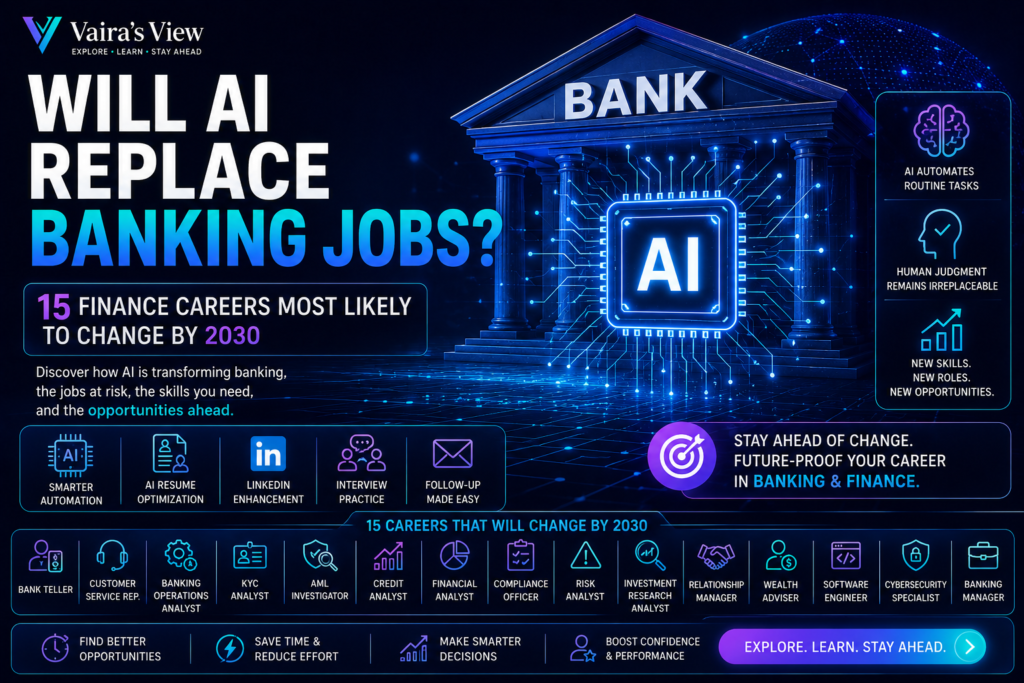
Will AI replace banking jobs? That question is becoming impossible to ignore across banks, fintech companies, wealth managers, investment firms, and financial-services teams.
Generative AI can already summarize documents, analyze large volumes of information, draft reports, search knowledge bases, classify cases, generate code, and assist with customer service. Tasks that once required hours of manual work can sometimes be completed in minutes.
That does not necessarily mean entire professions will disappear.
There is an important difference between automating part of a job and eliminating the whole job.
Research from the International Labour Organization suggests that generative AI is more likely to transform many occupations than completely replace them.
The World Economic Forum Future of Jobs Report 2025 also expects major changes in how work is divided between humans, technology, and human-machine collaboration through 2030.
For banking professionals, the better question is therefore not simply:
Will AI replace my banking job?
It is:
Which parts of my job can AI automate, and which skills will become more valuable?
This guide examines 15 banking and finance careers that could change significantly by 2030.
Will AI Replace Banking Jobs? The Short Answer
AI is likely to replace some individual tasks and may reduce demand for certain highly repetitive roles.
However, many banking jobs are more likely to be redesigned than completely eliminated.
A typical banking role may involve:
- collecting information
- checking documents
- preparing reports
- processing transactions
- communicating with customers
- investigating exceptions
- interpreting regulations
- assessing risk
- making decisions
- managing relationships
- taking responsibility for outcomes
AI can perform some of these activities extremely well.
But banking also involves:
- money
- regulation
- risk
- customer trust
- accountability
- professional judgment
- complex exceptions
- human relationships
These areas are much more difficult to automate completely.
A useful way to think about the future is:
Automation handles repetitive tasks.
AI copilots assist professionals.
AI agents may execute parts of workflows.
Humans remain accountable for important decisions.
Research from the Bank for International Settlements has also explored AI copilots and AI agents in financial services while highlighting the importance of human oversight.
15 Banking Jobs Most Likely to Change by 2030
| Banking Career | AI Impact | What AI May Automate | Human Advantage |
|---|---|---|---|
| Bank Teller | Very High | Routine transactions and basic queries | Advice and complex service |
| Customer Service Representative | Very High | FAQs, summaries, routing | Empathy and escalation |
| Banking Operations Analyst | Very High | Reconciliation support and workflow | Exceptions and controls |
| KYC Analyst | Very High | Document extraction and screening | Risk judgment |
| AML Investigator | High | Alert prioritization and summaries | Investigation decisions |
| Credit Analyst | High | Financial analysis and document review | Context and judgment |
| Financial Analyst | High | Research and first drafts | Interpretation |
| Compliance Officer | High | Monitoring and documentation | Regulatory responsibility |
| Risk Analyst | High | Monitoring and scenario preparation | Risk decisions |
| Investment Research Analyst | High | Research synthesis | Investment thesis |
| Relationship Manager | Medium | Meeting preparation and summaries | Trust and negotiation |
| Wealth Adviser | Medium | Portfolio preparation and analysis | Advice and client understanding |
| Banking Software Engineer | High Transformation | Coding, testing and documentation | Architecture and security |
| Cybersecurity Specialist | High Transformation | Detection and triage | Incident judgment |
| Banking Manager | Medium | Reporting and decision support | Leadership and accountability |
These ratings describe the level of likely transformation, not the probability that an entire profession will disappear.
1. Bank Tellers — Very High AI Impact
Bank branches were changing long before generative AI arrived.
ATMs, mobile banking, online payments, digital wallets, and self-service tools have already reduced the need for customers to visit a branch for simple transactions.
AI could accelerate that change.
What AI Can Automate
AI-powered assistants may increasingly help customers with:
- basic transaction questions
- account information
- payment inquiries
- card-related questions
- product information
- profile updates
- simple troubleshooting
What Humans Still Do Better
Human branch employees remain valuable for:
- complex customer problems
- financial guidance
- product explanations
- sensitive conversations
- relationship building
- customer trust
AI Impact by 2030
Very High
The safest career path for branch employees is likely to be moving away from purely transactional work and toward advisory and relationship-based services.
2. Customer Service Representatives — Very High AI Impact
Customer service is one of the most obvious areas for generative AI automation.
Banks receive enormous numbers of repetitive questions.
For example:
- Why was my card declined?
- Where is my transfer?
- How can I update my address?
- How do I activate my card?
- When will a payment arrive?
Generative AI can understand natural-language questions much better than traditional menu-based chatbots.
What AI Can Automate
AI can support:
- common customer queries
- call summaries
- email drafting
- case classification
- request routing
- knowledge-base searches
- basic troubleshooting
What Humans Still Do Better
Human service staff remain essential when customers are:
- angry
- worried
- confused
- financially vulnerable
- dealing with unusual circumstances
Humans also retain an advantage in:
- empathy
- difficult conversations
- escalation
- judgment
- exception handling
AI Impact by 2030
Very High
Routine customer-service work may decrease, while complex service and escalation work may become more important.
3. Banking Operations Analysts — Very High AI Impact
Banking operations teams often manage large volumes of structured, repetitive, and process-driven work.
Typical activities include:
- reconciliations
- payment investigations
- transaction checks
- document processing
- exception handling
- case creation
- reporting
AI can take traditional automation much further by working with both structured and unstructured information.
What AI Can Automate
AI may assist with:
- identifying mismatches
- summarizing exceptions
- retrieving procedures
- preparing case notes
- recommending next steps
- workflow routing
- document extraction
What Humans Still Do Better
Operations teams remain important for:
- approvals
- unusual exceptions
- incident handling
- control decisions
- accountability
AI Impact by 2030
Very High
Operations professionals who understand process, controls, data, and automation together may become especially valuable.
4. KYC Analysts — Very High AI Impact
Know Your Customer work is highly document intensive.
KYC analysts may review:
- passports
- company documents
- ownership structures
- tax information
- addresses
- customer profiles
- supporting evidence
Document-intelligence systems can already extract and compare much of this information.
What AI Can Automate
AI can help with:
- document extraction
- missing-field detection
- profile comparison
- basic screening
- case summaries
- information matching
- profile updates
What Humans Still Do Better
Complex KYC cases still require judgment.
Examples include:
- complex ownership structures
- unusual source-of-wealth explanations
- cross-border entities
- high-risk customers
- regulatory exceptions
AI Impact by 2030
Very High
Basic document-processing work is highly exposed, while advanced KYC expertise and risk judgment should remain valuable.
5. AML Investigators — High AI Impact
Anti-Money Laundering is an excellent example of a profession AI may transform rather than eliminate.
Transaction-monitoring systems can produce large numbers of alerts.
Investigators must determine which cases require deeper analysis or escalation.
What AI Can Automate
AI may assist with:
- alert prioritization
- transaction summaries
- customer-profile summaries
- network analysis
- historical-case comparison
- draft documentation
- evidence retrieval
What Humans Still Do Better
Investigators still need to determine:
- whether behavior makes economic sense
- whether an explanation is credible
- whether activity requires escalation
- whether apparently separate events are connected
- what final action should be taken
AI Impact by 2030
High
The future AML investigator may spend less time gathering information and more time challenging AI-generated analysis.
6. Credit Analysts — High AI Impact
Credit analysis combines structured financial information with professional judgment.
Credit analysts evaluate:
- income
- financial statements
- repayment history
- debt
- collateral
- business performance
- industry conditions
- cash flow
AI can process much of this information rapidly.
What AI Can Automate
AI may assist with:
- financial-statement extraction
- ratio calculation
- trend analysis
- document summaries
- borrower comparisons
- early-warning indicators
- scenario preparation
What Humans Still Do Better
Numbers rarely tell the complete story.
A temporary fall in cash flow may have a reasonable business explanation.
An experienced credit professional may understand contextual information that is not captured in the raw data.
AI Impact by 2030
High
The job may move from:
finding information
toward:
challenging information and making better credit judgments.
7. Financial Analysts — High AI Impact
Financial analysts spend a significant amount of time:
- researching
- summarizing
- comparing
- preparing reports
- analyzing data
- building presentations
These are areas where generative AI can provide significant productivity gains.
What AI Can Automate
AI can support:
- research summaries
- data extraction
- comparison tables
- first drafts
- report preparation
- scenario generation
What Humans Still Do Better
Information is not the same as judgment.
Professionals still need to determine:
- what matters most
- whether assumptions are reasonable
- which risks are being ignored
- whether conclusions are credible
- what recommendation should be made
AI Impact by 2030
High
Analysts whose main value is moving information from one document to another face greater automation pressure.
Analysts who turn information into decisions and insight should remain much more valuable.
8. Compliance Officers — High Transformation
AI may automate some compliance work while creating completely new compliance responsibilities.
Banks increasingly need governance around:
- privacy
- model risk
- bias
- explainability
- customer protection
- third-party AI
- human oversight
- data usage
- AI accountability
What AI Can Automate
AI may assist with:
- regulatory searches
- policy comparisons
- monitoring
- documentation
- control evidence
- case summaries
What Humans Still Do Better
Humans remain responsible for:
- interpreting regulation
- determining whether controls are adequate
- managing regulatory accountability
- assessing exceptions
- making high-impact decisions
AI Impact by 2030
High Transformation
Compliance roles may gradually shift from manually reviewing workflows toward governing AI-enabled workflows.
9. Risk Analysts — High AI Impact
Risk teams spend large amounts of time collecting information and producing reports.
AI can automate much of that repetitive work.
What AI Can Automate
AI can support:
- data aggregation
- anomaly detection
- scenario preparation
- trend monitoring
- report generation
- risk summaries
What Humans Still Do Better
Risk professionals still need to decide:
- which risks matter most
- what level of risk is acceptable
- when models should be challenged
- when management action is required
- whether recommendations fit business reality
AI Impact by 2030
High
Professionals who understand both traditional financial risk and AI-model risk may become particularly valuable.
10. Investment Research Analysts — High AI Impact
Investment research involves processing enormous volumes of information.
Analysts may review:
- annual reports
- earnings calls
- financial statements
- market news
- industry research
- competitor information
AI can process and summarize this information very quickly.
What AI Can Automate
AI may assist with:
- document summaries
- research screening
- earnings-call analysis
- company comparisons
- data extraction
- first-pass investment notes
What Humans Still Do Better
A summary is not an investment thesis.
Two analysts can review the same company and reach completely different conclusions.
Human professionals remain responsible for:
- interpretation
- conviction
- judgment
- risk assessment
- investment decisions
AI Impact by 2030
High
Routine research becomes easier to automate.
Original thinking becomes more valuable.
11. Relationship Managers — Medium AI Impact
Relationship management is a role AI can support significantly but may struggle to replace.
A large amount of administrative work takes place before and after customer meetings.
What AI Can Automate
Before a meeting, AI could summarize:
- portfolio activity
- recent transactions
- customer issues
- product opportunities
- previous discussions
- upcoming events
AI can also prepare meeting notes and follow-up summaries.
What Humans Still Do Better
Relationships depend on:
- trust
- communication
- negotiation
- empathy
- understanding customer needs
AI Impact by 2030
Medium
Administrative work may decrease significantly.
The human relationship itself may become even more valuable.
12. Wealth Advisers — Medium AI Impact
AI can help wealth advisers with preparation and analysis.
What AI Can Automate
AI may support:
- portfolio summaries
- market research
- risk identification
- investment-document analysis
- meeting preparation
- scenario modeling
What Humans Still Do Better
Financial advice is about more than numbers.
Clients make decisions involving:
- retirement
- inheritance
- family needs
- property
- market fear
- long-term financial goals
An AI system can identify portfolio risks.
But calming an anxious client during a severe market downturn requires trust, judgment, and communication.
AI Impact by 2030
Medium
A likely future model is:
AI prepares. Humans advise.
13. Banking Software Engineers — High Transformation
AI is already changing software engineering.
Developers increasingly use AI for:
- code generation
- debugging
- testing
- documentation
- code explanation
- prototype development
However, generating code is only one part of professional engineering.
The World Economic Forum continues to identify software developers, AI specialists, big-data specialists, and FinTech engineers among important growth areas.
What Humans Still Do Better
Banking software requires:
- security
- architecture
- reliability
- regulatory controls
- integration
- maintainability
- production accountability
AI Impact by 2030
High Transformation with strong career opportunities
The most valuable engineer may not be the person who can type code fastest.
It may be the engineer who understands:
banking + architecture + AI + security + business requirements.
14. Cybersecurity Specialists — High Transformation
AI will affect cybersecurity from both sides.
Security teams can use AI.
Attackers can also use AI.
What AI Can Automate
AI may assist with:
- threat detection
- anomaly analysis
- phishing identification
- behavioral monitoring
- incident prioritization
- suspicious-login detection
What Humans Still Do Better
Security professionals remain necessary to:
- design secure systems
- investigate incidents
- understand business impact
- make response decisions
- manage access
- challenge automated conclusions
AI Impact by 2030
High Transformation but relatively low career risk
AI security itself may create new specialist positions.
15. Banking Managers and Executives — Medium AI Impact
Management jobs will also change.
AI can give managers faster access to:
- performance summaries
- business reports
- operational information
- scenario analysis
- meeting preparation
- decision-support material
What Humans Still Do Better
Leaders still need to decide:
- which risks to accept
- which projects to fund
- how organizations should change
- how teams should be structured
- when AI recommendations should be challenged
- who remains accountable
AI Impact by 2030
Medium
AI may not replace decision-makers, but it could increase expectations for faster and better-informed decisions.
Which Banking Jobs Are Most Vulnerable to AI?
The most exposed types of work are generally:
- repetitive
- standardized
- rules-based
- digital
- high-volume
- information-heavy
This makes the following areas especially exposed:
Higher Automation Exposure
- routine branch processing
- repetitive customer support
- basic KYC processing
- administrative operations
- repetitive reporting
- document handling
High AI-Assisted Transformation
- AML
- credit analysis
- risk
- compliance
- financial analysis
- investment research
- software engineering
Strong Human Advantage
- relationship management
- wealth advice
- leadership
- complex cybersecurity
- high-impact judgment roles
- regulatory accountability
The key point is:
AI exposure does not automatically mean job replacement.
“AI Will Replace All Bankers” Is an Oversimplification
Jobs are collections of individual tasks.
Consider an AML investigator.
A typical role might include:
- gathering information
- summarizing cases
- investigating unusual activity
- communicating findings
- making escalation decisions
If AI automates much of the information gathering and summarization, several outcomes are possible.
A bank might reduce staffing.
Or it might handle more investigations with the same number of employees.
Or investigators might spend more time on high-risk and complex cases.
Different banks will make different choices.
Therefore, both of the following statements can be true:
AI will eliminate some banking jobs.
and
AI will make many banking professionals more productive and valuable.
6 Skills Banking Professionals Need Before 2030
Trying to find a career that AI will never affect is probably unrealistic.
A better strategy is to develop skills that become more valuable as AI adoption increases.
1. Domain Expertise
Know a banking area deeply.
Examples include:
- wealth management
- lending
- payments
- AML
- compliance
- risk
- investments
- operations
AI can provide information.
Domain expertise helps you determine whether that information actually makes sense.
2. AI Literacy
Understand concepts such as:
- generative AI
- machine learning
- large language models
- AI agents
- retrieval-augmented generation
- hallucinations
- model limitations
Not every banker needs to become a developer.
But professionals should understand what AI can and cannot do.
3. Data Literacy
Understand:
- data quality
- privacy
- databases
- analytics
- lineage
- access control
AI systems are only as useful as the information available to them.
4. Judgment
AI can make recommendations.
Professionals must decide whether those recommendations are credible and appropriate.
5. Communication
The ability to explain complex information clearly will continue to matter.
6. AI Governance
As AI becomes integrated into banking workflows, professionals should understand:
- permissions
- controls
- auditability
- model risk
- privacy
- security
- bias
- accountability
- human oversight
5 Questions to Ask About Your Banking Career
Instead of asking only whether AI can replace your job, ask these five questions.
1. Which parts of my job involve gathering information?
These are strong candidates for automation.
2. Which parts involve summarizing information?
Generative AI is particularly strong at summarization.
3. Which decisions must I make independently?
These activities are generally harder to automate completely.
4. Which activities depend on customer trust?
These frequently retain a strong human advantage.
5. What higher-value work could I do if AI removed 40% of my administrative tasks?
This is perhaps the most valuable question of all.
It shifts the conversation from:
“Will AI take my job?”
to:
“How can AI help me move toward more valuable work?”
AI Could Also Create New Banking Careers
AI is not only likely to eliminate or change jobs.
It may also create entirely new combinations of banking and technology skills.
Potential future roles include:
- AI Solution Architect for Banking
- AI Governance Specialist
- Responsible AI Lead
- Financial Crime AI Specialist
- AI Product Manager
- AI Model Risk Specialist
- AI Security Architect
- Banking Data Scientist
- Intelligent Automation Lead
- AI Compliance Specialist
The World Economic Forum already identifies AI specialists, FinTech engineers, big-data specialists, and software developers among important growth-job categories.
You can also explore our guide to AI jobs in finance.
How Banking Professionals Can Prepare for AI
You do not necessarily need to abandon your existing career.
In many cases, combining existing banking expertise with AI knowledge could be more valuable than starting over.
Step 1: Learn AI Fundamentals
Understand what modern AI can do and where its limitations remain.
Step 2: Use AI in Your Existing Work
Experiment with AI for:
- research
- meeting preparation
- document analysis
- summaries
- drafting
- data interpretation
Always follow your organization’s privacy, confidentiality, and AI-use policies.
Step 3: Strengthen Your Banking Expertise
Do not abandon your domain experience.
AI knowledge becomes more powerful when combined with strong financial-services expertise.
Step 4: Learn AI Governance
Understand:
- privacy
- hallucinations
- security
- bias
- model risk
- accountability
- human oversight
Step 5: Build an Applied Project
Create something practical.
Examples:
- AML investigation copilot
- credit-document analyzer
- banking knowledge assistant
- risk dashboard
- investment-research assistant
If you are preparing for a career transition, our AI for job search guide may also help.
Frequently Asked Questions
Will AI Replace Banking Jobs by 2030?
Some banking jobs and individual positions may disappear because of automation. However, current research suggests that many jobs are more likely to be transformed than completely eliminated.
Which Banking Jobs Are Most Vulnerable to AI?
Roles dominated by repetitive document processing, routine customer service, administrative work, information gathering, and standardized transactions generally face the highest exposure.
Will AI Replace Bank Tellers?
Routine branch transactions are already increasingly digital. Teller responsibilities are therefore likely to continue shifting toward advisory and customer-service activities.
Can AI Replace Financial Analysts?
AI can automate research, summaries, first drafts, and some types of data analysis. Human analysts remain important for interpretation, judgment, and recommendations.
Will AI Replace AML Analysts?
AI can assist with alert prioritization, information gathering, summaries, and case preparation. Investigators remain important for judgment, escalation, and accountability.
Will AI Replace Credit Analysts?
AI can automate significant portions of document review and financial analysis, while human professionals remain important for interpreting context and making credit decisions.
Will AI Replace Relationship Managers?
AI may automate administrative and repetitive parts of relationship management, but trust, communication, negotiation, and client understanding remain strongly human.
Will AI Replace Wealth Advisers?
AI can assist with portfolio analysis and meeting preparation. Human advisers remain important for complex financial decisions, emotional situations, and trust-based advice.
Are Banking Technology Jobs Safe From AI?
Technology jobs will change significantly, but expertise in AI, cybersecurity, software engineering, architecture, and FinTech is likely to remain valuable.
Which Skills Will Matter Most for Banking Professionals?
Important skills include:
- AI literacy
- data literacy
- banking domain expertise
- cybersecurity awareness
- analytical thinking
- communication
- governance
- judgment
Final Thoughts
So, will AI replace banking jobs?
Some jobs will almost certainly decline.
Some teams may become smaller.
Tasks that once required hours may increasingly take minutes.
But completely replacing banking professionals with AI is much less straightforward.
Banking still involves:
- money
- regulation
- risk
- trust
- accountability
- relationships
- human judgment
The more likely future is collaboration between banking professionals and increasingly capable AI systems.
Bank tellers may become more advisory.
Operations analysts may become exception specialists.
AML investigators may use AI to prepare investigations.
Credit analysts may spend less time collecting data and more time challenging conclusions.
Relationship managers may use AI-generated insights before meeting customers.
Wealth advisers may rely on AI for analysis while retaining responsibility for advice.
Software engineers may spend less time writing routine code and more time on architecture, security, and integration.
Compliance teams may move from manually reviewing workflows toward governing AI-powered workflows.
The biggest career divide by 2030 may therefore not be:
Humans versus AI.
It may be:
Professionals who know how to work with AI versus professionals who do not.
Instead of asking only:
“Will AI replace my job?”
Ask:
“Which repetitive parts of my job can AI remove, and how can I use that time to become more valuable?”
That may be the more useful way to prepare for the future of banking.
Pingback: AI in Banking 2027: 10 Proven Ways Artificial Intelligence Is Changing Finance
Pingback: AI vs Cybersecurity: 2026 Arms Race Breakdown - Hecate Labs