
PwC estimates that global assets under management across the asset and wealth management industry reached US$139 trillion in 2024 and could rise to US$200 trillion by 2030, while global investable wealth is expected to exceed US$481 trillion over the same period (PwC). That scale helps explain why wealth management vs investment banking is no longer just a prestige or pay question. It is a choice between two business models, two work styles, and two career paths that respond differently to market cycles, client demands, regulation, and AI-driven change.
If you are deciding where to build a career, the better question is not which path is universally better. It is which one fits how you want to work, what kind of pressure you handle best, and how you want your income, skills, and client exposure to compound over time.
| Aspect | Wealth Management | Investment Banking |
|---|---|---|
| Core business | Long-term client assets and advisory relationships | Transaction-led advisory, underwriting, and capital markets |
| Revenue style | Recurring fees on client assets | Deal-driven fees tied to transactions and market activity |
| Typical client base | Individuals, families, and institutions | Corporates, sponsors, and institutions |
| Business sensitivity | Fee pressure and retention | Deal flow and market cycles |
| Career shape | Relationship depth plus planning breadth | Technical execution plus commercial intensity |
Table of Contents
- Understanding the Scale and Business Model Divide
- Core Functions and Client Types Compared
- Compensation Structures and Earning Trajectories
- Licensing Requirements and Skill Development Paths
- How AI and Margin Pressure Are Reshaping Both Sectors
- Emerging Hybrid Roles and Future-Proof Career Paths
- Making Your Decision Based on Career Stage and Goals
- Conclusion
Understanding the Scale and Business Model Divide
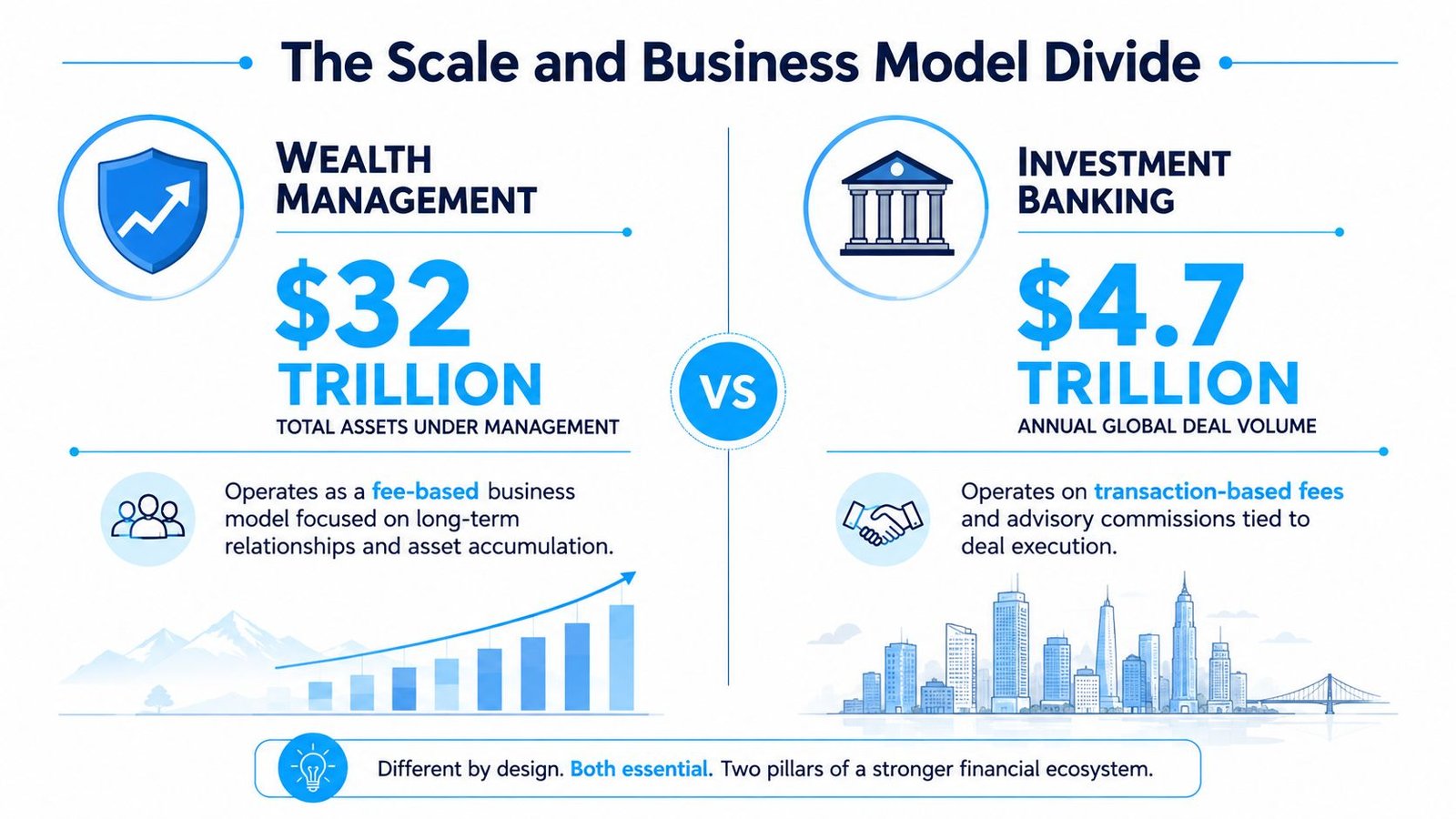
The clearest way to understand wealth management vs investment banking is to start with what each business actually sells. Wealth management sells ongoing stewardship of client assets. Investment banking sells execution, advice, and access around corporate events such as financings and mergers.
That difference shapes almost everything that follows, including revenue stability, client interaction, workflow, performance pressure, and the kind of skills that get rewarded over time.
Why scale changes the job itself
PwC's estimate of US$139 trillion in global assets under management in 2024, rising to US$200 trillion by 2030, frames wealth management as part of a large asset and wealth management industry built around client assets, not just one-off transactions. PwC also expects global investable wealth to exceed US$481 trillion by 2030 (PwC). That scale matters because it pushes firms toward recurring fees, client retention, and operating models that can serve many relationships at once.
By contrast, investment banking revenue is tied much more directly to deal flow, underwriting activity, and market conditions. The business rhythm is different. Wealth management tends to reward asset stickiness, relationship depth, and patience. Investment banking tends to reward mandate capture, transaction speed, and execution quality.
A practical way to think about it is this: in wealth management, a strong year often comes from keeping and deepening client relationships. In investment banking, a strong year often comes from winning and closing high-value mandates.
What major bank revenue mix reveals
Morgan Stanley's official filings show the split inside one large institution. In its 2025 annual results, the firm reported US$31.8 billion in Wealth Management net revenues and US$70.6 billion in total net revenues for the same period, which highlights wealth management as a sizeable recurring-fee business alongside more cyclical banking, trading, and markets activity (Morgan Stanley SEC filing).
That does not make the two career paths interchangeable. It shows how one universal bank can house two very different revenue engines. Wealth management is built to deepen relationships and retain assets across years. Investment banking is built to win mandates, execute under deadlines, and perform through cycles when corporate activity rises or slows.
AI sharpens the divide, but it also creates overlap. Routine portfolio reporting, data gathering, and document production are easier to automate in both businesses, which puts pressure on margins and raises the value of judgment, client access, and cross-border problem solving. The roles that hold up best are the ones that combine technical work with advisory context.
Practical rule: if the appeal is recurring client economics and the ability to compound relationships, wealth management is the closer fit. If the appeal is high-intensity execution around capital events, investment banking is the sharper match.
Core Functions and Client Types Compared
Day to day, these careers diverge more than most candidates expect. Wealth management is built around repeated client contact, portfolio reviews, planning conversations, and long-horizon decision support. Investment banking is built around analysis, documentation, modeling, and deal execution for a narrower set of events.
For someone comparing wealth management vs investment banking, this is often the section that matters most, because the job experience can feel very different even when both sit inside the same firm.
What professionals actually do
Wealth management teams spend much of their time understanding household balance sheets, goals, tax-sensitive allocation decisions, and the practical needs of families or institutional clients. The work is often relationship-dense, because trust and continuity matter more than a single transaction.
In practical terms, that can mean preparing for a client review, helping a family think through liquidity needs, discussing portfolio risk after a volatile quarter, or coordinating with tax and estate specialists when a more complex issue comes up.
Investment banking teams operate under a different tempo. Their work revolves around pitchbooks, valuation analysis, financing structures, due diligence, and transaction support. Client contact is real, but it is usually concentrated around specific mandates rather than ongoing household relationships.
In practice, that often means turning comments quickly, updating models late in a live process, preparing materials for senior bankers, and helping a team keep a financing or M&A timeline on track.
The best performers in wealth management are often judged on client retention and judgment under ambiguity. The best performers in investment banking are often judged on precision, responsiveness, and the ability to execute under time pressure.
Side-by-side operating logic
| Aspect | Wealth Management | Investment Banking |
|---|---|---|
| Primary function | Preserve and grow client assets | Advise on and execute transactions |
| Typical clients | Individuals, families, institutions | Corporates, sponsors, issuers |
| Interaction style | Frequent, relationship-led, ongoing | Episodic, mandate-led, deadline-driven |
| Time horizon | Multi-year and often multi-decade | Deal-specific and event-driven |
| Success metric | Client loyalty and asset retention | Closed deals and advisory outcomes |
| Working rhythm | Steadier, but commercially demanding | Faster, more cyclical, more intense |
The client difference matters because it changes the emotional labor of the job. Wealth managers often deal with life events, generational transfer, and behavioral coaching. Investment bankers deal with board-level decisions, strategic alternatives, and negotiation pressure.
Which environment fits which personality
A candidate who likes planning conversations, nuanced client service, and continuity usually fits wealth management better. A candidate who likes fast-moving analysis, high-stakes presentations, and shorter feedback loops usually fits investment banking better.
The stereotype that wealth management is "soft" and investment banking is "hard" misses the real distinction. Both require strong technical competence. They apply it to different problems, with different expectations around pace, client contact, and performance pressure.
A simple test is to ask what kind of wins feel motivating to you. If helping a client stay disciplined through a difficult market sounds satisfying, wealth management may fit. If helping a team close a financing or execute a live transaction sounds more energizing, investment banking may fit.
Compensation Structures and Earning Trajectories
Pay looks simple on the surface, but the drivers are different. Wealth management usually creates steadier income because compensation tracks assets and ongoing fees. Investment banking produces sharper swings because compensation tracks transactions.
Wealth management's fee model is built around recurring relationships. A common rule of thumb is a fee range of about 0.5% to 1.0% of assets under management, which supports recurring revenue but also caps how fast earnings can grow without adding more assets (Mergers & Inquisitions). That structure rewards patience, retention, and the ability to keep client assets in place through volatile markets.
Investment banking works on a different clock. Fees attach to mandates, so a single closing can matter far more than a month of account growth. The upside per transaction can be materially higher, but the flow is less predictable, and staffing tends to reflect that cycle.
The right question is not which path pays more in the abstract. It is which pay pattern fits the risk profile of the person taking it.
Wealth management is under pressure from fee competition and client price sensitivity, so the lower-variance profile can come with tighter margins and slower growth. Investment banking can still deliver stronger upside in a good cycle, but that upside is tied to market conditions, deal activity, and access to mandates.
| Compensation element | Wealth Management | Investment Banking |
|---|---|---|
| Base pay | Usually steadier | Usually strong, especially at junior levels |
| Variable pay | Often tied to asset growth and retention | Tied to deals, team performance, and firm results |
| Income pattern | More recurring, less explosive | More cyclical, more uneven |
| Long-term upside | Linked to book size and client relationships | Linked to deal volume, seniority, and mandate access |
Morgan Stanley's annual results point to a business with a meaningful recurring-fee engine, and that supports a different compensation culture than a model driven more heavily by market activity (Morgan Stanley SEC filing). For career switchers, that is the core comparison. The issue is not only which role has higher headline pay. It is whether the income stream matches your tolerance for volatility, your stage of career, and the kind of market cycles you expect to face.
One useful way to frame wealth management vs investment banking on compensation is this: wealth management tends to reward book building over time, while investment banking tends to reward execution intensity and access to deals.
Licensing Requirements and Skill Development Paths
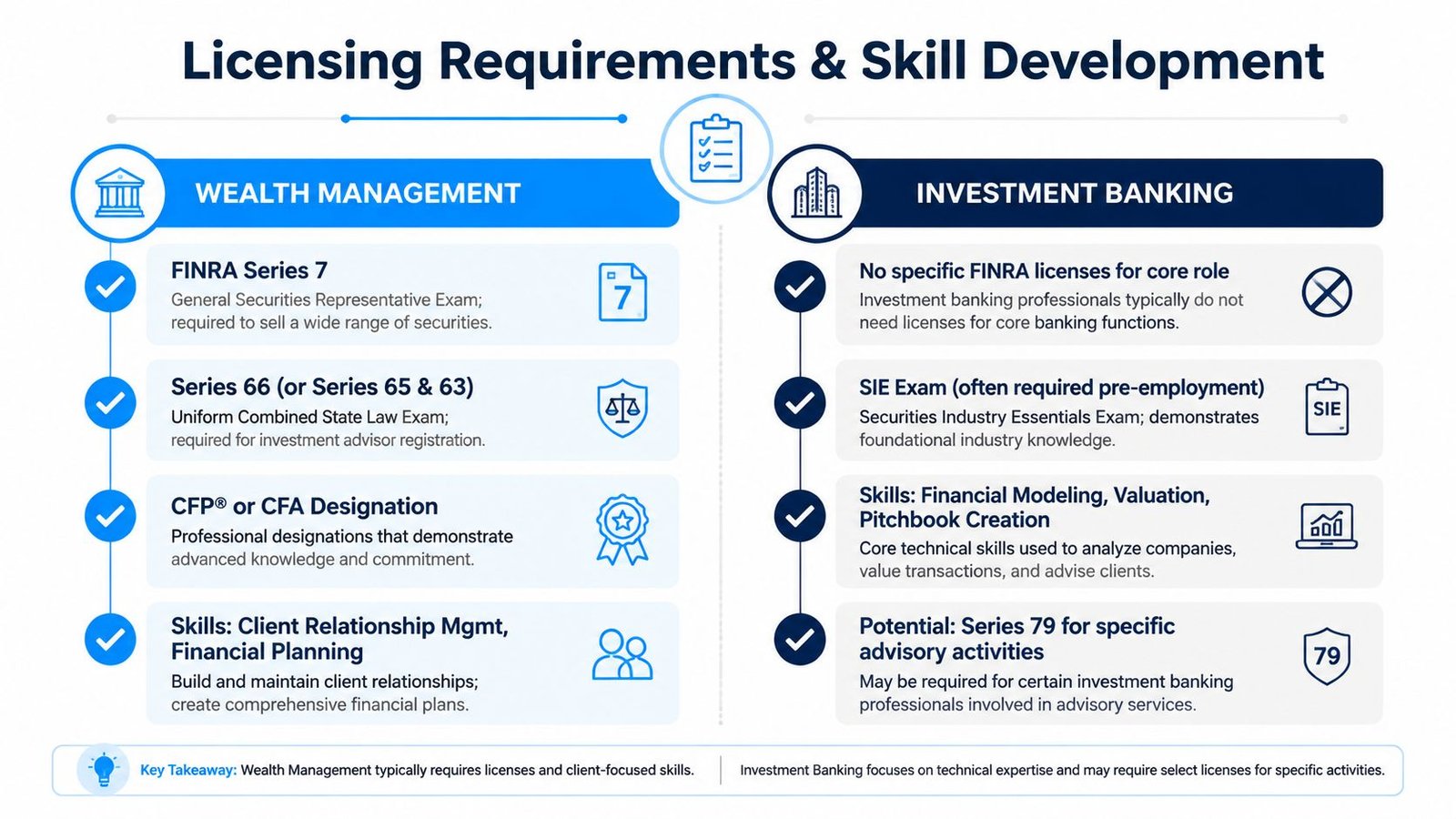
The credential path is clearer in wealth management than many candidates expect, but the details depend on what activity you actually perform. In the U.S., wealth roles commonly involve FINRA and state licensing, and requirements can include the SIE, Series 7, Series 63, and either Series 65 or 66, depending on whether the role involves securities sales, state registration, or investment advice for compensation (CFI; NASAA).
That matters for career planning because entry barriers are different. Wealth management often has a more visible compliance and licensing track. Investment banking also has licensing requirements in some roles, but they depend more specifically on the representative's function and regulated activities.
What the licenses signal
Series 7 covers broad securities representative activity. Series 63 addresses state securities law registration. Series 65 applies to investment adviser representatives, and Series 66 combines the Series 63 and Series 65, subject to NASAA and FINRA requirements (NASAA). In practice, wealth management uses a more formal gatekeeping structure than many newcomers expect.
Investment banking works differently, but not license-free. In the U.S., an Investment Banking Representative typically requires the Securities Industry Essentials (SIE) exam and Series 79, according to FINRA, while other registrations may apply depending on the person's activities and the firm's structure (FINRA Series 79). The filter is therefore not only about a standardized licensing ladder. It is also about evidence of analytical ability, communication quality, and disciplined execution.
What skills travel best
A strong wealth-management candidate usually needs client communication, planning literacy, and enough technical fluency to discuss portfolio structure without sounding scripted. A strong investment-banking candidate usually needs financial modeling, valuation logic, presentation building, and the ability to work accurately at speed.
- Wealth management focus: relationship management, planning discussions, portfolio construction, and client retention.
- Investment banking focus: Excel modeling, valuation work, pitchbook creation, process coordination, and transaction support.
- Shared advantage: AI literacy, because both sectors are increasingly expected to use technology for faster research, summarization, and workflow efficiency.
For professionals mapping a transition, best AI certifications for banking and finance is a practical next read. Credentials matter more now because technology skills are no longer optional support skills, they are part of the job.
A practical career takeaway is that client-facing credibility travels better into wealth management, while modeling-heavy experience travels more directly into investment banking. If you are choosing electives, training, or early projects, align them with the side of the market you actually want to enter.
How AI and Margin Pressure Are Reshaping Both Sectors
A stable wealth-management job and a cyclical investment-banking job still describe different risk profiles, but the gap is narrower than it used to be. Margin pressure is tightening wealth firms, while automation is changing how bankers and advisers spend their time.
This is one reason the old wealth management vs investment banking debate needs updating. Neither path is insulated from technology or commercial pressure. They are simply exposed to those pressures in different ways.
Why the “safe” path is getting squeezed
PwC found that 89% of asset managers reported profitability pressure over the past five years, with profit per AuM down 19% since 2018 and another 9% decline expected by 2030 (PwC). That undercuts the old assumption that wealth management is protected by steady fees and repeat clients. The revenue base is still recurring, but the economics are less forgiving.
Client behavior is adding to the strain. Price competition is sharper, technology costs are harder to absorb, and firms that once depended mainly on trust now need digital onboarding and tighter operating discipline. The result is simple: relationship managers have to produce more per client-facing hour.
Accenture Capital Markets Blog
AI is changing workflow quality, not just headcount
Accenture says generative AI is expected to affect over two-thirds of all functions across the capital-markets industry, which points to broad process change in both wealth and banking (Accenture). In wealth management, that means more automated client content, faster service, and cleaner workflow handoffs. In investment banking, it means quicker research synthesis, faster first-pass analysis, and more efficient deal support.
The career implication is more practical than the headline suggests. AI is more likely to strip out repetitive work than replace judgment, and that pushes both sectors toward a smaller premium on pure manual execution and a larger premium on judgment plus technology fluency. Professionals who can interpret outputs, not just produce them, will hold up better through the next cycle.
EY's Global Banking Outlook 2025 said investment-banking revenues were expected to grow 13% in 2025, driven by recovering M&A activity and debt and equity issuance (EY PDF). That adds a useful counterpoint to the pressure in wealth. The better comparison is not stability versus volatility. It is margin compression plus AI versus cycle sensitivity plus AI.
For a closer look at how these changes are playing out on the banking side, see AI in banking in 2027.
Emerging Hybrid Roles and Future-Proof Career Paths
The sharp boundary between wealth management and investment banking is starting to blur. That does not mean the two careers are becoming identical. It means some of the most valuable roles now sit in the overlap, especially where advice, cross-border complexity, and digital delivery meet.
For readers evaluating wealth management vs investment banking, this overlap matters because career paths are becoming less linear than they used to be.
Where the overlap is forming
Thinking Ahead Institute reported that 76% of wealth firms plan to expand investment management and financial advice, 40% expect talent shortage to be their top business challenge, and 53% of relationship managers will need more cross-border specialization (Thinking Ahead Institute). That combination points to a wealth role that is more technical, more global, and more specialized. The same trend is visible in the firm's broader 2025 findings, which reinforce the shift toward advisory depth and operating complexity. (Thinking Ahead Institute 2025)
Capgemini highlights digital onboarding, unified operating models, gen AI copilots, and real-world asset tokenization as active wealth-management trends, and that pushes the sector toward platform thinking rather than pure relationship selling. As noted earlier in the Accenture coverage, AI is also reshaping how capital markets functions get staffed and executed. For professionals, the next generation of winners may not fit cleanly into "advisor" or "banker."
The roles worth watching
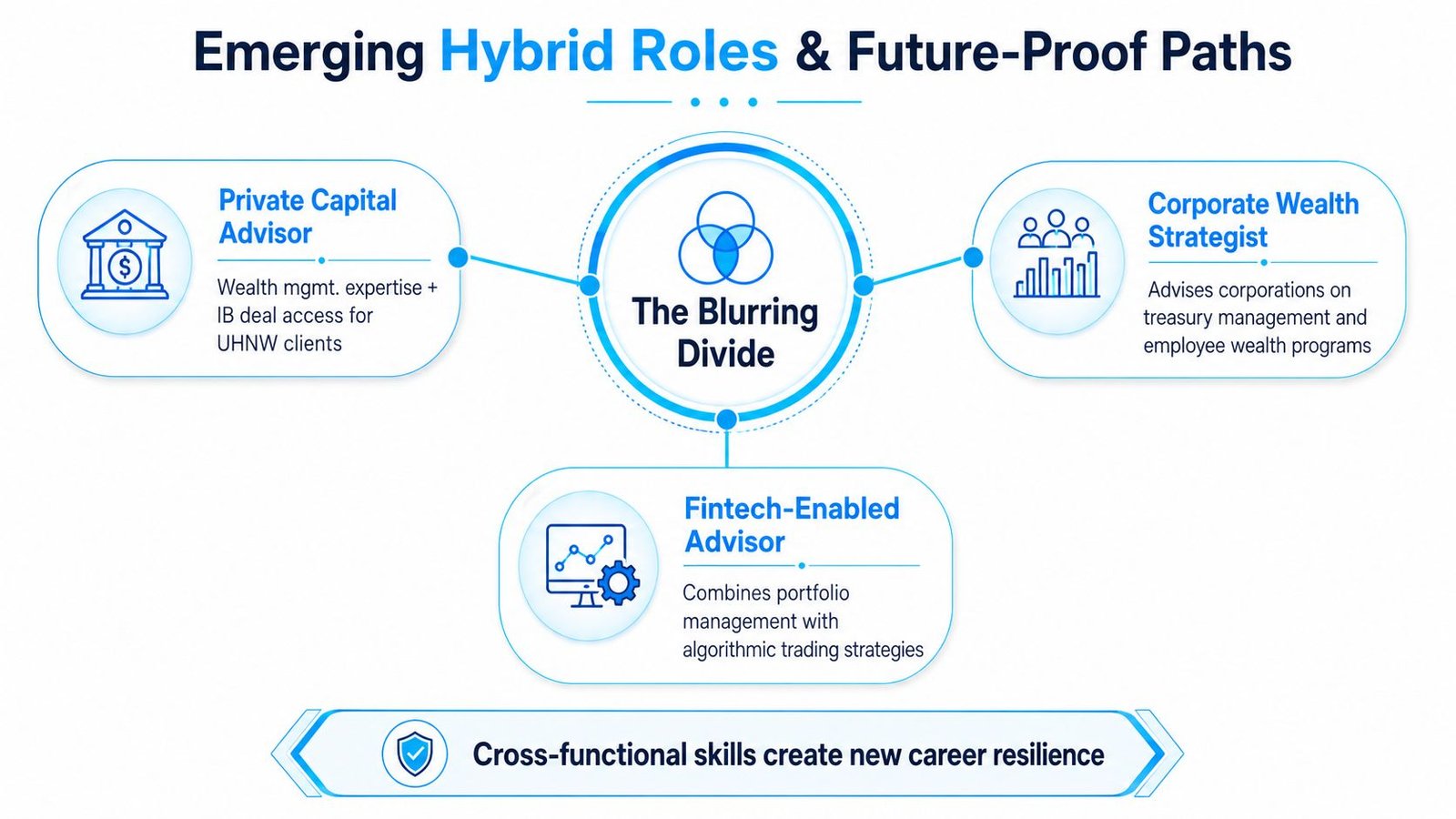
Three hybrid paths stand out.
- Private Capital Advisor. This role blends wealth management judgment with access to deal flow, especially for ultra-high-net-worth clients who want broader private-market exposure.
- Corporate Wealth Strategist. This role bridges treasury, executive compensation, employee financial wellness, and institutional advisory.
- Fintech-Enabled Advisor. This role combines portfolio thinking with algorithmic and platform-driven execution.
Global personal wealth grew 10.8% in 2025, which makes the advisory surface area larger and the complexity higher (Thinking Ahead Institute). More wealth does not just create more assets to manage. It creates more planning layers, more cross-border issues, and more demand for people who can translate across product, tax, and technology.
For someone trying to future-proof a career, these roles highlight a useful pattern. The market is placing more value on professionals who can connect technical knowledge with client judgment, not just specialists who stay in a narrow lane.
For readers tracking the AI side of these career paths, fastest-growing AI jobs in finance in 2027 is the more relevant follow-up than a traditional banking career guide.
Making Your Decision Based on Career Stage and Goals
The best choice depends less on branding and more on fit. Wealth management suits people who can build trust, stay organized over long periods, and handle repeated client conversations without losing focus. Investment banking suits people who can tolerate speed, stress, and constant commercial pressure in exchange for sharper execution experience.
If you are still weighing wealth management vs investment banking, the most useful decision filter is to focus on the work itself, not the label. Titles can look similar on paper. The daily cadence usually does not.
Early-career professionals
Younger candidates often underestimate how quickly the two paths shape work habits. Wealth management can build durable client skills and a broad commercial foundation, while investment banking can build a deep technical toolkit and intense process discipline.
Decision filter: if the candidate wants a career that compounds through relationships, wealth management usually fits better. If the candidate wants a career that compounds through technical reps and high-intensity deal work, investment banking usually fits better.
Early on, the better choice is often the one that builds the type of skill you want to keep using. Repeated client conversations, retention work, and planning exposure point toward wealth management. Modeling reps, transaction process work, and fast-turn analysis point toward investment banking.
Mid-career switchers
Mid-career professionals should think about transferability. A professional with client-facing experience, regulatory familiarity, or planning exposure can often move into wealth management more naturally. A professional with transaction experience, valuation work, or corporate finance exposure may find investment banking adjacent roles more realistic than a full reset.
For switchers, the practical question is not whether a move is possible. It is how much of your current credibility carries over on day one. The easier transitions usually build on what the market already believes you can do well.
Red flags that usually predict poor fit
- Short attention span for long cycles: wealth management punishes shallow follow-through.
- Low tolerance for ambiguity under deadlines: investment banking will feel relentless.
- Weak comfort with client psychology: wealth management becomes frustrating fast.
- Dislike of repetitive technical work: investment banking can become draining.
- No appetite for technology adoption: both sectors now expect it.
The most future-proof candidates are not the ones who cling to the old divide. They are the ones who can pair financial judgment with digital fluency, client empathy with data discipline, and commercial ambition with adaptability.
Conclusion
The real difference in wealth management vs investment banking is not prestige, and it is not a simple question of pay. It is the difference between relationship compounding and transaction intensity, between recurring client economics and deal-driven revenue, and between two forms of pressure that reward different strengths.
Wealth management tends to suit professionals who want to build trust over time, guide clients through complex decisions, and grow through long-term relationships. Investment banking tends to suit professionals who want faster feedback loops, technical execution, and exposure to high-stakes corporate events.
Both paths are changing as AI, margin pressure, and cross-border complexity reshape finance. The strongest career decision is usually the one that matches your working style, your tolerance for uncertainty, and the kind of problems you want to solve repeatedly for the next several years.
If you choose based on how the work actually feels, not just how the title sounds, you are more likely to end up in the right lane.
Vaira's View publishes practical analysis on AI, banking, finance, fintech, and careers for professionals who need more than generic commentary. For more research-driven guides on finance careers, AI tools, and the future of work in banking, visit Vaira's View and keep building a career that fits where the industry is going, not where it used to be.