
Table of Contents
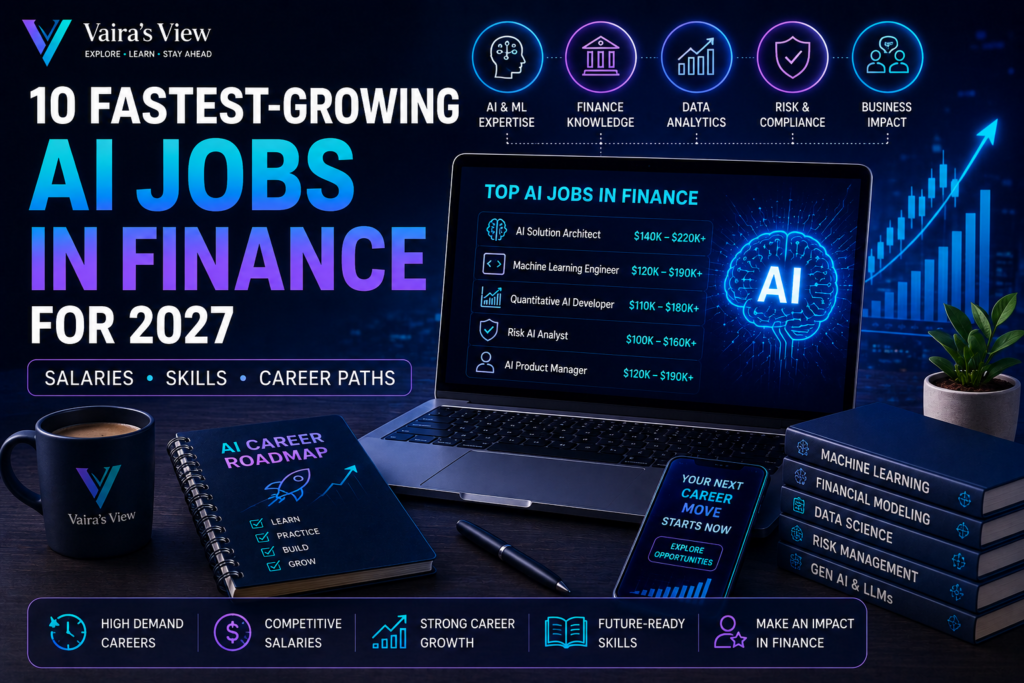
The fastest-growing AI jobs in finance are creating new career opportunities across banking, fintech, risk, compliance, data, and technology. As financial institutions adopt generative AI and automation, demand is growing for professionals who understand both finance and artificial intelligence.
Artificial intelligence is changing finance, but not always in the way people expect.
For years, conversations about AI and banking have focused on one question: Will AI replace financial jobs?
In reality, another change is happening at the same time.
Banks, fintech companies, insurers, investment firms, payment providers and consulting companies increasingly need people who understand both technology and financial services. If you want to understand the bigger transformation behind these careers, read our guide to AI in Banking 2027.
That combination is creating an entirely new category of careers.
Some require strong programming skills. Others are better suited to professionals from banking, risk, compliance, operations, product management or consulting backgrounds who learn how AI systems work.
If you are planning your career for 2027 and beyond, these are some of the AI jobs in finance worth watching.
Note: Salary figures in this article are indicative annual base-salary ranges for experienced professionals and are intended for career comparison only. Actual compensation varies considerably by country, company, seniority, bonuses and market conditions.
Why the Fastest-Growing AI Jobs in Finance Matter in 2027
Financial institutions have always relied heavily on data.
Banks process transactions, evaluate creditworthiness, detect fraud, calculate investment risk, monitor regulations and manage enormous amounts of customer information every day.
AI makes it possible to analyze that information faster and automate parts of workflows that previously required large amounts of manual effort.
Generative AI has accelerated the trend even further.
Financial companies are experimenting with AI for:
- Customer service
- Investment research
- Fraud detection
- Anti-money laundering
- Software development
- Document analysis
- Financial forecasting
- Regulatory compliance
- Employee productivity
- Personalized banking
- Risk management
However, financial services is highly regulated.
The European Commission has also examined the opportunities and risks associated with the growing use of artificial intelligence across financial services.
A bank cannot simply connect an AI model to sensitive customer data and allow it to make unrestricted decisions.
That means financial institutions need professionals who can build AI systems and people who can govern, validate, secure and integrate them.
This is why some of the most interesting finance careers of 2027 may sit somewhere between traditional banking and technology.
1. AI Solution Architect – Banking & Financial Services
An AI Solution Architect designs the overall technology architecture behind AI applications.
Instead of spending the entire day developing machine-learning models, the architect looks at the bigger picture.
For example, imagine a private bank wants an AI assistant that helps relationship managers review customer information.
The architect may need to determine:
- Which AI model should be used
- Where customer data will be stored
- How the AI accesses internal documents
- How authentication will work
- What information employees are allowed to see
- How responses will be monitored
- Where human approval is required
- How the system integrates with existing banking applications
That makes this role especially valuable in financial institutions where AI projects must satisfy security, privacy and regulatory requirements.
Useful Skills
Strong candidates often understand:
- Cloud architecture
- Azure, AWS or Google Cloud
- Generative AI
- Large language models
- APIs
- Databases
- Vector search
- RAG architecture
- Identity and access management
- Cybersecurity
- Financial systems
- Responsible AI
Professionals preparing for architecture, cloud or AI roles may also want to explore the best AI certifications for banking and finance to identify certifications that complement their career goals.
Indicative 2027 Salary
US: $140,000–$220,000+
Europe: €90,000–€160,000+
Switzerland: CHF 130,000–CHF 200,000+
Senior architects working on large financial transformation programs may earn considerably more when bonuses and consulting compensation are included.
Career Path
Software Engineer → Cloud Engineer → Solution Architect → AI Solution Architect → Enterprise AI Architect
Banking professionals with strong technology experience may also move into this role from platform architecture, integration or digital-transformation positions.
2. Generative AI Engineer
The rise of ChatGPT-style applications has created demand for engineers who know how to build applications around large language models.
A Generative AI Engineer may create tools such as:
- Investment research assistants
- Customer-service copilots
- Banking knowledge assistants
- Document summarizers
- Compliance copilots
- Employee productivity tools
- Automated report generators
The role often involves much more than simply writing prompts.
Production AI applications may need retrieval systems, databases, security controls, evaluation frameworks, APIs and monitoring.
Useful Skills
Employers may look for:
- Python
- LLM APIs
- Prompt engineering
- Retrieval-Augmented Generation
- Vector databases
- AI agents
- Model evaluation
- Cloud AI platforms
- API development
- Data security
Indicative 2027 Salary
US: $130,000–$210,000+
Europe: €80,000–€145,000+
Switzerland: CHF 120,000–CHF 190,000+
Career Path
Software Engineer → AI Engineer → Generative AI Engineer → Senior AI Engineer → AI Architect
For developers already working in banking technology, this can be one of the most direct routes into the AI industry.
Generative AI skills are also becoming useful outside software development. If you are exploring a career move, these practical ChatGPT prompts for job seekers can help you experiment with AI during your job search.
3. AI Risk & Governance Specialist
Not every rapidly growing AI career requires deep programming.
As banks deploy more AI, they also need professionals who can answer difficult questions.
Who approved this model?
What data was used?
Can the AI explain why it generated a recommendation?
Could customer information leak?
What happens if the model makes a mistake?
Is a human reviewing important decisions?
An AI Risk & Governance Specialist helps organizations develop policies and controls for these situations.
This role is particularly relevant in banking because financial institutions already operate under extensive risk-management and regulatory frameworks.
Useful Skills
Useful knowledge includes:
- Responsible AI
- Model risk management
- Data governance
- Regulatory compliance
- Privacy
- AI ethics
- Risk frameworks
- Audit
- Financial regulation
- Documentation
Technical literacy is important, but this role does not necessarily require advanced software engineering.
Indicative 2027 Salary
US: $110,000–$180,000+
Europe: €75,000–€135,000+
Switzerland: CHF 110,000–CHF 170,000+
Career Path
Risk Analyst → Technology Risk Specialist → AI Risk Specialist → AI Governance Lead → Head of Responsible AI
This may be particularly attractive for professionals currently working in risk, audit, compliance or governance.
As banks introduce AI into more business processes, governance is becoming an important part of the broader AI transformation happening in banking.
4. Financial Data Scientist
Data science has been important in finance for years, but AI is expanding what financial data teams can do.
A Financial Data Scientist uses data to identify patterns, create predictive models and support financial decisions.
Projects may involve:
- Credit-risk prediction
- Customer segmentation
- Fraud detection
- Portfolio analytics
- Churn prediction
- Market forecasting
- Pricing
- Liquidity analysis
The strongest candidates understand both statistical modelling and the financial meaning behind the data.
A technically impressive model is not particularly useful if nobody understands how it affects the business.
Useful Skills
Common skills include:
- Python
- SQL
- Statistics
- Machine learning
- Pandas
- Scikit-learn
- Data visualization
- Feature engineering
- Financial modelling
- Cloud data platforms
Indicative 2027 Salary
US: $120,000–$190,000+
Europe: €75,000–€130,000+
Switzerland: CHF 115,000–CHF 170,000+
Career Path
Data Analyst → Data Scientist → Senior Data Scientist → Lead Data Scientist → Head of Data Science
Finance knowledge can make a major difference because understanding concepts such as credit risk, securities, portfolios and financial instruments helps analysts interpret the data correctly.
5. AI Product Manager – Fintech
Building impressive technology is only useful when customers or employees actually need it.
That is where the AI Product Manager comes in.
The product manager works between business teams, designers, engineers, compliance specialists and customers.
They may decide:
- Which AI feature should be built
- What problem it should solve
- Who will use it
- How success will be measured
- What risks need to be considered
- What should remain under human control
In financial services, this role requires additional judgement because AI features may affect money, investment decisions or customer information.
Useful Skills
Employers may value:
- Product strategy
- AI fundamentals
- Financial services knowledge
- User experience
- Analytics
- Agile delivery
- Stakeholder management
- Responsible AI
- Business-case development
Coding can be helpful, but it is rarely the main requirement.
Indicative 2027 Salary
US: $125,000–$200,000+
Europe: €85,000–€145,000+
Switzerland: CHF 125,000–CHF 185,000+
Career Path
Business Analyst → Product Owner → Product Manager → AI Product Manager → Head of AI Products
This is one of the strongest career options for people who understand banking but do not want to become full-time developers.
6. AI Compliance and RegTech Specialist
Compliance departments deal with enormous amounts of information.
They may need to monitor transactions, review customer documents, understand regulatory updates and investigate suspicious activity.
AI can help automate parts of this workload.
An AI Compliance or RegTech Specialist helps organizations introduce AI while ensuring compliance processes remain explainable and controlled.
Possible applications include:
- KYC document review
- AML investigations
- Regulatory-change monitoring
- Transaction monitoring
- Sanctions screening
- Compliance knowledge assistants
- Regulatory reporting
Useful Skills
Helpful knowledge includes:
- AML
- KYC
- Sanctions
- Financial regulation
- Compliance operations
- Data analytics
- AI fundamentals
- Governance
- Model validation
- RegTech platforms
Indicative 2027 Salary
US: $100,000–$175,000+
Europe: €70,000–€125,000+
Switzerland: CHF 105,000–CHF 165,000+
Career Path
Compliance Analyst → Compliance Technology Specialist → AI Compliance Specialist → RegTech Lead
This career could become increasingly important as regulators scrutinize the use of AI in financial institutions.
7. Fraud Detection & Financial Crime AI Specialist
Fraudsters are also becoming more sophisticated.
AI-generated identities, deepfakes, automated phishing and increasingly complex payment fraud are creating new challenges for banks.
Financial institutions therefore need specialists who combine financial-crime expertise with modern analytics.
The Bank for International Settlements has also highlighted how financial institutions are using AI across areas including fraud detection, risk management and financial services.
A Fraud AI Specialist may help build systems that detect unusual customer or transaction behaviour.
Instead of relying only on static rules, AI-based systems can examine combinations of signals, including behaviour, device information, transaction history and unusual patterns.
Useful Skills
Potential skills include:
- Fraud analytics
- Machine learning
- SQL
- Python
- Anomaly detection
- Transaction monitoring
- Graph analytics
- Cybersecurity concepts
- AML
- Data visualization
Indicative 2027 Salary
US: $105,000–$180,000+
Europe: €70,000–€125,000+
Switzerland: CHF 105,000–CHF 165,000+
Career Path
Fraud Analyst → Fraud Analytics Specialist → AI Fraud Specialist → Financial Crime Technology Lead
The role is particularly interesting because financial crime is unlikely to disappear simply because automation improves.
The technology on both sides keeps evolving.
8. Quantitative Analyst with AI Skills
Quantitative analysts — often called quants — have used mathematics and computing in financial markets for decades.
AI is giving them additional tools.
Modern quantitative analysts may use machine learning for:
- Trading strategies
- Portfolio optimization
- Risk modelling
- Derivatives pricing
- Market prediction
- Alternative data analysis
These roles can be highly technical and competitive, particularly inside investment banks, hedge funds and trading firms.
Useful Skills
Strong quantitative roles may require:
- Mathematics
- Probability
- Statistics
- Python
- C++
- Machine learning
- Time-series analysis
- Financial markets
- Derivatives
- Optimization
Advanced university degrees are common in this field.
Indicative 2027 Salary
US: $150,000–$300,000+
Europe: €100,000–€200,000+
Switzerland: CHF 140,000–CHF 220,000+
Total compensation can be significantly higher in trading organizations where bonuses make up a large part of pay.
Career Path
Quantitative Analyst → Senior Quant → Quant Researcher → Portfolio Manager / Quantitative Research Lead
This is potentially one of the highest-paying AI careers in finance, but also one of the most technically demanding.
9. AI Transformation Consultant – Financial Services
Many financial institutions know they need an AI strategy.
They do not always know where to start.
An AI Transformation Consultant helps banks identify opportunities where AI can genuinely improve the business.
A project might begin with questions such as:
- Which processes consume the most employee time?
- Where can generative AI improve productivity?
- Which AI use cases have measurable business value?
- Which applications are too risky to automate?
- How should the organization govern AI?
- What skills will employees need?
The consultant may help create an AI roadmap and coordinate implementation across different departments.
Useful Skills
Important skills include:
- Financial services
- AI fundamentals
- Business analysis
- Transformation strategy
- Stakeholder management
- Process optimization
- Consulting
- Cloud concepts
- Responsible AI
- Presentation and communication
Indicative 2027 Salary
US: $120,000–$210,000+
Europe: €85,000–€150,000+
Switzerland: CHF 125,000–CHF 190,000+
Career Path
Business Analyst → Technology Consultant → AI Consultant → AI Transformation Lead → AI Strategy Director
This role can suit experienced banking professionals particularly well because understanding how a bank actually operates can be more valuable than knowing every AI algorithm.
This is also why the future of finance careers is more complicated than simply asking whether machines will eliminate jobs. Our analysis of whether AI will replace banking jobs looks at which roles are most likely to change and where new opportunities may emerge.
10. AI Model Validation Specialist
Banks cannot simply deploy a model and assume that it works forever.
Financial models must often be tested, challenged and monitored.
As AI becomes more complex, AI Model Validation Specialists may become increasingly important.
Their job is to independently assess whether models behave as expected.
They may examine:
- Model accuracy
- Bias
- Data quality
- Stability
- Explainability
- Assumptions
- Performance deterioration
- Governance documentation
Generative AI creates additional challenges because outputs can be probabilistic and difficult to predict.
This means model validation itself is evolving.
Useful Skills
Relevant knowledge may include:
- Statistics
- Machine learning
- Model risk
- Validation methodologies
- Financial regulation
- Python
- Data analysis
- Responsible AI
- Documentation
- Audit principles
Indicative 2027 Salary
US: $115,000–$190,000+
Europe: €80,000–€135,000+
Switzerland: CHF 115,000–CHF 175,000+
Career Path
Risk Analyst → Model Validator → AI Model Validation Specialist → Model Risk Manager → Head of Model Risk
AI Jobs in Finance: Salary Comparison
| AI Career | Indicative US Salary | Technical Level | Finance Knowledge |
|---|---|---|---|
| AI Solution Architect | $140K–$220K+ | High | High |
| Generative AI Engineer | $130K–$210K+ | Very High | Medium |
| AI Risk & Governance Specialist | $110K–$180K+ | Medium | High |
| Financial Data Scientist | $120K–$190K+ | High | High |
| AI Product Manager | $125K–$200K+ | Medium | High |
| AI Compliance / RegTech Specialist | $100K–$175K+ | Medium | Very High |
| Fraud AI Specialist | $105K–$180K+ | High | High |
| Quantitative AI Analyst | $150K–$300K+ | Very High | Very High |
| AI Transformation Consultant | $120K–$210K+ | Medium | Very High |
| AI Model Validation Specialist | $115K–$190K+ | High | High |
These figures should be viewed as broad career-market estimates rather than guaranteed 2027 salaries.
Do You Need to Learn Coding?
Not necessarily.
This is one of the biggest misunderstandings around AI careers.
Some jobs absolutely require strong programming.
If you want to become a Generative AI Engineer, Data Scientist or Quantitative Analyst, coding will be central to your work.
However, jobs such as:
- AI Product Manager
- AI Governance Specialist
- AI Transformation Consultant
- RegTech Specialist
- AI Program Manager
may require more knowledge of business processes, risk, regulation and AI capabilities than advanced software development.
The question should therefore not be:
“Do I need to become an AI programmer?”
A better question is:
“Where does my existing experience overlap with AI?”
A compliance professional does not need to compete with a machine-learning engineer.
They can become the person who understands how AI should be used responsibly inside compliance.
That combination of domain expertise and AI knowledge may become extremely valuable.
Which Skills Should You Learn Before 2027?
If you want to prepare for AI jobs in finance, start with a combination of technical understanding and industry knowledge.
1. Understand Generative AI
Learn how modern AI systems work at a practical level.
Understand concepts such as:
- LLMs
- Prompts
- Tokens
- Hallucinations
- Embeddings
- Vector databases
- RAG
- AI agents
You do not need to understand every mathematical detail at the beginning.
2. Learn One Cloud Platform
Large financial institutions increasingly build technology using cloud platforms.
You could focus on:
- Microsoft Azure
- AWS
- Google Cloud
Understanding
Pingback: Fintech Careers in 2026: Best Jobs, Skills & Salaries