
Why Reconciliations Fail Even When Rules Are Correct
Why AP Reconciliation Is a Financial Control Layer
The Core Reconciliation Workflow Explained
Three-Way Matching as a Payment Control Gate
Manual Versus Automated Reconciliation Approaches
Building Controls That Prevent Cash Leakage
Implementation Steps and Maturity Indicators
Expert-Reviewed FAQ for AP Managers
Corpay's AP productivity benchmarks
Why AP Reconciliation Is a Financial Control Layer
Scry AI's AP reconciliation guidance
Reconciling accounts payable is the process of confirming that recorded supplier liabilities are complete, accurate, properly timed, and supported by underlying documents before and during close. In practice, that means tying the AP subledger to the general ledger, investigating vendor-level differences, resolving cutoff and posting issues, and keeping evidence that supports the final balance.
Definition: Reconciling accounts payable means comparing the AP subledger, vendor balances, invoices, receipts, and the general ledger to confirm that liabilities are recorded in the right amount and period, then documenting and resolving any differences.
For finance teams, this is a control activity, not just an administrative matching task. Done well, it helps prevent duplicate payments, identify missing or misstated liabilities, support accrual accuracy, and produce audit-ready support for the period-end close.
What mature operations look like
U.S. Tech Automations on purchase order and receipt matching
When AP reconciliation is treated as a clerical clean-up step, teams often focus only on whether an invoice appears to match a payment or purchase order. That is too narrow. The real control objective is to verify that liabilities in the accounting records are valid, complete, accurately valued, and recorded in the correct reporting period.
That framing changes what the team reviews. Instead of stopping at invoice status, reviewers test whether the AP subledger agrees to the general ledger, whether manual journals affected AP-related balances, whether unmatched receipts create cutoff risk, and whether old reconciling items have clear ownership and resolution dates.
The Core Reconciliation Workflow Explained
A practical workflow for reconciling accounts payable usually follows five steps.
What to compare first
Start with the AP aging or AP subledger report and tie the total to the AP control account in the general ledger for the same date. If the totals do not agree, confirm the reporting period, entity, currency, and report parameters before investigating transactions.
The real problem is format normalization
Before detailed review, make sure document numbers, supplier names, and dates are being compared consistently. Formatting issues can create false exceptions, especially when data comes from multiple systems or locations.
Yooz on invoice reconciliation fragmentation
Where teams get it wrong
Many breaks are not caused by one large error. They come from timing differences, unapplied credit memos, duplicate postings, manual journal entries to AP-related accounts, or invoices recorded in one period while receipts or approvals land in another.
DigiParser's AP error-rate statistics
What to do first
Once you confirm a real difference, move from summary to detail:
- Reconcile the subledger total to the AP control account.
- Identify whether the variance is concentrated in one vendor, one batch, one journal source, or one cutoff window.
- Review unmatched invoices, credit memos, receipts, and payments.
- Check for manual journals posted directly to AP or related accrual accounts.
- Determine whether the issue is timing, duplication, misclassification, or missing support.
- Assign ownership and a due date for resolution.
Why documentation is part of the workflow
Why this becomes a fraud and error control
A reconciliation is not complete when a reviewer understands the difference informally. It is complete when the team can show the tie-out, the exception list, the root cause, the action taken, and the final disposition. That documentation matters for review discipline, audit support, and repeat issue reduction.
Why Reconciliations Fail Even When Rules Are Correct
The controls that actually hold up
AP reconciliations often break down because the underlying process crosses procurement, receiving, AP, treasury, and the general ledger. The matching rule may be correct, but the records still diverge when one part of the process posts late or inconsistently.
Common causes include:
- invoices posted before goods receipt is recorded
- receipts entered after period close
- vendor credits not applied promptly
- duplicate invoice capture under slightly different document formats
- manual journals that bypass normal AP workflows
- changes in supplier master data or document numbering conventions
This is why reconciliations need exception ownership. Someone has to decide whether a break belongs to AP operations, receiving, procurement, accounting, or system administration, then ensure it is resolved rather than carried forward indefinitely.
What automation handles well, and what it doesn't
Three-Way Matching as a Payment Control Gate
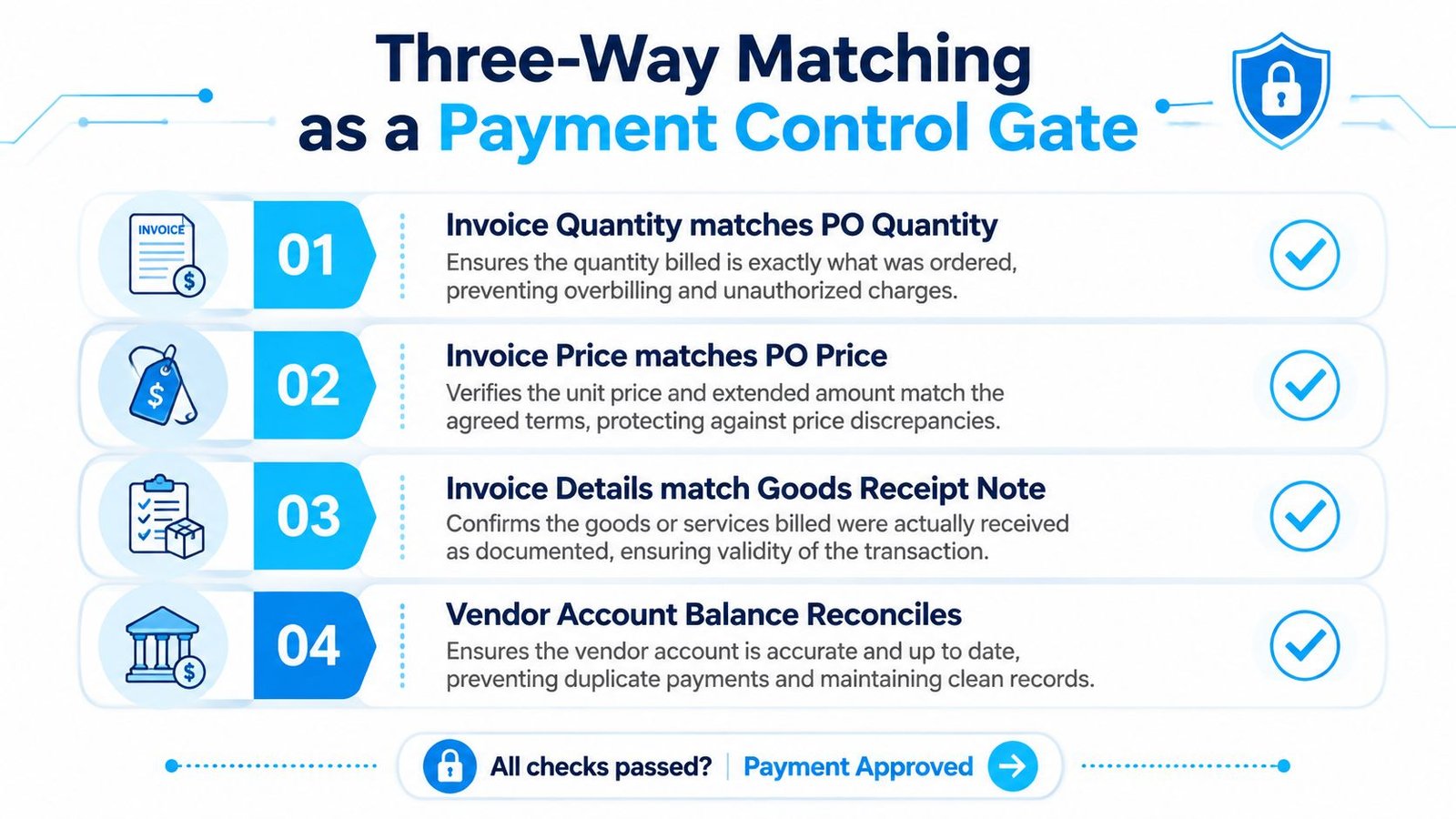
Three-way matching is a core AP control because it compares three forms of evidence before payment approval: the supplier invoice, the purchase order, and proof of receipt or delivery. Major ERP guidance describes this as a control that helps verify that the organization is paying for goods or services that were ordered and received. See Oracle NetSuite help documentation and NetSuite's three-way matching overview.
Stealth Agents' AP automation statistics
What the control actually verifies
Manual and automated side by side
Used properly, three-way matching helps confirm:
- the supplier billed the expected item or service
- the quantities and prices align with the purchase order
- receipt or delivery evidence exists
- the invoice is eligible to move forward for payment review
What to compare first
When a match fails, review whether the variance is due to quantity, price, terms, tax treatment, freight, or timing of receipt. A failed match does not always mean fraud or error. It often points to a process step that needs correction or approval.
Why documentation is part of the workflow
Three-way matching is only one gate in reconciling accounts payable. It helps validate individual invoices, but the close process still requires subledger-to-GL reconciliation, vendor-level analysis, and review of period-end accrual and cutoff issues.
What automation handles well, and what it doesn't
Automation can reduce manual comparison work, standardize exception routing, and improve record retention. It is especially useful for invoice capture, duplicate-check logic, rule-based matching, and workflow tracking.
But automation does not remove the need for judgment. People still need to resolve exceptions involving disputed receipts, pricing disagreements, contract interpretation, cutoff decisions, and manual journal activity. Automation supports control execution. It does not eliminate the need to review whether the final liability balance is correct.
Manual Versus Automated Reconciliation Approaches
The most useful way to compare manual and automated AP operations is not to combine unrelated benchmarks into a single implied standard. Instead, use reputable benchmarks as directional context and keep the source attached to each metric.
| Measure | Example benchmark and context |
|---|---|
| Cost to process an invoice | Ardent Partners has published AP cost benchmarks showing meaningful differences between top-performing and lower-performing teams. Use the Ardent Partners AP metrics benchmark for the specific metric definitions and peer group context. |
| Touchless invoice rate | Ardent Partners also tracks touchless processing rates, but those figures should be interpreted within its survey methodology and participant mix, not as a universal market standard. |
| Operational efficiency | APQC benchmarking measures list and APQC accounts payable benchmark resources provide broader process benchmarking context for finance leaders evaluating AP performance. |
The practical takeaway is simple: manual environments usually create more opportunities for delays, inconsistency, and weak exception visibility. Automated environments generally improve speed and control consistency, but only when the workflow design, approval logic, and master data are reliable.
APQC's benchmark measure definition
Building Controls That Prevent Cash Leakage
Controls for reconciling accounts payable should focus on preventing both misstatement and avoidable cash loss.
The real problem is format normalization
The controls that actually hold up
The most durable controls typically include:
- regular AP subledger-to-GL reconciliation
- review of aged unmatched items and unapplied credits
- duplicate invoice detection logic and follow-up review
- restricted use and review of manual journals affecting AP-related balances
- cutoff review around period end
- segregation of duties across invoice entry, approval, vendor master changes, and payment release
- retained support for reconciliations, exceptions, and approvals
Why this becomes a fraud and error control
Duplicate and erroneous payments are not just efficiency issues. They can signal poor process discipline, weak master data governance, ineffective approval controls, or gaps in payment review. CFO's metric on duplicate and erroneous payments cites APQC benchmarking context showing that even a small percentage of disbursement error can become material at scale.
What the control actually verifies
How to know when to escalate
Escalation is appropriate when:
- reconciling items repeat across periods
- a variance cannot be explained by normal timing
- a manual journal changed AP-related balances without clear support
- a vendor balance appears misstated after invoice, payment, and credit review
- receipts or approvals are consistently missing at period end
- there is evidence of a duplicate or erroneous payment pattern
What mature operations look like
Why documentation is part of the workflow
Mature teams do not rely on one perfect benchmark number. They show discipline in a few observable ways:
- reconciliations are completed on a defined cadence
- open items have owners and aging visibility
- cutoff issues are identified before close pressure peaks
- manual journals affecting AP are visible and reviewed
- supporting documents are easy to retrieve
- automation is used for repeatable checks, while judgment-heavy exceptions are reviewed by the right people
If your team uses operational targets such as faster exception resolution, lower duplicate incidence, or higher auto-match rates, treat them as internal management goals unless they are tied to a clearly cited benchmark source.
Implementation Steps and Maturity Indicators
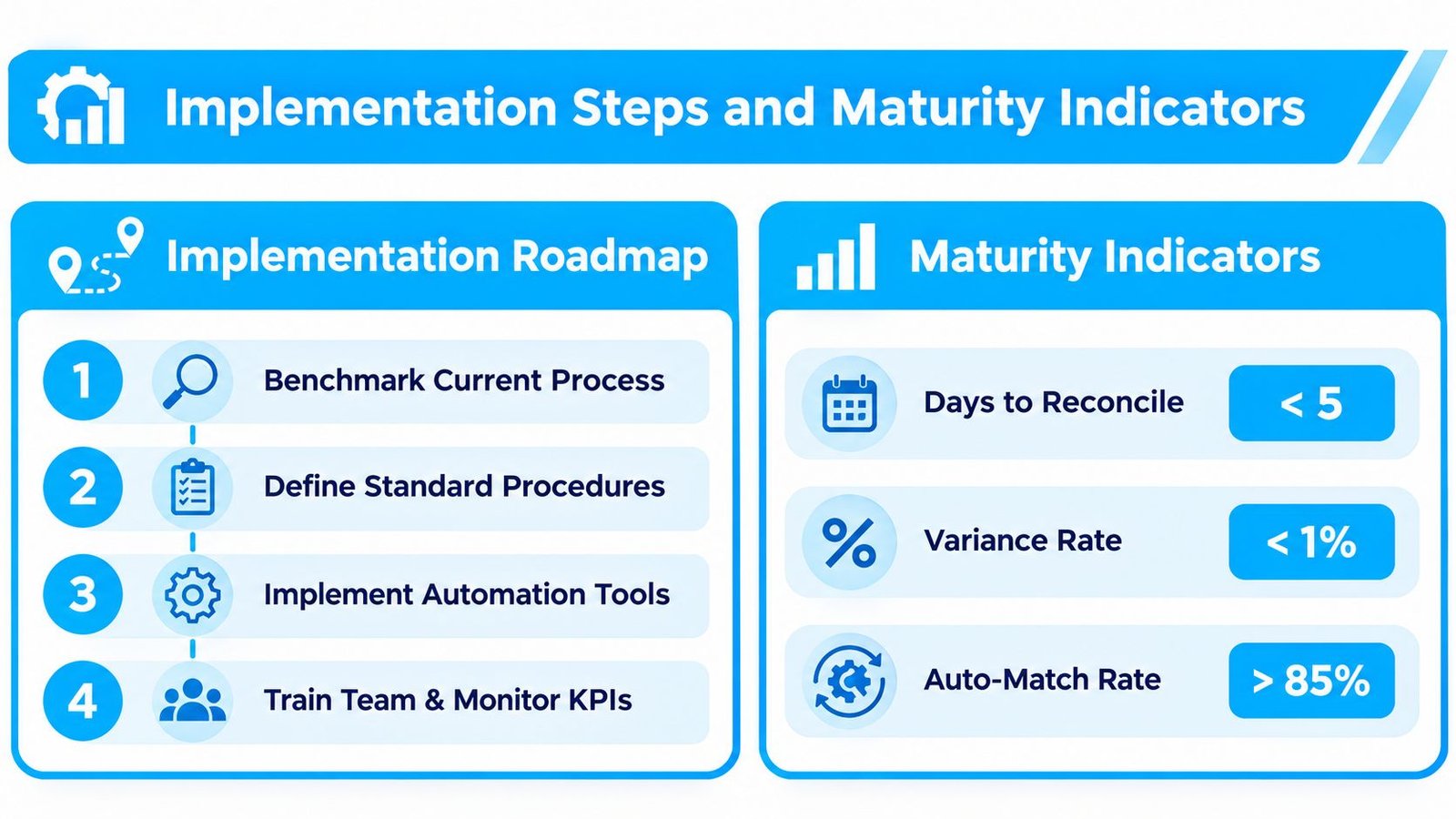
A practical implementation sequence for stronger AP reconciliation looks like this:
- Standardize the close-period reconciliation package.
- Tie the AP subledger to the general ledger every period.
- Create an exception log with owners, root causes, and due dates.
- Review manual journals affecting AP-related balances.
- Tighten receipt, invoice, and approval cutoff practices.
- Use automation for repeatable checks and routing where it improves consistency.
- Retain support so reviewers and auditors can follow the logic from balance to transaction.
Why the control framing matters
Teams can assess maturity by looking at consistency and control quality rather than chasing one universal benchmark. The real question is whether reconciling items are resolved promptly, balances can be supported, and period-end liabilities are reliable.
For broader finance operations context, see Vaira's View banking and finance coverage and Vaira's View coverage of AI risk management software.
FAQ: Reconciling Accounts Payable
How often should AP be reconciled?
At minimum, reconcile AP as part of every period-end close. Higher-volume teams often perform key checks more frequently so exceptions do not accumulate until month end.
What should we check first if the AP subledger does not match the general ledger?
Start with report parameters and timing, then review manual journals, batch postings, unapplied credits, duplicate entries, and cutoff differences.
Is three-way matching enough on its own?
No. Three-way matching helps validate individual invoices, but reconciling accounts payable still requires subledger-to-GL review, vendor investigation, and period-end cutoff analysis.
Where does automation help most?
It helps most with repeatable tasks such as invoice capture, duplicate-check logic, workflow routing, and document retention. Human review is still needed for disputes, exceptions, and accounting judgment.
What documents should be retained for audit support?
Keep the reconciliation tie-out, exception log, supporting invoice and receipt evidence, relevant approvals, and documentation showing how each material difference was resolved.
Reconciling accounts payable works best when it is treated as a financial control with clear ownership, sound documentation, and disciplined follow-up. The goal is not just to match records mechanically. It is to confirm that the liability balance is complete, accurate, and ready to stand up to close review and audit scrutiny.
Explore more practical guides on banking, finance, automation, and financial controls at Vaira's View.
Pingback: Cybersecurity in Banking: Top Threats and Best Practices
Pingback: What Are Financial Controls: A 2026 Guide