
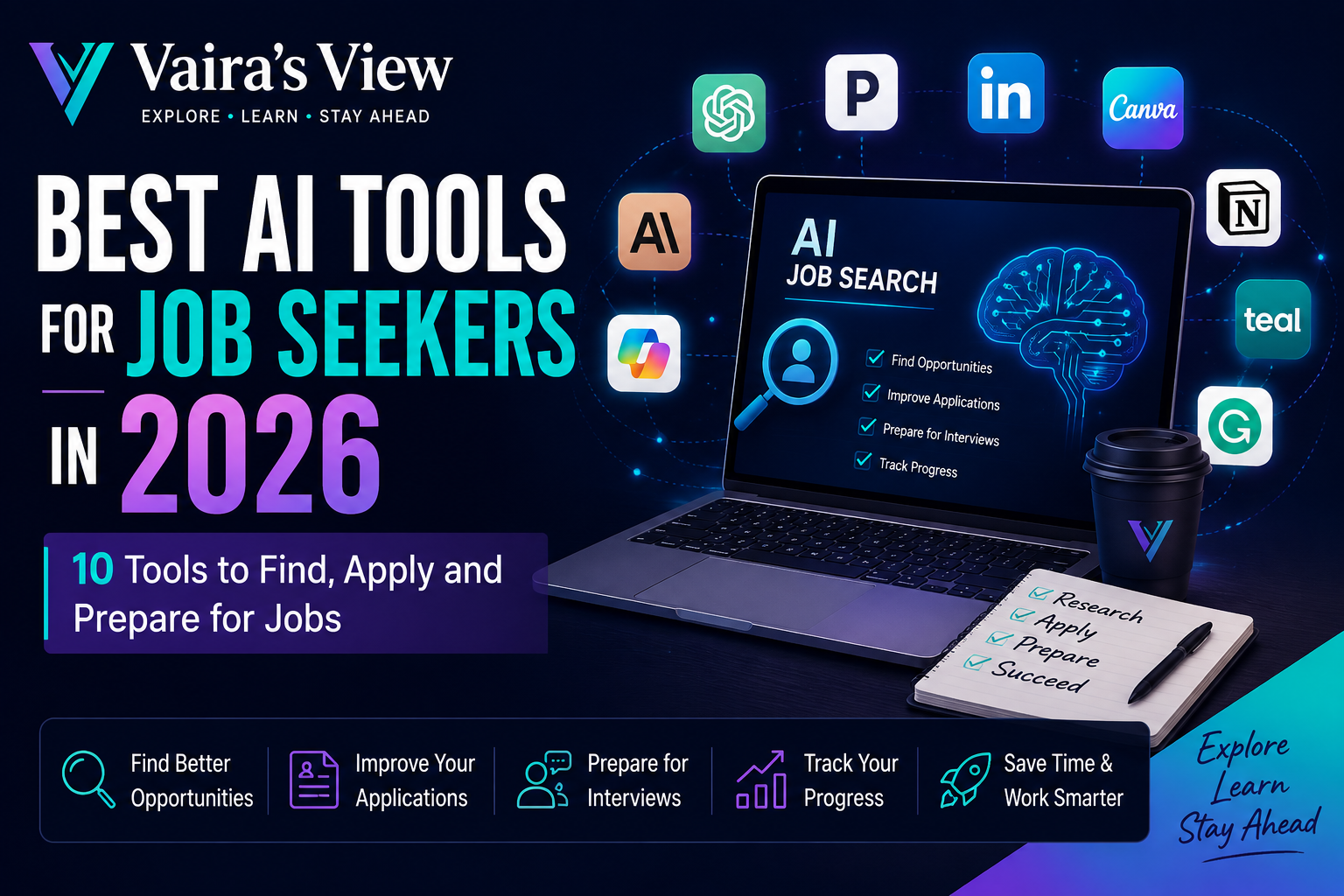
In 2026, the best AI tools for job seekers can help streamline the job search, application, and interview processes.
The smart use of AI for job seekers can help to minimize repetitive tasks and improve the specificity of each application.
The worst thing that you can do is write a cover letter entirely from AI.
Better way to do it, is to use AI throughout the entire process of finding a job, which includes finding the right job, learning about a prospective employer, improving their CV, preparing for their interview, tracking the job, and following up after the interview.
When deployed effectively, AI can help you save hours. Can give a more general, overdone or fabricated appearance to your application when overused.
The best AI tools for job seekers each solve a different part of the job-search process.
This guide is for the purposes of the practical applications of AI for job seekers, but does not discuss the philosophical or ethical implications of AI technology. In this guide, we will not be covering the philosophical and ethical concerns of AI regarding job seekers.
1. Best AI Tools for Job Seekers: ChatGPT for Smarter Job Matching
You don’t need to spend the time to apply for a job to know if it’s right for you.Before submitting an application, you can validate a job to see if it is a good match for you by asking questions of ChatGPT.
Rather than asking the question: “Am I qualified for this position?,” copy and paste the job description and request a comparison in a structured format.
You can request it to recognize:
- must-have skills
- nice-to-have skills
- likely interview topics
- missing experience
- transferable skills
- Using keywords that are used naturally in the text.
A useful prompt is:
This position is very similar to mine! Divide the needs into strong match, part match and gaps. When I can think of ways to tell the truth without embellishment, then I can sort of do that.
The upside of this is that it will save you time because you will only be checking jobs that you have a chance at applying for the job. The top AI tools for job seekers are those that address a specific task that they are unable to do without using the judgment of human beings.
2. Google for deeper research into more specific topics
It’s best to use LinkedIn as a tool for finding a job, instead of as a professional search engine.
The recruiters need to know the worth of the applicants within just a couple of seconds to make their profile as promising as possible.
Focus on:
- a clear headline
- A certain role to be aimed for
- measurable achievements
- relevant certifications
- recent projects
- strong skills
- A new About page
While AI can improve the language, it should be a factual experience.
While a profile that is well done up but not quite specific, is not as useful as one that is specific in what you can do.
3. Research on perplexity in company
Many candidates waste a lot of time looking through several websites prior to an interview.
Use Perplexity to summarise company research to save time:
- recent business developments
- products and services
- key markets
- competitors
- leadership changes
- technology strategy
- recent news
This is helpful prior to recruiter calls, first round interviews, and final interviews.
You do not need to use all of the best AI tools for job seekers every day.
It is crucial that you always verify what is imperative from an official company source before saying in an interview.
4. Claude for detailed job-description analysis
There are some job descriptions that are brief. Some are quite extensive with many pages.
Claude will be helpful if you have a role that requires a lot of different technologies, compliance, leadership expectations and responsibilities.
You can request it to convert a lengthy job description into:
- a skills checklist
- A strategy for a preparation meeting for an interview
- a 7-day study plan
- likely scenario questions
- Amended technical areas to edit
- leadership themes
It’s particularly helpful for senior people looking to move into a consulting, architecture, product, risk, banking, and technology roles.
5. Grammarly for business communication
Despite having favorable qualifications, even candidates could fail to get a job because they communicate too quickly.
Grammarly can assist with enhancing:
- recruiter replies
- networking messages
- application emails
- follow-up messages
- cover letters
- LinkedIn posts
Polishing is the best use of Grammarly.
It should be used in addition to your own tone.
6. Organize the entire process of a job hunt with Notion AI.
Getting a job can be overwhelming.
You may be interviewing with multiple companies, meeting with recruiters, practicing interview skills and learning new skills at the same time!
This is where you can get organized using Notion.
You can create a dashboard with:
- company name
- role
- application date
- recruiter contact
- interview stage
- follow-up date
- salary range
- notes
- outcome
AI can provide a summary of the interview notes and turn them into actionable items.
This can help create a more organized method to search and less reactive.
7. Tracking applications and tailoring CVs in teal color
Teal is a career management centric service.
It can take care of your CV and help you review and contrast job applications along with your CV.
It’s helpful since many candidates create one CV and distribute it to all.
That usually underperforms.
The better way is to have a solid base CV, and then simply and honestly tweak it for each major application.
You can change:
- profile summary
- skill order
- emphasis on projects
- achievement wording
- keywords
Relevancy – not re-writing your career profile for each position.
8. The Monday morning meeting
These days, a portfolio is more than just for designers.
Any technological, consulting, AI, architecture, product, marketing, analytical or leadership professional can benefit from visualizing their work.
You can use Canva to create:
- project case studies
- one-page career profiles
- portfolio decks
- architecture summaries
- consulting presentations
- personal brand graphics
A simple application of portfolio can help to make your application more memorable by showcasing your thought and reasoning process— which is more important than your job titles.
9. Prepare for using Microsoft Copilot for Enterprise-roles.
Candidates who want to work in organizations that have extensive adoption of Microsoft solutions could benefit from Microsoft Copilot.
It can help with:
- technical research
- summarizing documents
- interview preparation
- role-specific learning
- professional drafting
- enterprise-product research
It can also be used to structure learning related to Microsoft technologies for those aiming for cloud, security, AI, Microsoft 365 or enterprise architecture careers.
The best way to use a product is to prepare for it, but not to ‘act as if you know it’ if you haven’t used it.
Interview with AI
The more you rehearse, the better you get at your interview.
AI can create various interview styles and provide feedback in a structured manner.
You can practice:
- HR questions
- behavioural questions
- leadership scenarios
- technical questions
- case studies
- architecture scenarios
- salary conversations
A useful prompt is:
Interviewer of this position. If you have a question, ask it at a time. After I respond, cross off the following if I have: Clear answers, evidence, structure, relevance. Then tell me how I can make my answer better, but still be true.
This can aid you to become conciseness and confident.
Combining a few of the best AI tools for job seekers can create a simple and practical workflow.
AI-powered job search tool that is easy to use and effective.
Don’t have to use 10 tools a day.
Follow simple workflow (such as the one from the previous step).
- Look for jobs via LinkedIn.
- Use ChatGPT or Claude to analyse job description.
- Research about a company using Perplexity.
- Use Notion or Teal to track and monitor the application.
- Polish up on important messages with Grammarly.
- AI Mock Interviews prior to the interview.
This is a pretty nice system by itself.
It isn’t meant to be the answer to using AI.
The best AI tools for job seekers are most effective when they make the job-search process clearer, faster, and more organized.
The object is to eliminate needless labour and better judgement.
AI should never be used for creating job search strategies.
Don’t create fake awards using AI!
Don’t use it to come up with ideas:
- projects
- employers
- certifications
- years of experience
- technical skills
- team sizes
- leadership responsibilities
- salary history
- business results
You should not submit answers created by AI without checking them over either.
The best AI tools for job seekers should support your decisions rather than replace your judgment.
Try not to use ‘cliches’ or ‘general words’.Cliches and vague / general language is becoming more recognisable to recruiters.
Your app should still sound like the human and not like the robot or like you’ve never been in such a situation before.
The tips and tricks to not sound like an AI.How to Speak Like a Human with AI.
The simplest method is to begin with materials that are raw materials.
Write first in simple words, your experience.
Then, give AI the instruction to make it clearer.
For example:
Instead of asking:
Write a compelling CV-bullet!
Try:
This is what I really did! Write in one succinct and clear CV bullet in professional language. Please don’t add numbers, technologies and responsibilities which I didn’t give.
The one line changes a lot of things and makes the script more realistic.
The best AI tools for job seekers should make each stage of the search easier without replacing your own judgment.
A Realistic 30 minute day to day schedule
You don’t have to work hours per day.
It can be sufficient to complete a 30-minute program that is focused.
- Allow 10 minutes to find one or two strong-fits.
- Read through role and CV for 5 minutes.
- Aim for 5 minutes to take and fine-tune your application.
- Take 5 minutes to send 1 networking message.
- Practice 1 interview question 5 minutes.
This will be better than sending dozens of impromptu applications in succession if done regularly.
Final thoughts
While AI is reshaping the job search landscape, it’s not taking the place of basic job search skills.
But there are others skills, experience, good communication and perseverance that are still important.
AI can assist in taping into those assets and even present them more easily.
If you’re looking for the smartest job seekers of 2026, you’re not going to find them wielding all of the tools.
They will use some tools in an imaginative manner, taking care of the outcomes that emerge; mixing
The best AI tools for job seekers can support better research, stronger applications and more effective interview preparation.
Pingback: AI for Job Search in 2026: Resume, LinkedIn & Interviews
Pingback: 25 Best ChatGPT Prompts for Job Seekers in 2026