
Choosing the right AI risk management certification for finance is less about prestige than about the problem a professional needs to solve. A bank's AI work can involve governance, model oversight, audit evidence, cyber controls, vendor reviews, compliance, and operational implementation, and no single credential covers all of that equally well. The better question is whether the credential is built for enterprise governance, financial risk control, assurance, ISO implementation, cloud and AI security, vendor-specific operations, or ethics.
That distinction matters because the market is already split between frameworks, certificates, and role-based badges. ISO/IEC 42001:2023 is the first international management-system standard for artificial intelligence, published in December 2023, and it gives organizations an auditable AI governance framework across the full AI lifecycle, including risk assessment, impact assessment, and risk treatment (ISO/IEC 42001 overview). NIST's AI Risk Management Framework is different, it is voluntary guidance released in January 2023 and not an official certification program, which means private “AI RMF certifications” are training credentials built around NIST's ideas rather than NIST-issued credentials (NIST AI RMF distinction).
For finance professionals, the strongest comparison criteria are simple, syllabus depth, assessment format, prerequisites, maintenance rules, implementation relevance, and whether the credential fits the reader's actual job. A governance lead, an internal auditor, a second-line risk manager, and a cloud security specialist should not be shopping for the same badge. The list below compares the main options through that lens, so the reader can see which path fits current responsibilities and which one is only useful after another credential or some hands-on experience.
Table of Contents
- 1. IAPP Artificial Intelligence Governance Professional
- 2. PRMIA AI Risk Management Certificate
- 3. ISACA Advanced in AI Risk
- 4. ISACA Advanced in AI Audit
- 5. ISO/IEC 42001 AIMS Lead Auditor and Lead Implementer
- 6. ISO/IEC 23894 AI Risk Management Certificates
- 7. Cloud Security Alliance Trusted AI Safety Expert
- 8. TÜV SÜD AI Quality Certification Program
- 9. IBM Certified watsonx Governance Lifecycle Advisor
- 10. CertNexus Certified Ethical Emerging Technologist
- Top 10 AI Risk Management Certifications Comparison
- Build a Role-Based AI Risk Learning Path
1. IAPP Artificial Intelligence Governance Professional
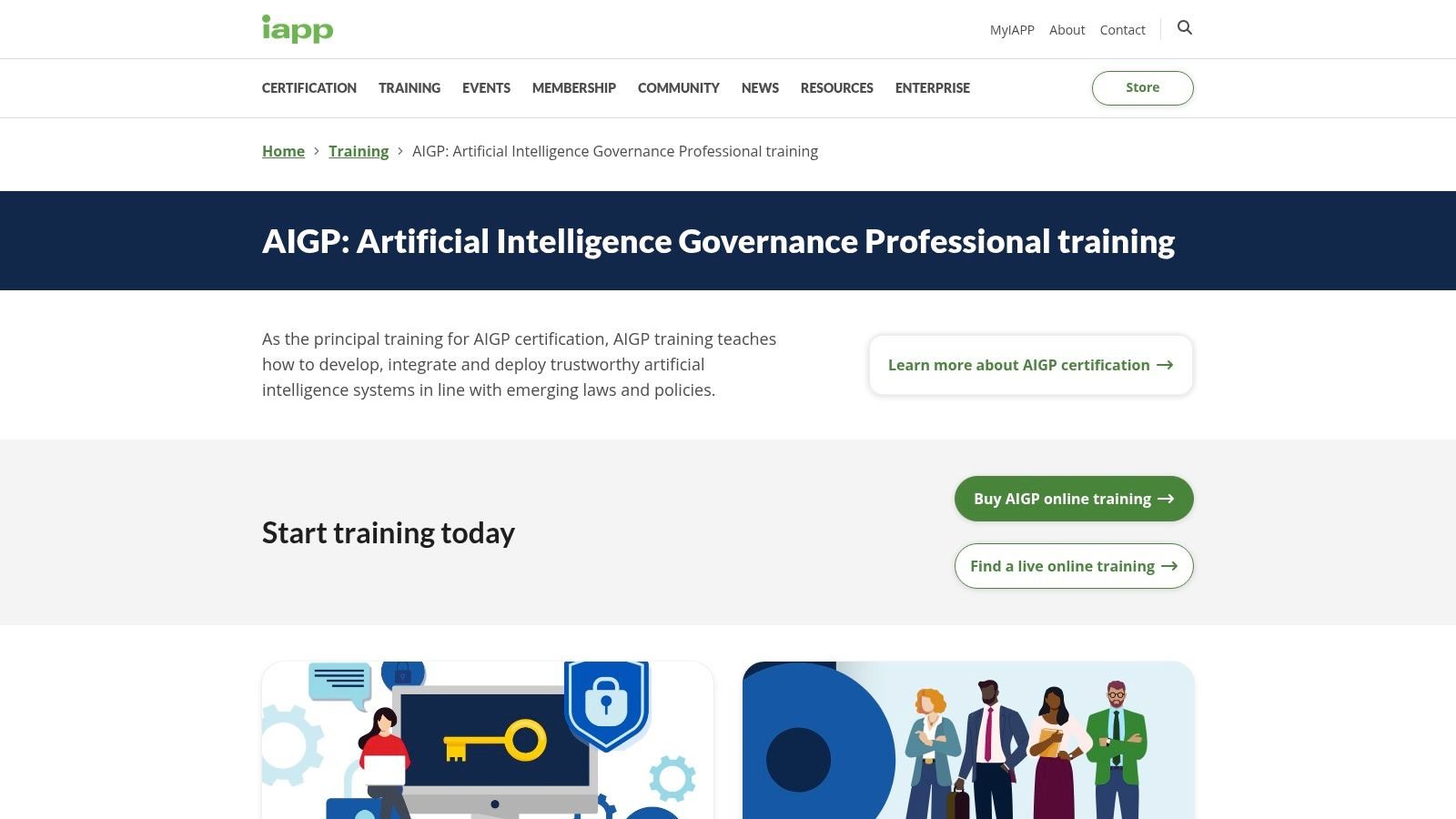
The IAPP's Artificial Intelligence Governance Professional credential is the clearest fit for people who need a vendor-neutral governance badge with broad market recognition. Its own training page positions the credential around AI governance across the lifecycle, and that makes it especially relevant for policy teams, legal-aligned reviewers, and compliance leaders who have to explain how AI is controlled rather than how a specific model is tuned. For banking and finance, that broad scope is an advantage when the role touches multiple functions and the candidate needs a credential that looks credible outside one technology stack.
The exam format is straightforward but demanding. IAPP states that the exam uses 100 questions, lasts 2.75 hours, and is proctored through Pearson VUE. It also requires 20 CPE credits per term to keep the credential current, which signals that the body of knowledge is expected to move with changing AI law and practice (IAPP AIGP training).
Why it fits governance-heavy finance roles
AIGP makes the most sense for professionals who need to talk to legal, privacy, model risk, and product teams in the same meeting. It is less about one technical control and more about governance maturity, which is why it pairs well with board reporting, policy design, and oversight work in regulated firms. The main tradeoff is breadth. That breadth makes the exam relevant, but it also means the questions can feel scenario-heavy and the preparation burden is wider than a niche certification.
A practical rule for finance teams is simple, if the job is to define how AI should be governed, not just how it should be tested, AIGP is one of the strongest vendor-neutral starting points.
Best AI certifications for banking and finance can help readers compare AIGP with adjacent credentials that sit closer to cloud, security, or audit work.
2. PRMIA AI Risk Management Certificate
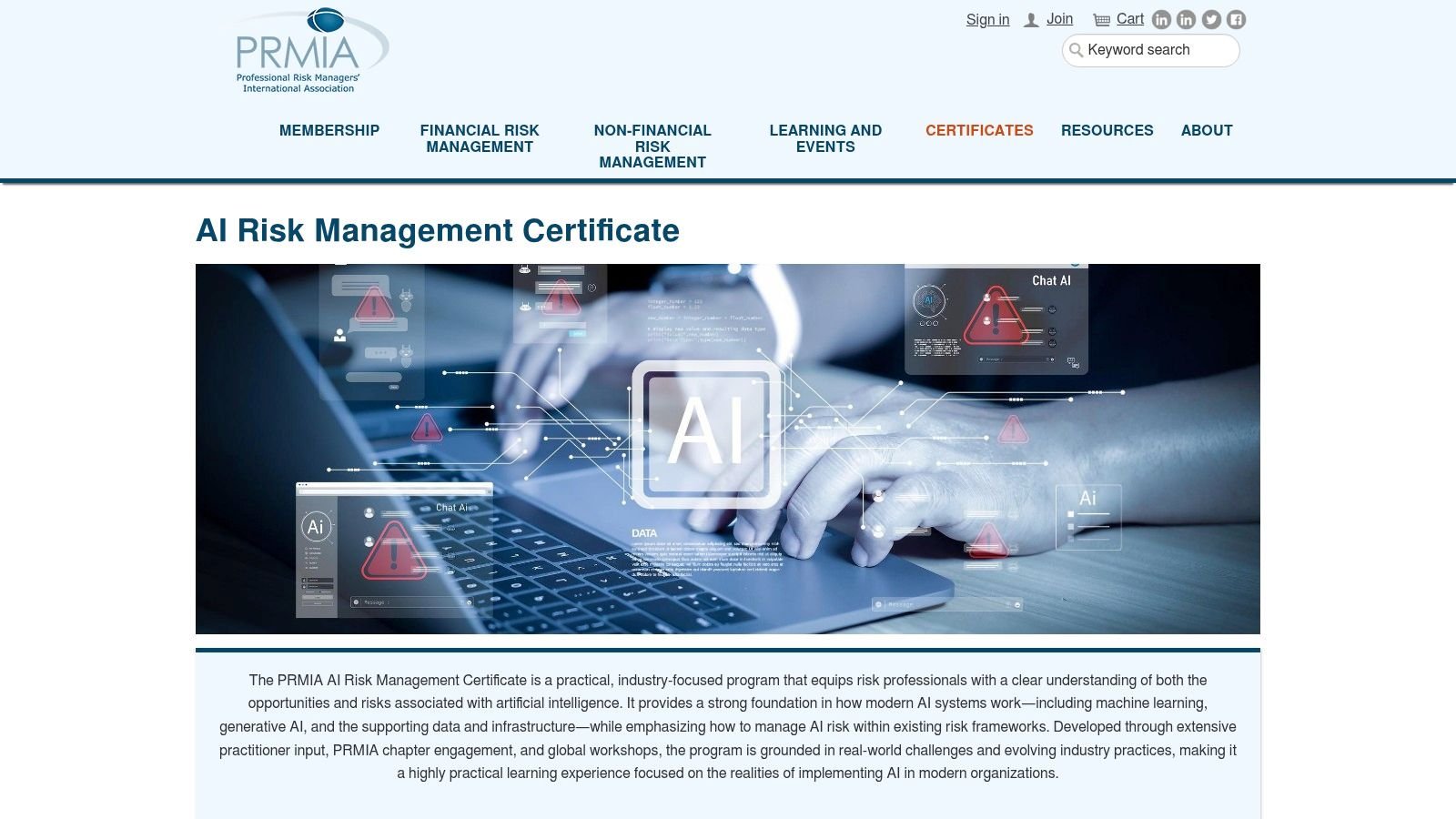
PRMIA's AI Risk Management Certificate is built for risk and control practitioners who want a direct bridge between AI concepts and financial risk language. That matters in banking, where governance teams often need a credential that sounds familiar to enterprise risk functions rather than technology teams. PRMIA also frames the program around identifying, assessing, governing, and reporting AI risks, which makes it useful for model risk, operational risk, and control functions that need practical structure more than broad theory.
The program is more compact than some governance credentials. PRMIA lists a single computer-based exam with 60 multiple-choice questions, a 2-hour duration, and availability through Pearson VUE or online. The fee includes access to the AI Risk Management eCoach and exam authorization, and the syllabus spans AI foundations, data and infrastructure, governance and GRC, threats, ethics, and regulation (PRMIA AI Risk Management Certificate).
Best use case in banking and controls
PRMIA stands out because it speaks directly to the people who have to translate AI risk into control language. That includes second-line risk teams, internal control analysts, and practitioners who sit near finance, compliance, and operational risk. It is less of a broad policy credential and more of a practical certificate for people who need a risk-management lens on AI. The main limitation is that it is a certificate, not a full professional designation, so employers may view it as a useful capability signal rather than a career-defining credential.
For candidates who want a clean first step into AI risk management certification without a heavy prerequisite stack, PRMIA is one of the easiest programs to understand and start.
Its global test access also helps distributed finance teams, especially when a candidate needs flexibility rather than a fixed classroom calendar.
3. ISACA Advanced in AI Risk
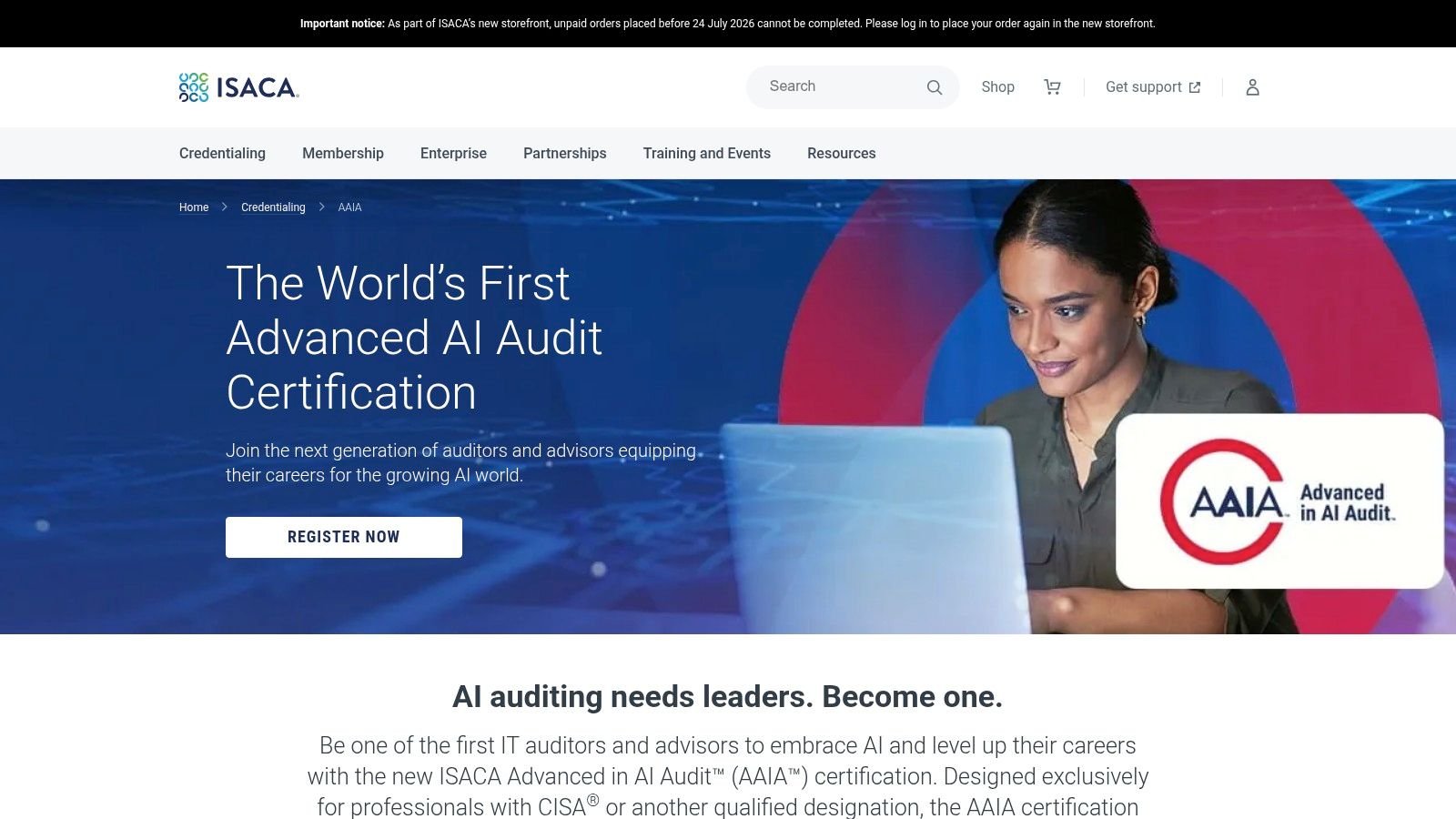
ISACA's Advanced in AI Risk is best read as a credential for experienced risk professionals. Its prerequisite structure makes that clear. The public program description says it is aimed at seasoned governance, audit, security, and enterprise risk practitioners, and it requires one of 25 prerequisite credentials plus prior IT risk or advisory experience (ISACA AAIR context). That puts it in the category of advanced capability signaling, not early-stage AI training.
The market need it addresses is narrower than generic AI literacy. ISACA's credential is meant for people who already work inside risk functions and need a structured way to extend that work to AI controls, oversight, and accountability. In finance and banking, that matters because AI risk rarely sits in one team. It cuts across model governance, third-party exposure, security review, and compliance evidence, so a credential aimed at senior practitioners can be more useful than a broad introductory certificate.
A separate reason this credential matters is the gap between formal oversight and day-to-day practice. Analysts have pointed to a split between leaders who say AI risk programs exist and practitioners who experience something less complete, which suggests the problem is not just policy, but execution and ownership. For banks, that kind of gap is familiar, because governance language often moves faster than control design. AAIR is relevant where teams need to turn broad AI oversight goals into operational risk management.
Who should not jump straight to AAIR
AAIR is a poor first step for career changers or early-career professionals. The prerequisite logic suggests that ISACA expects a base in IT risk, audit, security, or advisory work before AI-specific risk is added on top. That makes it a better fit for enterprise risk managers, third-party risk specialists, and governance professionals who already work with control frameworks. Employers are also likely to value it most in mature risk teams, where the job already involves defining scope, testing controls, and documenting accountability.
For readers comparing AI risk management certification options, AAIR is the path for people who already understand risk operations and now need AI-specific depth. It is selective, and that selectivity is part of the signal.
4. ISACA Advanced in AI Audit
ISACA's Advanced in AI Audit fits a different professional problem. Instead of asking how to govern AI at a program level, it asks how to audit models, data, and machine-learning pipelines with enough rigor to support assurance. That makes it useful for internal audit teams, external assurance professionals, and GRC practitioners who need a credential that maps to control testing rather than strategy decks.
The value here is role clarity. Audit teams do not just want to know whether AI exists, they need to know whether the control environment is testable, documented, and traceable. ISACA's positioning around AI audit leadership makes AAIA relevant for organizations that need formal assurance over models, data flows, and machine-learning operations. That is especially important in finance, where audit functions often have to explain how a system was reviewed, what evidence was gathered, and where management accountability sits.
Why assurance teams may prefer it
AAIA complements the broader ISACA portfolio, which matters because audit and risk functions often build skills in layers rather than with a single credential. The main advantage is that the certification speaks directly to AI assurance work, an area where many legacy audit programs still have thin coverage. The main constraint is adoption. As a newer program, it has fewer third-party prep resources than older ISACA credentials, so candidates may need to rely more on official materials and internal experience.
Audit credentials are strongest when they help a team prove what was tested and why it was sufficient. AAIA is built around that exact need.
For professionals in banking, AAIA is a better fit than a broad governance credential if the job is to test controls, review evidence, and document findings for model oversight committees or regulators.
5. ISO/IEC 42001 AIMS Lead Auditor and Lead Implementer
ISO-oriented credentials are the right choice when the organization is trying to build or assess an Artificial Intelligence Management System, not just learn AI concepts. ISO/IEC 42001:2023 is the international AI management-system standard, and it specifies requirements for establishing, implementing, maintaining, and continually improving an AIMS (PECB's ISO/IEC 42001 brochure). That is a different job from broad governance training. It is about making AI controls operational, auditable, and repeatable over time.
BSI's Lead Auditor and Lead Implementer pathways are valuable because they translate the standard into competence. The certification guidance ties to the standard's clauses 4–10, covering context, leadership, planning, support, operation, performance evaluation, and improvement (BSI lead auditor training). That is exactly the kind of structure implementation teams need when they are defining scope, assigning top-management responsibility, and maintaining an AIMS over time (ISO/IEC 42001 examination guide).
Where the ISO path is strongest
This is the most implementation-heavy option in the list. It suits teams that are working toward ISO-based AI management, preparing for audits, or translating policy into a control system that can survive internal review. It is also one of the best choices for organizations that want a standards-aligned story for AI governance across business units. The downside is practical. Standards literacy is required, and course pricing often depends on region and delivery mode, so candidates usually need to request details rather than get a quick online checkout.
For finance professionals, that tradeoff is acceptable when the job sits close to compliance operations, management-system design, or audit readiness. For anyone trying to build a real AIMS, ISO/IEC 42001 training is less a theory badge and more an operating manual.
6. ISO/IEC 23894 AI Risk Management Certificates
ISO/IEC 23894 is the better fit when the reader wants an AI risk methodology without moving all the way into management-system certification. PECB's tiered offerings around the standard create a path from Foundation to Implementer and Lead Implementer, which works well for professionals who need a structured risk process but not necessarily a full ISO management-system engagement. The standard is also tied to ISO 31000 principles, which helps risk teams place AI within a familiar enterprise risk framework.
AI risk management software guidance is useful context for teams that want to connect methodology with tooling. ISO/IEC 23894 is not software itself, but it gives the process logic that risk platforms and control workflows should support.
Why risk teams use it
The strongest part of this path is its emphasis on identification, assessment, treatment, and monitoring. That makes it immediately relevant for model inventories, third-party AI review, and operational risk programs that need a repeatable method for classifying and tracking AI exposure. PECB's tiered structure also lets professionals choose the level that matches current responsibilities rather than jumping into an advanced exam too early.
The tradeoff is complexity. Market recognition varies by region, and the advanced credential levels bring experience-hour requirements that can slow down early entrants. That means this path is strongest for practitioners who already work inside risk, audit, or compliance and want an ISO-aligned method rather than a generic AI overview.
ISO/IEC 23894 is useful when the question is not “what is AI risk?” but “what is our risk process, and can we evidence it consistently?”
For banking teams, that makes the credential especially attractive in model risk management, enterprise risk, and control mapping work.
7. Cloud Security Alliance Trusted AI Safety Expert
When AI risk and cloud security sit in the same team, the Cloud Security Alliance's Trusted AI Safety Expert certificate is the most direct path. That matters because many AI systems now run inside cloud infrastructure, SaaS platforms, and identity-controlled environments, so model risk often overlaps with access management, threat modeling, and runtime security. CSA's curriculum spans 10 domains, covering AI safety, security, and governance, which gives the certificate a more technical security orientation than many governance-only options (CSA TAISE).
Security teams need this lens
TAISE fits teams that need to defend AI systems in cloud environments, not just document policy. Topics like threat modeling, MLSecOps, Zero Trust for AI, and responsible AI practices make it relevant for cloud security architects and security leaders supporting AI workloads. For practitioners in financial services, that also connects neatly with our cybersecurity-in-banking guide, since identity, data, and model access often need to be reviewed together in the same control set.
The main limitation is access. The program is newer, and pricing and delivery are handled through authorized training partners, so candidates may need to work through partner channels for instructor-led options and exam access. That does not make it weaker, but it does make it less straightforward than a single vendor checkout.
For financial services, TAISE is strongest when AI security and cloud security already converge inside one team, especially in digital banking, fraud detection, and platform operations.
8. TÜV SÜD AI Quality Certification Program
TÜV SÜD's AI Quality Certification Program is a practical choice for organizations that care about conformity, testing, and applied compliance. The program includes the AI Coordinator – TÜV certificate and related tracks, and its content aligns with risk-based AI quality frameworks and regulatory expectations, including ISO/IEC 23894, ISO/IEC 42001, and IEEE 7000 (TÜV SÜD AIQCP). That makes it particularly relevant for teams that need a quality and compliance lens, not just a conceptual overview.
Where TÜV SÜD adds value
The brand matters. TÜV SÜD has long been associated with conformity and testing, so its AI program feels familiar to organizations that already rely on certification logic in safety, quality, or regulated engineering contexts. In finance, that familiarity can help when AI governance must be explained to compliance, procurement, or operational risk teams that prefer structured assurance pathways. The program is also useful for practitioners who need a practical, implementation-oriented curriculum rather than a research-heavy one.
The downside is the usual one for regional training brands, availability, language, and pricing vary by market, and candidates often need to inquire rather than find one universal schedule. That can slow down multinational teams trying to standardize learning across locations. Still, for companies pursuing a quality-oriented AI assurance model, TÜV SÜD gives them a credible path that links training to operational discipline.
9. IBM Certified watsonx Governance Lifecycle Advisor
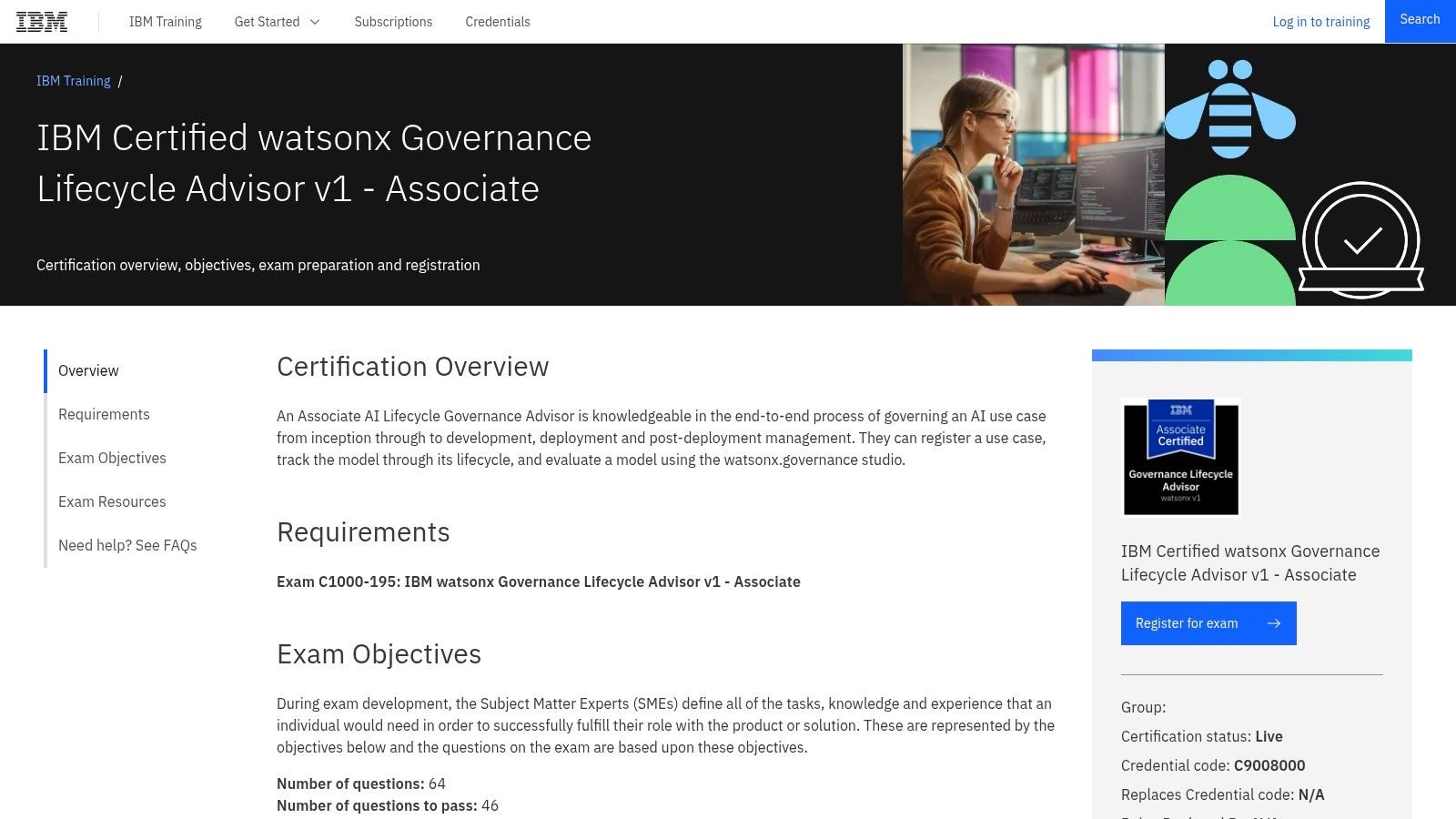
IBM's Certified watsonx Governance Lifecycle Advisor, Associate is the most tool-specific option in the list, which is exactly why some teams will prefer it. The credential validates the ability to operationalize governance inside IBM watsonx.governance, including reporting, dashboards, and control mapping within an enterprise workflow. For regulated organizations already using IBM tooling, that specificity turns abstract governance concepts into usable daily tasks.
Best for teams already on IBM stacks
This credential is strongest when the employer has already chosen IBM as part of its AI governance architecture. The practical value is clear, candidates learn how to use a specific platform to support governance lifecycle work, which is useful for policy implementation, monitoring, and compliance reporting. In a bank or insurer that has standardized on IBM tools, that can be more valuable than a vendor-neutral badge because the output is directly usable on the job.
The tradeoff is transferability. Tool-specific skills often travel poorly across multi-vendor environments, and that matters in finance, where platform stacks are rarely uniform forever. So this should be treated as an implementation credential rather than a universal market signal. It is a strong fit for the right employer, but not the best first choice if the goal is broad portability.
10. CertNexus Certified Ethical Emerging Technologist
CertNexus' Certified Ethical Emerging Technologist is the broadest ethics-oriented option here, which makes it a useful complement rather than a standalone AI specialization. It covers AI and machine learning alongside other emerging technologies, and its exam, CET-110, is delivered through Pearson VUE with a continuing education program (CertNexus CEET). That gives it a structured, vendor-neutral format that can support people who need a grounded ethics and governance perspective across more than one technology domain.
A good complement, not the whole answer
CEET is most useful for professionals who want to strengthen their ethical reasoning, bias awareness, and governance vocabulary before or alongside a more AI-specific credential. It pairs well with ISO/IEC 42001 or 23894 because those standards provide the management and risk structure, while CEET adds an ethics and responsible-technology perspective. In finance, that combination can be valuable for data governance, product governance, and control teams that evaluate the fairness or appropriateness of data-driven systems.
The limitation is scope. Because CEET also covers IoT and data science, it is not narrowly focused on AI risk management certification in the same way that PRMIA, AIGP, or ISO-focused programs are. That said, its broader coverage can be a strength for career changers who want a cross-functional baseline before specializing.
Top 10 AI Risk Management Certifications Comparison
| Credential | Core focus | Target audience | Key benefit(s) | Exam & maintenance | Price / availability |
|---|---|---|---|---|---|
| IAPP Artificial Intelligence Governance Professional (AIGP) | Lifecycle AI governance: policy, model oversight, monitoring | Governance leads, privacy, compliance, risk officers | Market‑recognized governance credential; frequent BoK updates tied to laws | 100‑question, 2.75‑hr proctored exam (Pearson VUE); 20 CPE/term required | Pricing varies; training often paid; global test centers |
| PRMIA AI Risk Management Certificate | Applied AI risk management for finance: foundations, GRC, ethics | Risk & control practitioners in financial services | Transparent fees; includes eCoach self‑study and practice exam | 60 MCQs, 2‑hour computer exam (Pearson VUE or online); no formal CPE | Program fee includes eCoach + exam; globally available |
| ISACA Advanced in AI Risk (AAIR) | AI risk governance, lifecycle risk management, program mgmt | Second‑line risk, TPRM, enterprise risk teams | ISACA brand recognition; part of AI credential suite; CE support | ISACA exam with defined domains; supported by ISACA continuing education | Launched 2026; pricing varies, may require ISACA account |
| ISACA Advanced in AI Audit (AAIA) | AI auditing: controls, testing, reporting for models & pipelines | IT/AI auditors, internal/external assurance professionals | Addresses AI assurance skill gap; complements ISACA audit creds | Official review manual + ISACA/PSI exam | Early adoption; prep resources growing; pricing varies |
| ISO/IEC 42001 AIMS Lead Auditor / Lead Implementer (BSI) | ISO AI Management System auditing & implementation | Auditors, implementers, orgs seeking ISO AIMS certification | Direct alignment to ISO and EU AI Act; widely recognized auditor creds | Multi‑day courses + exams; pathways for internal/practitioner auditors | Regional schedules; course fees typically quote‑based |
| ISO/IEC 23894 (PECB) – Foundation→Lead Implementer | ISO‑aligned AI risk management methodology (ISO 31000 base) | Risk managers implementing org‑level AI risk processes | Tiered ISO training; strong methodology for risk ID/assessment/treatment | Tiered certs with experience hours for advanced levels; PECB exam | Delivered via PECB partners; pricing/delivery vary by partner |
| CSA Trusted AI Safety Expert (TAISE) | AI safety & security, MLSecOps, threat modeling, Zero Trust | Cloud security, ML security, AI safety practitioners | Deep safety/security focus; complements cloud & Zero Trust creds | Exam‑based certificate with Credly badge issuance | Newer program; partner‑managed delivery and pricing |
| TÜV SÜD AI Quality Certification Program (AIQCP) / "AI Coordinator – TÜV" | AI quality, risk & compliance; ISO & EU AI Act alignment | Quality, compliance, and risk teams seeking audit readiness | Practical, implementation‑oriented training from respected testing body | Tiered tracks with exam; Digital Academy delivery | Regional catalogs; dates/pricing often on request |
| IBM Certified watsonx Governance Lifecycle Advisor – Associate | Tool‑specific governance using IBM watsonx (policy, lineage, monitoring) | Teams deploying IBM watsonx in regulated enterprises | Concrete, tool‑level skills for enterprise governance workflows | Role‑based IBM exam; IBM badge and training resources | Vendor cert; availability and fees vary by region |
| CertNexus Certified Ethical Emerging Technologist (CEET) | Ethics & governance across emerging tech (AI/ML, IoT, data) | Practitioners seeking ethics/risk foundations across tech | Vendor‑neutral ethics focus; pairs well with ISO/AIMS or risk certs | Vendor‑neutral exam (CET‑110) via Pearson VUE; continuing education | Widely available via partners/platforms; regional pricing varies |
Build a Role-Based AI Risk Learning Path
The best AI risk management certification depends on the role, not on a universal hierarchy. PRMIA and AAIR are the strongest fits for risk and control professionals who want AI risk language that maps to enterprise risk management, with AAIR better suited to experienced practitioners because of its prerequisite structure. AIGP is the broad governance choice for people who need a vendor-neutral credential that speaks to policy, oversight, legal alignment, and lifecycle governance.
For assurance work, AAIA is the cleaner match because internal audit and external assurance teams need evidence, testing logic, and reporting discipline more than broad AI education. For implementation, ISO/IEC 42001 and ISO/IEC 23894 solve different problems. 42001 is for organizations building or auditing an AI management system, while 23894 is for teams that need an ISO-aligned risk methodology without committing to the full management-system structure. That distinction matters in banks, where some teams own governance operating models and others own risk treatment processes.
Security teams should look first at TAISE, especially when AI workloads live inside cloud infrastructure and the job involves threat modeling, MLSecOps, and Zero Trust for AI. IBM's watsonx credential is the right fit when governance work must be executed inside IBM tooling, not just discussed in principle. CEET works best as an ethics complement, especially for professionals who want to sharpen their bias and governance lens before moving into more specialized AI risk credentials.
Before enrolling, candidates should check the current syllabus, prerequisites, exam delivery, regional pricing, renewal rules, and employer expectations. Newer credentials can be useful, but employer familiarity is still maturing in parts of the market, so the safest move is to pair the certification with visible experience in financial-services AI risk workflows. That combination, practical responsibility plus the right credential, is what turns a certificate into a career signal.
Vaira's View publishes practical analysis for professionals who work at the intersection of AI, banking, finance, fintech, and careers. Readers who want more comparisons like this, plus guidance on AI certifications, banking technology, and future-ready finance roles, can visit Vaira's View for research-driven articles built for real-world decision-making.
Pingback: 7 Best Cloud Certifications in 2026 for High-Demand Careers