
Internet banking vs mobile banking is no longer simply a choice between using a browser and an app. The two channels now have different usage patterns, security risks, authentication requirements and customer expectations.
Mobile banking fraud losses in the United Kingdom rose 9% to £43.0 million in the first half of 2025, even as internet banking fraud losses fell 46% to £24.0 million. UK fraud-loss reporting points to a structural shift: internet and mobile banking are no longer interchangeable digital channels, and the mobile app has become a distinct security, product, and operational environment.
That distinction matters for banking leaders. Browser-based internet banking supports broad, information-heavy workflows, while mobile banking is built around frequent access, device trust, biometrics, notifications, and actions completed in constrained contexts. A bank that applies one channel strategy to both may create unnecessary friction on the app while leaving web-based and mobile-specific attack paths poorly controlled.
Table of Contents
- How Internet and Mobile Banking Became Two Distinct Channels
- Comparing Internet Banking and Mobile Banking Usage Patterns
- Security Surfaces and Fraud Trends Across Channels
- Authentication Requirements and Regulatory Expectations
- Adoption Gaps and Key Bottlenecks in Digital Banking
- UX Design Principles for Internet and Mobile Banking
- Strategic Implications for Banking Product and Operations Teams
How Internet and Mobile Banking Became Two Distinct Channels
Global mobile internet users reached 4.7 billion in 2024, or 58% of the world's population, and are projected to reach 5.5 billion by 2030. Smartphones accounted for about 80% of global mobile connections in 2024, with that share projected to reach 91% by 2030, according to mobile banking and connectivity analysis. These figures describe more than broader connectivity. They show why mobile banking developed into a channel with its own operating assumptions.
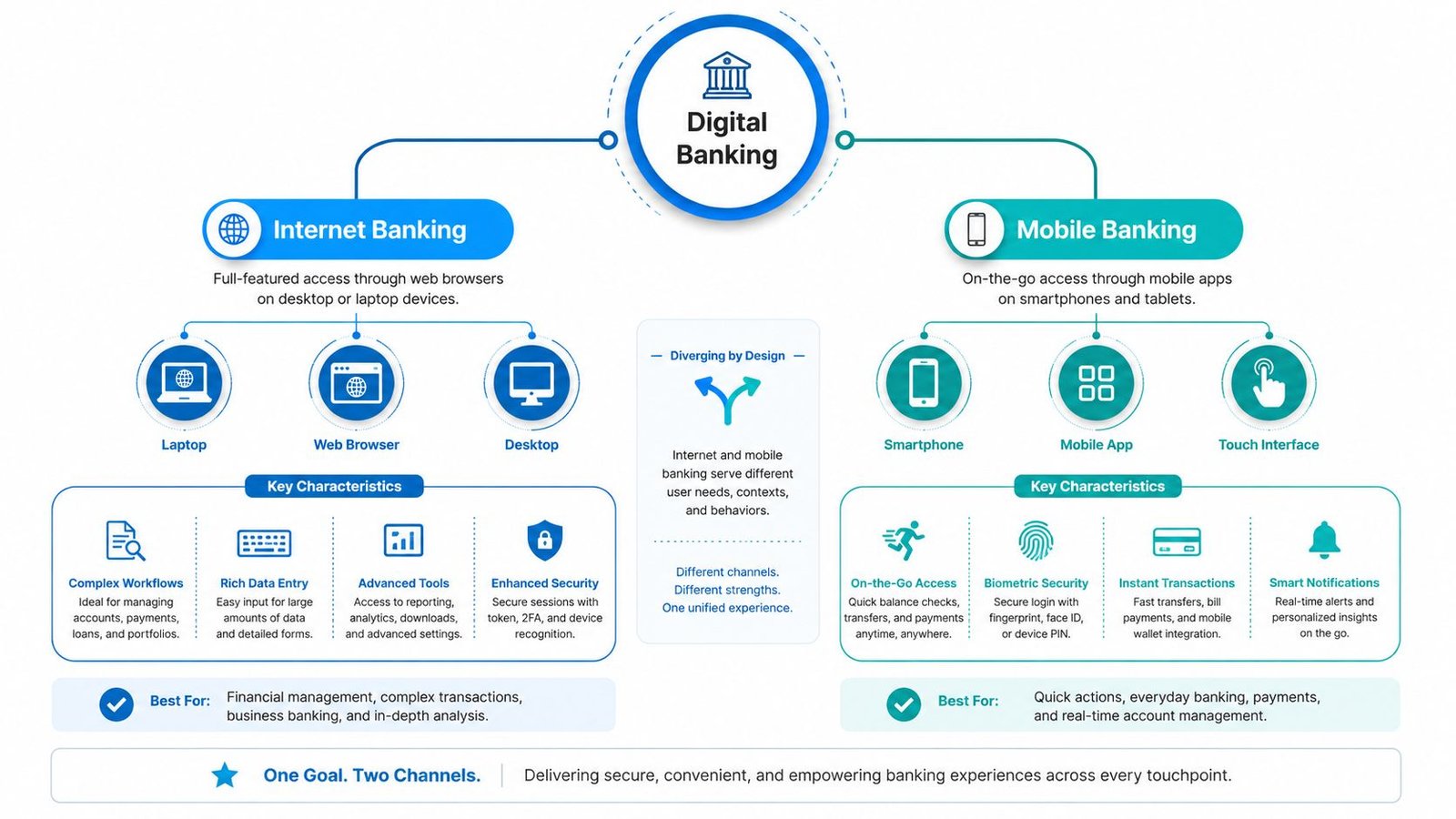
Internet banking grew around browser access on desktop and laptop computers. Its interface supports statement review, product management, detailed forms, and financial tasks that involve several stages. Mobile banking developed through smartphone operating systems and app ecosystems, where customers expect rapid access, biometric sign-in, push notifications, and transaction controls from varied locations.
Both channels may connect to the same core banking platform, but they expose different security surfaces and user constraints. A browser session provides more visible information and space for navigation, comparison, and data entry. A mobile app can use device capabilities such as biometrics, camera-based capture, secure notifications, and contextual location features. Those capabilities improve convenience while introducing dependencies on device integrity, permissions, operating-system behavior, and app distribution.
Different constraints require different decisions
Internet banking teams must manage browser compatibility, session security, accessibility on larger displays, and complex information architecture. Mobile teams must manage app releases, operating-system changes, device integrity, permissions, app-store distribution, and use in settings where customers may be distracted or switching between networks.
Regulatory expectations increasingly connect the channels. A web transaction may require confirmation through a mobile app, hardware token, or soft token. The app therefore can form part of the web channel's authentication architecture, rather than serving only as a separate interface.
Operating principle: A shared account experience does not require identical interfaces, controls, or performance measures.
Internet banking should operate as a full-service browser channel. Mobile banking should operate as a device-centered channel for engagement and transactions. Effective operating models coordinate the two while keeping their security controls, user experience measures, release processes, and regulatory responsibilities distinct.
Comparing Internet Banking and Mobile Banking Usage Patterns
Customers select a channel according to the task, context, and information required. Mobile banking fits short, repeated interactions such as checking balances, reviewing recent activity, approving a payment, transferring money, or receiving an alert. Internet banking offers a stronger setting for comparison, document review, detailed input, and decisions that unfold across several steps.
Adoption figures show why banks still need both channels. The U.S. Federal Reserve reported that 21% of mobile phone users had used mobile banking in the previous 12 months, compared with 68% of consumers with regular internet access and a bank account who had used online banking during that period, according to the Federal Reserve mobile device report. These figures describe an earlier stage of adoption, not current market penetration. Their continuing value is analytical: mobile and browser access developed as related, but distinct, customer behaviors. Current product decisions should validate that distinction against the bank's own channel, completion, and service data.
| Dimension | Internet Banking | Mobile Banking |
|---|---|---|
| Primary environment | Desktop or laptop browser | Smartphone or tablet app |
| Session pattern | More deliberate and information-heavy | Shorter, more frequent, and context-dependent |
| Strongest use cases | Detailed statements, product servicing, loan applications, complex transfers | Balance checks, alerts, quick transfers, approvals, and everyday payments |
| Interface advantage | Larger display, richer navigation, more visible data | Touch interaction, biometrics, camera access, and push notifications |
| Main design risk | Excessive complexity and poor workflow clarity | Too many steps, small targets, weak error recovery, and notification fatigue |
| Security dependency | Browser, session, credential, and transaction controls | App, device, operating system, network, and transaction controls |
Journey design should follow task complexity
A loan application may require customers to read disclosures, compare rates, upload documents, and correct information across several screens. A mobile app can support selected stages, yet forcing the full process into a small-screen flow can increase abandonment and service demand.
Routine actions create the opposite constraint. Requiring a desktop browser to approve a transfer or review a real-time alert adds friction that a mobile app can remove. Product teams should assign each journey a primary channel and define a clear handoff when the task crosses channel boundaries. The handoff should preserve entered information, explain the next action, and avoid making customers repeat authentication without a risk-based reason.
Channel metrics need separate interpretation
A high number of mobile sessions may represent frequent balance checks rather than higher-value activity. A longer internet banking session may signal a complex service journey rather than stronger engagement. Operations leaders should interpret activity alongside completion, error recovery, authentication challenges, support contacts, and fraud outcomes.
The useful question is not which channel wins overall. It is whether each channel handles the journeys it can deliver most safely and clearly, while transfers between channels remain understandable and measurable.
Security Surfaces and Fraud Trends Across Channels
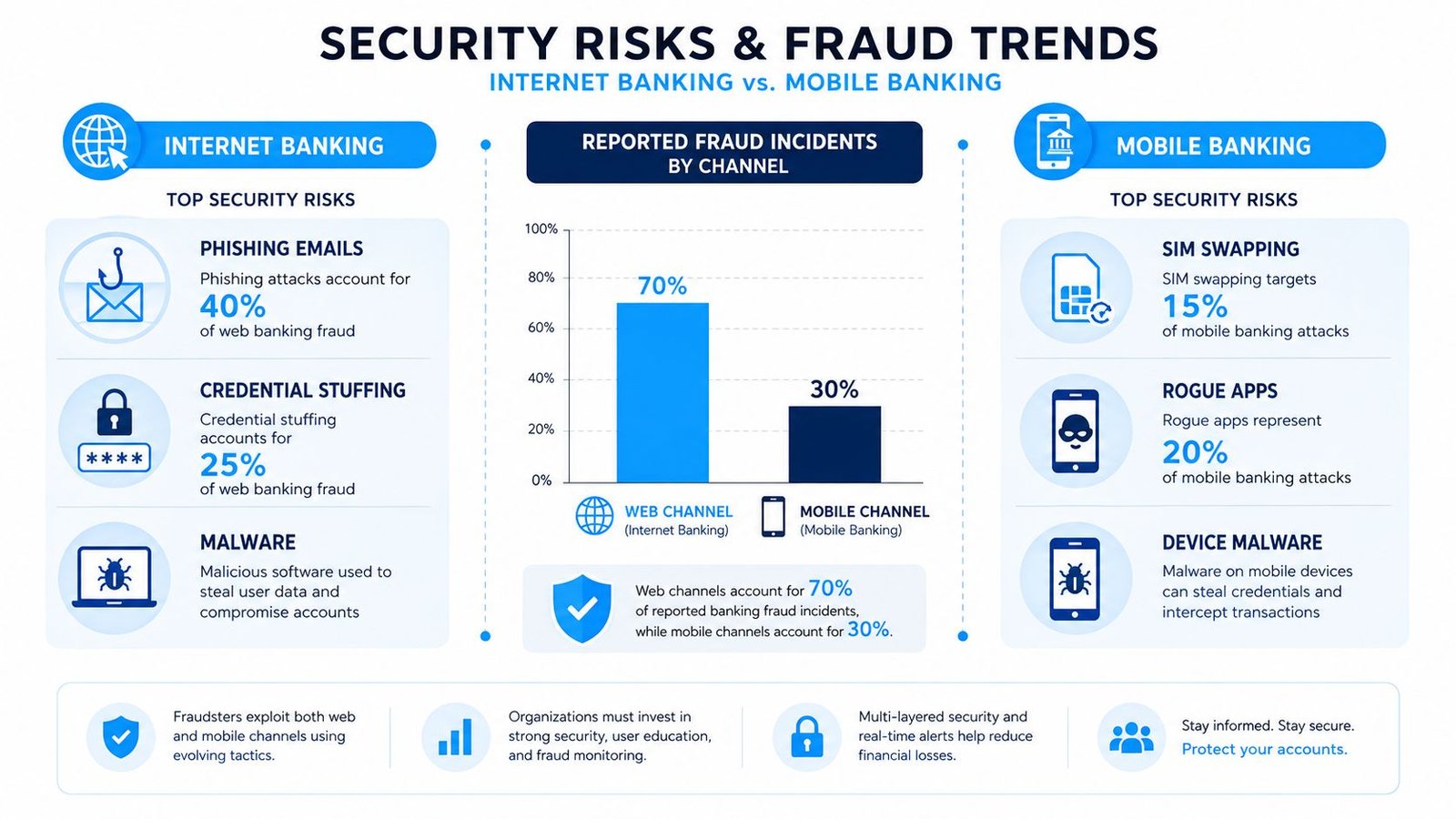
Internet banking and mobile banking are separate security environments, not interchangeable access points. Browser services face phishing, credential theft, credential stuffing, malicious browser activity, and session manipulation. Mobile services add app vulnerabilities, device compromise, malicious applications, insecure data handling, and remote attack paths that may operate without physical possession of the phone.
A technical assessment of mobile banking apps found that 76% of vulnerabilities could be exploited without physical device access, more than one-third worked without jailbreak or root privileges, and server-side weaknesses averaged 23 per app. The assessment also reported that half of the mobile banks examined were vulnerable to fraud and theft of funds, according to Positive Technologies' mobile banking vulnerability research.
App security extends beyond account takeover
Independent benchmarking of 726 banking and finance mobile apps found that 99% contained at least one security risk that failed OWASP MASV checks, while 61% leaked personally identifiable information. The analysis gave the apps an average security score of 66 out of 100 in 2022, as reported in Business of Apps' mobile finance security benchmark.
The control scope therefore extends beyond credential protection. Banks must examine how apps store, transmit, display, and expose customer data, including weaknesses in application logic, backend services, logging, third-party libraries, and transaction authorization. A protected sign-in does not establish that the wider application is safe.
Fraud outcomes also differ by channel. In the first half of 2025, mobile banking fraud losses in the United Kingdom rose 9% to £43.0 million, while internet banking fraud losses fell 46% to £24.0 million, according to UK Finance's H1 2025 remote banking fraud report. The figures support separate monitoring of device compromise, malware, social engineering, and browser-based attacks rather than a single digital-fraud category.
Control implication: Authentication proves identity at a point in time. Fraud controls must also evaluate device trust, transaction context, payee behavior, and customer intent.
Security programs should maintain distinct web and mobile telemetry, threat models, release controls, and incident playbooks. A shared identity platform can coordinate both channels, but a browser control does not automatically protect an app, and app biometrics do not resolve every web-fraud scenario.
Banking leaders can place these controls within a wider cybersecurity in banking framework, then align application testing and fraud monitoring with each channel's specific attack surface.
Authentication Requirements and Regulatory Expectations
Authentication has moved from a login feature to a cross-channel control system. Regulators and supervisory frameworks increasingly expect banks to verify identity strongly during first-time access, sensitive account changes, and high-risk transactions. The central design issue is not just whether a bank uses more than one factor. It's whether the factors are independent, resistant to takeover, and usable in the customer's actual channel.
For web-based internet banking, some regulatory frameworks require customers to confirm activity through a separate secure channel. That channel may be a mobile banking app, hardware token, or soft token. Weak methods such as SMS one-time passwords, email one-time passwords, or static passwords should not serve as the only authentication method for login or transaction approval under the requirements described in strong authentication guidance for digital banking.
A practical control sequence
Establish identity at enrollment. First-time access and device registration should use stronger identity verification than a reusable password. The bank needs confidence that the person enrolling the device is the legitimate account holder.
Bind approval to the transaction. A customer approving a new payee or transfer should see meaningful transaction details, not merely approve an abstract login request. This reduces the gap between authentication and authorization.
Use channel separation deliberately. A web session can request approval through a trusted mobile app, hardware token, or soft token. The second channel should add independent assurance, not merely repeat the same vulnerable credential.
Apply risk-based escalation. Low-risk access can remain low friction, while unusual devices, unfamiliar behavior, or high-value actions can trigger stronger checks. The model should explain failure states clearly so customers don't bypass controls through support channels.
The Central Bank of the UAE notice cited by the regulatory update on stronger fraud protection says financial institutions must stop using SMS OTP, email OTP, or static passwords as the sole authentication method for financial transactions and account provisioning. It also requires stronger identity verification for first-time access, with most requirements subject to compliance by 31 March 2026.
Design and compliance must work together
A control that customers can't understand will generate support demand and risky workarounds. Product, fraud, compliance, and operations teams should test authentication journeys together, especially where web and mobile actions depend on one another.
Teams evaluating automated controls can also examine AI risk management software as part of a wider governance discussion. AI may assist risk scoring and anomaly detection, but banks still need explainable decisions, escalation paths, audit records, and human ownership of control outcomes.
Adoption Gaps and Key Bottlenecks in Digital Banking
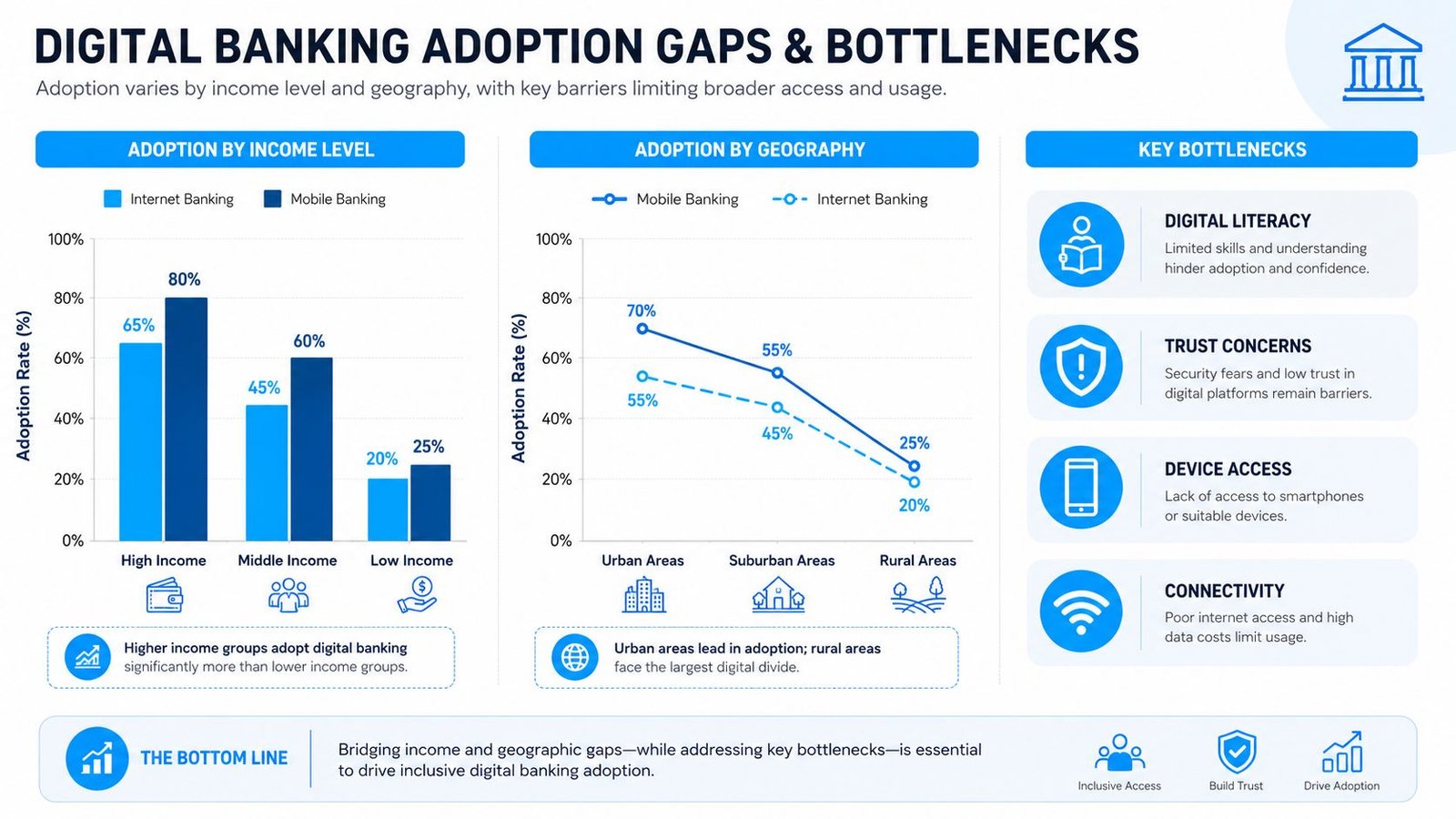
Digital banking adoption varies sharply by income level. World Bank-linked indicators for 2022 show that 87% of adults in high-income countries used internet or mobile banking, compared with 43% in middle-income countries and 19% in low-income countries, according to the internet banking adoption data summary.
The gap reflects more than channel preference. Connectivity, device access, financial-account ownership, digital skills, trust, and the availability of useful transactions all affect adoption. Mature markets have normalized online account access. Developing markets may grow through a mix of internet banking, mobile banking, mobile money, and other payment rails, each with different access and risk conditions.
A World Bank enterprise survey in 2023 found that 43.9% of firms in the sampled set used internet and mobile banking, including direct debit transfer, while 50.6% used mobile money. The comparison indicates that mobile money can provide an entry point into formal digital finance, rather than functioning only as a substitute for a conventional bank app.
Access is only the first bottleneck
Opening an account or downloading an app does not establish usable access. Customers must recognize scams, recover access, interpret payment confirmations, and trust the institution's dispute process. First-time users may struggle with identity verification. Frequent app users face a different problem: social engineering can defeat strong authentication by persuading customers to authorize fraudulent activity.
The IMF reported that digital transactions in emerging market and developing economies more than quadrupled between 2017 and 2024. It also noted that Sub-Saharan Africa added 100 mobile money accounts for every 50 additional deposit accounts per 100 adults, as described in the IMF data brief. This pattern supports a channel-specific adoption strategy. Mobile money may address access constraints, while internet and mobile banking still require different controls for credentials, devices, and transaction approval.
Fraud exposure rises with transaction activity. UK Finance reported that 70% of authorised push payment fraud cases started online in 2025, and its 2026 report recorded APP fraud losses of £576.4 million. These figures should be treated as UK Finance findings, not as evidence from the IMF brief. Inclusion programs therefore need measures for safe completion, recovery, and dispute handling, not registration alone.
Inclusion test: A digital channel is accessible only when customers can use it confidently, recover from mistakes, and obtain fair support when fraud occurs.
UX Design Principles for Internet and Mobile Banking
Channel-specific UX starts with the task, not the device. Internet banking should support detailed review, comparison, document handling, and multi-stage servicing. Mobile banking should prioritize quick comprehension, touch-safe actions, biometric access, and timely alerts without hiding the information required for informed approval.
Design for the channel's strongest advantage
Internet banking benefits from visible account context. Designers can place balances, transaction history, payment instructions, and supporting documents within a coherent workspace. Progressive disclosure helps prevent complex workflows from becoming overwhelming, but critical fees, dates, payees, and confirmation details shouldn't disappear behind unnecessary layers.
Mobile banking requires tighter prioritization. A customer should be able to identify the account, action, amount, recipient, and status without navigating a dense desktop layout. Touch-friendly controls, clear confirmation states, and recovery options matter because a small-screen error can be difficult to diagnose.
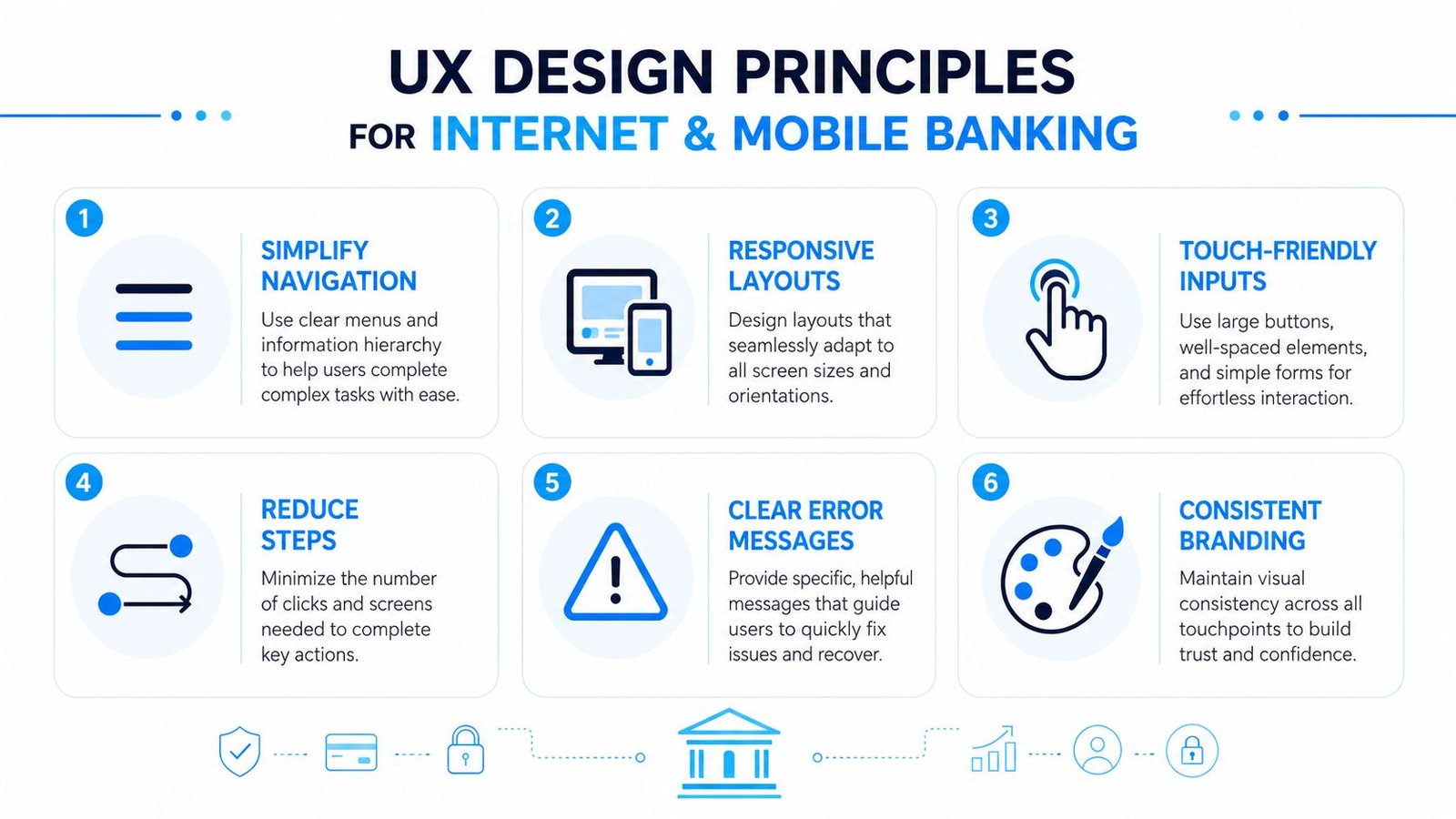
Six practical design rules
- Simplify navigation: Give complex web journeys a visible hierarchy, and keep common mobile actions close to the primary screen.
- Use responsive layouts: A browser experience should adapt across display sizes, while the app should respect platform conventions rather than imitate a desktop site.
- Make inputs touch-friendly: Mobile forms need generous controls, readable labels, and input methods that reduce typing.
- Reduce unnecessary steps: Remove avoidable screens from routine tasks, but retain deliberate review before irreversible payments.
- Write useful errors: “Payment failed” isn't enough. The message should explain what happened and what the customer can do next.
- Keep visual signals consistent: Consistent branding, status language, and confirmation patterns reinforce trust across web and app.
Accessibility must run through both channels. Keyboard navigation, readable contrast, screen-reader support, plain language, and predictable focus behavior aren't optional refinements. They reduce operational friction for customers who use assistive technologies and improve clarity for everyone.
UX rule: Speed is valuable only when the customer can still understand and verify the action.
Product teams should decide feature placement through journey evidence. A complex application may begin on the web and continue in the app for identity confirmation. A routine transfer may begin and end on mobile. The best experience doesn't force channel loyalty. It makes the handoff explicit and preserves state securely.
Strategic Implications for Banking Product and Operations Teams
Banks and fintech companies should stop managing internet and mobile banking as one undifferentiated roadmap. Product teams need separate channel strategies, shared journey ownership, and a common service architecture that allows each interface to exploit its strengths.
A workable operating model assigns responsibility across three dimensions:
- Product teams prioritize journeys by channel fit. Web receives investment for complex servicing and information-rich workflows, while mobile receives investment for frequent actions, device capabilities, and real-time engagement.
- Risk and compliance teams maintain channel-specific threat models, authentication policies, fraud signals, and incident playbooks. Shared identity services should support both channels without erasing their distinct risks.
- Operations teams measure completion, support demand, authentication failure, fraud outcomes, recovery time, and customer complaints separately. A mobile session count or web conversion rate isn't enough to explain channel health.
The distinction also matters as financial institutions expand embedded finance strategies. Banking capabilities delivered inside partner journeys may inherit mobile, browser, API, and third-party risks simultaneously. Channel ownership must therefore extend beyond the bank's own app and website.
The strongest roadmap asks four questions before approving a feature: Which channel best fits the task? What new attack surface does the feature create? How will customers recover from failure? Which operational team owns the outcome?
Vaira's View helps banking, finance, fintech, and technology professionals understand practical developments in AI, digital banking, cybersecurity, risk technology, and future careers. Visit Vaira's View for research-driven analysis that connects banking technology decisions with professional skills and industry change.
Pingback: multi asset trading platforms