
Compliance risk in banking is the risk that a bank or other financial institution will face legal or regulatory sanctions, material financial loss, or reputational damage because it fails to comply with laws, regulations, rules, standards, or codes of conduct. That core definition comes from the Basel Committee's guidance on Compliance and the compliance function in banks, and it remains one of the clearest starting points for understanding how this risk works in practice.
In simple terms, compliance risk in banking appears when a bank knows, or should know, what the rules require, but its people, systems, processes, products, or third parties do not consistently meet those requirements. A missed KYC refresh, an unresolved sanctions alert, a misleading disclosure, a vendor data-sharing issue, or an ungoverned AI decision can all create exposure.
This matters because compliance risk is not just a legal problem. It can affect revenue, growth plans, supervisory relationships, customer trust, and the bank's ability to launch products or enter new markets. As the Basel Committee notes, the risk includes sanctions, financial loss, and reputational harm, not just formal rule breaches.
Key Takeaways
How Compliance Risk Is Measured and Reported
The Future of Compliance Risk and Key Takeaways
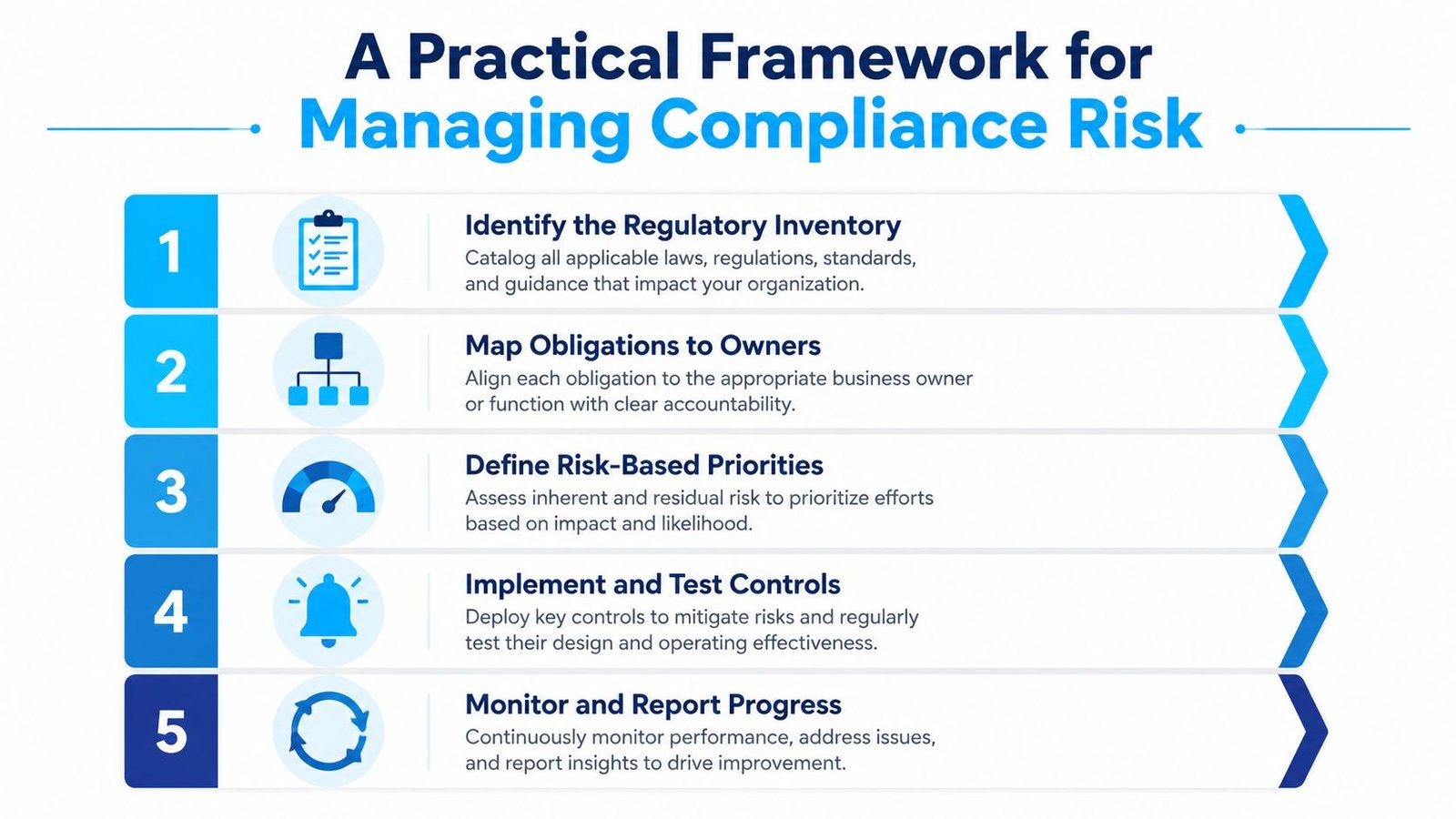
5. Monitor and report progress
4. Automate and test repeatable controls
3. Define risk-based priorities
1. Identify the regulatory inventory
A Practical Framework for Managing Compliance Risk
Governance makes the controls durable
Controls and Frameworks That Reduce Exposure
Turning indicators into decisions
Technology creates new control questions
Emerging Sources Banks Often Underestimate
The Main Sources of Compliance Risk
- Compliance risk in banking is the risk of sanctions, financial loss, or reputational damage caused by failure to follow applicable laws, regulations, rules, standards, or codes of conduct.
- It is different from credit, market, and operational risk, although it often overlaps with all three.
- Common sources include AML and KYC, sanctions, conduct, consumer protection, privacy, FATCA/CRS, outsourcing, and AI governance.
- Banks need to distinguish between a compliance failure, a control failure, and a regulatory breach because the response and severity may differ.
- Effective management depends on clear ownership, tested controls, strong reporting, issue escalation, and board oversight.
- Emerging risks now include AI models, cloud dependencies, ICT third-party concentration, cross-border data rules, DORA, and the EU AI Act.
Basel banking guidance on compliance risk
Why Compliance Risk Matters to Financial Institutions
Compliance risk compared with other banking risks
What Compliance Risk Actually Means in Banking
Table of Contents
- Key Takeaways
- What Is Compliance Risk in Banking?
- Why Compliance Risk in Banking Matters
- Main Types of Compliance Risk in Banking
- Compliance Risk Examples in Banking
- 1. Incomplete beneficial ownership at onboarding
- 2. Missed sanctions alert before payment release
- 3. Unfair outcome from an automated lending model
- 4. Misleading product disclosure
- 5. Vendor changes a data-retention process
- 6. FATCA or CRS classification error
- 7. Cross-border data transfer without proper review
- Emerging Compliance Risks Banks Often Underestimate
- How Banks Measure Compliance Risk
- Controls and Frameworks That Reduce Compliance Risk
- A Practical Five-Step Framework for Managing Compliance Risk
- FAQ: Compliance Risk in Banking
- What is compliance risk in banking?
- What are examples of compliance risk?
- What is the difference between compliance risk and operational risk?
- What are the main types of compliance risk?
- How do banks measure compliance risk?
- How can banks reduce compliance risk?
- Who is responsible for compliance risk in a bank?
- How does AI create compliance risk for banks?
- Conclusion
What Is Compliance Risk in Banking?
The Basel Committee defines compliance risk as the risk of legal or regulatory sanctions, material financial loss, or loss to reputation a bank may suffer because it fails to comply with applicable laws, regulations, rules, related self-regulatory standards, and codes of conduct. The most widely cited official banking source is the Basel Committee's 2005 paper, Compliance and the compliance function in banks. The earlier 2003 consultative paper was later superseded by the final version at the Bank for International Settlements.
That definition is broad on purpose. In banking, compliance risk does not only arise when a regulator imposes a fine. It can also arise when the bank cannot show that it identified its obligations, assigned accountability, designed appropriate controls, and responded to warning signs in time.
For example, imagine a bank onboarding a new commercial customer. The front line collects incorporation documents, but beneficial ownership information is incomplete. The account is opened before sanctions screening is fully resolved, and a payment later touches a restricted counterparty. The original problem may look small, but it could involve failures in KYC, screening, escalation, workflow sequencing, and recordkeeping.
A practical working definition is this:
Compliance risk in banking is the possibility that a bank's people, systems, processes, products, or third parties fail to meet an applicable obligation, creating legal, financial, operational, or reputational consequences.
Compliance risk compared with operational, credit, and market risk
Compliance risk is its own risk category, but it often overlaps with other bank risks.
| Risk type | Core question | Typical example | How it overlaps with compliance risk |
|---|---|---|---|
| Credit risk | Will a borrower repay? | A borrower defaults after poor underwriting | Weak customer due diligence can undermine both lending quality and regulatory compliance |
| Market risk | Could changes in prices, rates, or spreads reduce value? | A trading desk loses value during volatility | Misconduct, market abuse, or unsuitable trading activity can create both market and compliance consequences |
| Operational risk | Could people, processes, systems, or external events cause failure? | A screening engine fails after a system change | The same incident may be an operational breakdown and a compliance failure |
| Compliance risk | Did the bank follow applicable obligations and conduct standards? | A sanctions alert is not resolved before payment release | The result may include fines, restrictions, remediation, and reputational harm |
This distinction matters because not every process failure is a compliance issue, and not every compliance issue starts with a bad legal interpretation. Many begin as operational weaknesses that leave the bank unable to meet a regulatory requirement consistently.
Compliance failure vs control failure vs regulatory breach
These terms are often used loosely, but they are not identical.
- Compliance failure: The institution did not meet an internal or external compliance requirement. Example: a KYC review was required but not completed on time.
- Control failure: A control designed to prevent or detect a problem did not work as intended. Example: the KYC workflow allowed account opening even though beneficial ownership fields were incomplete.
- Regulatory breach: The facts amount to a breach of law, rule, regulation, or supervisory requirement. Example: prohibited payments were processed in violation of sanctions requirements.
A single event can involve all three, but not always.
For instance, a missed customer-risk review may be a compliance failure. If the system should have blocked the process but did not, that is also a control failure. If the omission results in a violation of a regulatory requirement, it may become a regulatory breach. This distinction helps banks prioritize remediation, root-cause analysis, escalation, and reporting.
Why Compliance Risk in Banking Matters
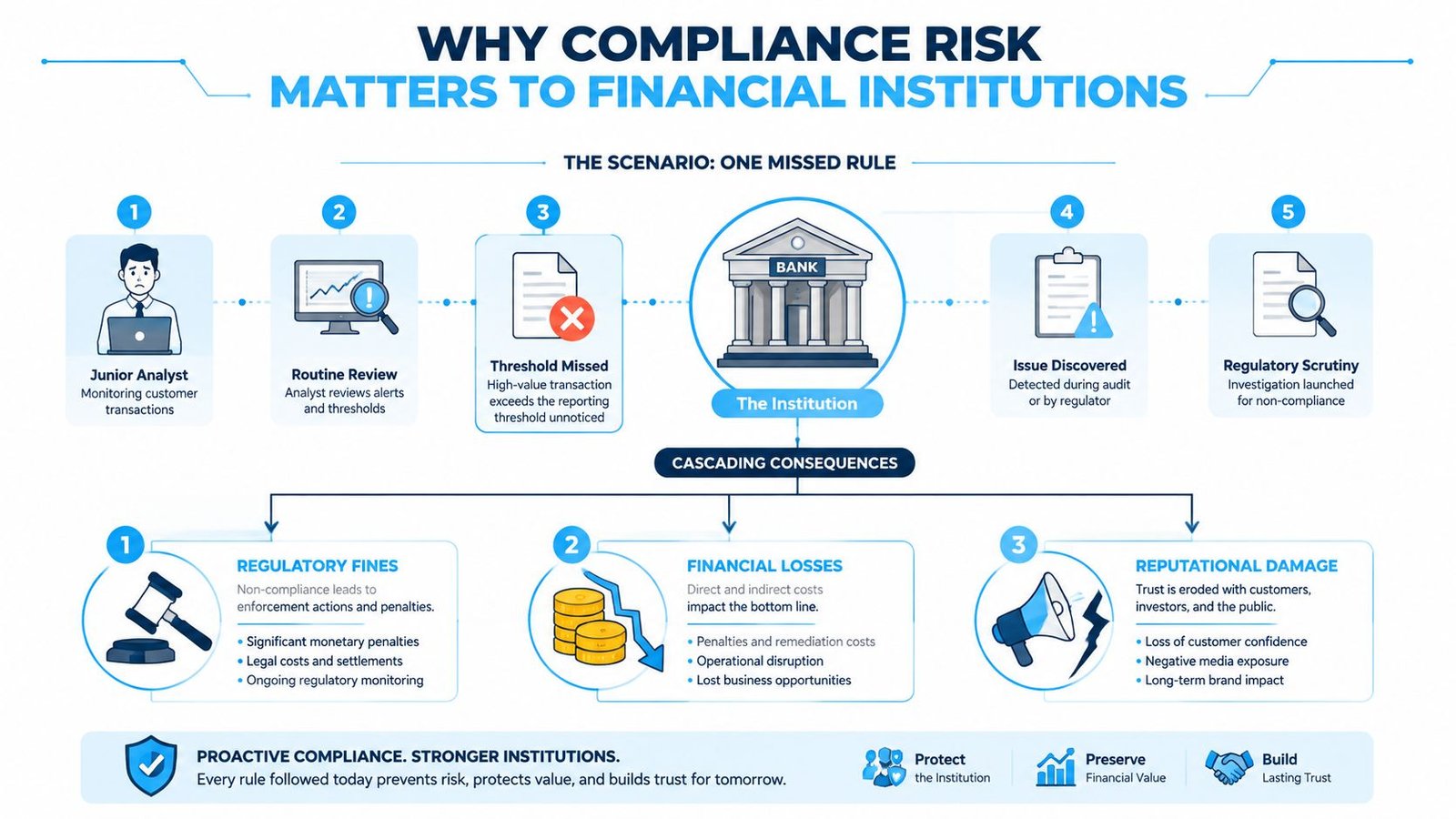
Compliance risk in banking matters because even a narrow failure can spread quickly across products, customers, jurisdictions, and regulators.
A transaction-monitoring alert that is not reviewed on time may lead to a missed suspicious activity escalation. A weak disclosure process may produce customer complaints, conduct findings, and remediation costs. A third-party data issue may trigger privacy, outsourcing, and operational resilience concerns at the same time.
The consequences usually fall into three broad categories:
Direct financial cost
This can include fines, remediation programs, legal costs, consultant reviews, customer compensation, and replacement of weak controls.Supervisory and strategic impact
Regulators may require enhanced reporting, independent reviews, restrictions on new business, or changes to governance. These responses can consume management capacity and delay growth.Reputational damage
Customers, counterparties, investors, and employees may lose confidence in the institution's risk management and judgment.
This is why supervisors expect banks to maintain effective compliance risk management programs tailored to their size, complexity, and geographic footprint. The Federal Reserve's official guidance on Compliance Risk Management Programs and Oversight at Large Banking Organizations with Complex Compliance Profiles states that banking organizations should have effective compliance risk management programs suited to their risk profiles.
Enforcement trends also show why boards treat this area seriously. Wolters Kluwer's Regulatory Violations Intelligence Index reported 199 violations in H1 2024, up from 136 in H2 2023, while total penalties in H1 2024 were $1.876 billion, down from $7.977 billion in the prior half-year period. The same analysis reported 132 financial violations in H1 2024, compared with 58 in H2 2023 (official release). Those figures do not prove a single global trend, but they do show that compliance failures continue to generate frequent enforcement activity.
For another example of how recurring these issues can be, reporting on the Reserve Bank of India's FY25 annual report noted that the RBI imposed 353 monetary penalties totaling ₹54.78 crore on regulated entities for contraventions and non-compliance across areas such as KYC, cyber security, fraud reporting, and exposure norms (Economic Times coverage of the annual report figures).
Main Types of Compliance Risk in Banking
The main types of compliance risk in banking often sit inside routine business activity. A customer is onboarded, a payment is processed, a product is sold, data is shared with a vendor, or an AI tool ranks applicants. Each step can trigger a different regulatory obligation.
| Risk category | Typical rule or regime | Banking example | Main exposure |
|---|---|---|---|
| AML and KYC | Customer due diligence, ongoing monitoring, suspicious activity controls | A bank opens an account with incomplete beneficial ownership information and does not refresh the file after the customer's risk changes | Enforcement action, remediation, monitoring obligations |
| Sanctions | Restricted-party and jurisdictional controls | A payment is released because a screening rule produced a false negative that nobody investigated | Penalties, blocked transactions, investigation costs |
| Conduct and market abuse | Market conduct rules, product governance, internal codes | Staff pressure customers into unsuitable products or misuse inside information | Compensation, enforcement, reputational harm |
| Consumer protection and fair lending | Fair treatment, disclosures, fair lending, complaint handling | Disclosures are unclear, fees are misapplied, or lending outcomes are inconsistent | Customer remediation, complaints, litigation, supervisory scrutiny |
| Data privacy and protection | Privacy, data access, retention, consent, cross-border transfer rules | Customer data is shared with a service provider without proper governance or retention limits | Regulatory investigation, breach response, loss of trust |
| Tax transparency | FATCA and CRS classification and reporting | A customer is incorrectly classified and reportable account data is submitted inaccurately | Reporting corrections, penalties, operational rework |
| Third-party and outsourcing risk | Outsourcing, vendor oversight, contractual and monitoring requirements | A cloud or fintech provider changes a process that affects screening, data handling, or controls | Indirect control gaps, service disruption, supervisory concern |
| AI and technology governance | Model governance, explainability, data governance, security, bias controls | An automated credit model uses data that the bank cannot adequately explain or validate | Discrimination risk, audit findings, regulatory intervention |
These are not isolated buckets. A weak onboarding process can simultaneously affect AML, sanctions, privacy, outsourcing, and product-risk assessments. That is why mature banks map obligations to the customer journey, data flows, systems, and accountable owners, not just to legal topics.
Compliance Risk Examples in Banking
Below are concise, real-world-style scenarios that show how compliance risk in banking appears in day-to-day operations.
1. Incomplete beneficial ownership at onboarding
A corporate customer opens an account before all beneficial owners are verified. The bank later discovers ownership links to a higher-risk jurisdiction. This creates AML, KYC, and screening exposure.
2. Missed sanctions alert before payment release
A payment-screening rule generates a possible sanctions match, but the alert sits unresolved in a backlog and the transfer is released. The issue began as an alert-management weakness and may end as a sanctions breach.
3. Unfair outcome from an automated lending model
An AI-based decision tool ranks similar applicants differently, and the bank cannot explain which variables caused the result. That raises fair lending, model governance, and documentation concerns.
4. Misleading product disclosure
A retail banking product is marketed with language that understates fees or overstates likely returns. Even if the legal documentation exists, poor presentation can still create conduct and consumer-protection risk.
5. Vendor changes a data-retention process
A third-party service provider modifies how long customer documents are stored, but the bank is not told in time. This can create privacy, outsourcing, and recordkeeping issues.
6. FATCA or CRS classification error
A reportable customer account is tagged incorrectly, so the institution submits inaccurate tax-reporting information. The result may be corrections, regulator questions, and expensive manual review.
7. Cross-border data transfer without proper review
A bank centralizes compliance operations across regions but transfers personal data into another jurisdiction without assessing local transfer restrictions or retention requirements. This creates privacy and governance risk, even if the original business reason was operational efficiency.
Emerging Compliance Risks Banks Often Underestimate
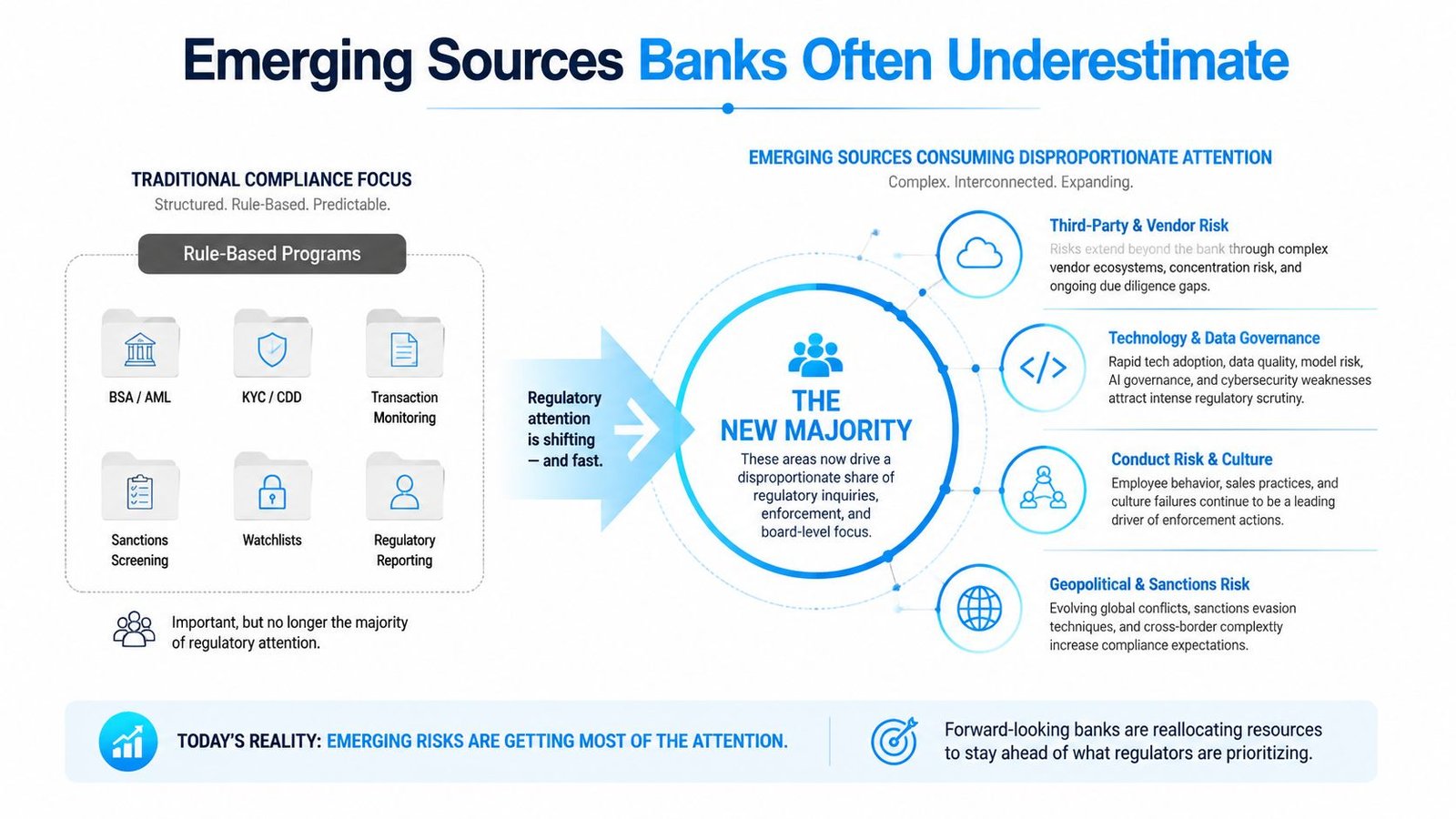
Traditional compliance programs were built for relatively stable rules, clearly owned internal processes, and slower product change. That environment is disappearing.
Banks now depend on cloud services, fintech partners, shared data environments, cross-border operating models, and AI-assisted decision tools. These dependencies increase speed and scale, but they also make responsibility harder to trace.
AI governance and explainability
AI creates compliance risk when a bank cannot show what data a model used, why an outcome was produced, how performance is monitored, and who approves changes. This matters most when AI influences customer access, pricing, fraud controls, monitoring, or investigation workflows.
The EU AI Act is especially relevant here. The European Commission's overview of the AI Act treats certain uses of AI in financial services as high-risk, including AI used to evaluate the creditworthiness of natural persons or establish their credit score. High-risk systems face obligations around risk management, data governance, documentation, transparency, human oversight, and robustness.
For banks, the compliance question is not just whether AI improves efficiency. It is whether the institution can govern training data, explain outputs, document intended use, monitor drift, manage overrides, and prove effective human oversight.
Cloud and ICT third-party concentration
Banks increasingly rely on a small number of cloud and technology providers for critical services. This creates outsourcing risk, resilience risk, and compliance risk if contracts, monitoring, exit planning, and data controls are weak.
In the EU, the Digital Operational Resilience Act (DORA) applies from 17 January 2025 and requires financial entities to manage ICT third-party risk as part of their broader ICT risk management framework. DORA also requires a complete, up-to-date register of information on contractual arrangements with ICT third-party service providers and establishes oversight for critical ICT third-party providers (EBA DORA oversight page).
Even for institutions outside the EU, DORA is a useful signal. Regulators increasingly expect banks to know which vendors support critical functions, what data they process, how disruptions are escalated, and how concentration risk is managed.
Cross-border data and multi-jurisdiction requirements
One customer relationship can involve local banking rules, sanctions, privacy laws, tax reporting, outsourcing requirements, and data localization expectations in multiple countries. A control that works in one market may not transfer cleanly into another.
This is especially important when compliance operations are centralized across borders, when customer data is processed in shared platforms, or when investigations use tools hosted in another jurisdiction.
Third-party visibility gaps
Banks may perform due diligence on a direct vendor but still have limited visibility into subcontractors, model providers, analytics platforms, or external data suppliers. That creates blind spots in screening, recordkeeping, data protection, resilience, and incident response.
Kiteworks' 2025 annual survey report highlights third-party and compliance-management weaknesses across organizations, which reinforces a broader point for banking teams: vendor oversight often looks stronger on paper than in end-to-end practice.
Regulatory complexity itself is a risk driver
PwC's Global Compliance Survey 2025 found that 85% of respondents said compliance requirements had become more complex over the previous three years, and 47% said the complexity of regulation itself is what makes compliance more challenging. For banks, this means policy updates alone are not enough. Institutions need operating models that can absorb fast-moving rule change without losing clarity, ownership, or evidence.
For fintech leaders evaluating embedded finance models, the compliance perimeter should include the bank, the platform, the data flow, the customer journey, and the responsibility matrix, not just the licensed entity named in the contract.
How Banks Measure Compliance Risk
Banks do not measure compliance risk by counting policies. They measure it by assessing whether obligations are understood, controls are working, issues are being fixed, and exposure is increasing or decreasing over time.
A useful compliance-risk measurement approach normally combines:
- Inherent risk assessment, based on products, customers, geographies, channels, and regulatory exposure
- Control assessment, based on the design and operating effectiveness of key controls
- Issue and incident analysis, based on findings, breaches, complaints, near misses, and root causes
- Management information, based on KRIs, KCIs, thresholds, and trend reporting
- Independent assurance, based on testing, second-line oversight, and internal audit
Banks also need clear escalation thresholds. A metric only becomes useful when it changes a management decision.
Useful KRIs and KCIs
Key Risk Indicators (KRIs) provide early warning signals. They show where pressure may be building before a confirmed breach occurs.
Key Compliance Indicators (KCIs) focus more directly on compliance outcomes, such as regulatory findings, repeat issues, or customer remediation.
| Indicator | Type | What it measures | Why it matters |
|---|---|---|---|
| Transaction-monitoring alerts | KRI | Alert volumes, backlog size, ageing, escalation quality, closure times | Large or ageing backlogs may suggest coverage or capacity weaknesses |
| KYC refresh backlog | KRI | Number of overdue or incomplete periodic reviews | Indicates whether customer due diligence remains current |
| Sanctions screening exceptions | KRI | Unresolved matches, false-negative analysis, override rates | Highlights potential payment and screening exposure |
| Training completion and assessment scores | KRI | Completion rates for mandatory training and understanding checks | Reveals whether front-line staff can apply required rules |
| Issue ageing | KRI/KCI | How long audit, compliance, or regulatory findings remain open | Aging issues often signal weak ownership or inadequate remediation |
| Customer complaints | KRI/KCI | Volume, themes, escalation rates, repeat issues | Can reveal conduct, disclosure, or fair-treatment problems early |
| Confirmed breaches or reportable events | KCI | Actual policy breaches, legal breaches, and reportable incidents | Measures realized compliance outcomes |
| Third-party due diligence coverage | KRI | Percentage of vendors assessed by risk tier, monitoring status, overdue reviews | Shows how much outsourced exposure is actually under oversight |
| Control testing results | KCI | Pass or fail rates for key preventive and detective controls | Connects compliance reporting to control effectiveness |
| Remediation timeliness | KCI | Whether action plans meet agreed deadlines | Shows whether the institution closes known gaps promptly |
In better-run programs, dashboards also show:
- the business line or legal entity affected
- the accountable executive and operational owner
- the threshold for escalation
- the target remediation date
- whether the issue is repeat or systemic
- whether a third party, model, or cross-border dependency is involved
The Basel Committee's BCBS 239 principles for effective risk data aggregation and risk reporting are relevant here because compliance oversight depends on accurate, complete, timely, and adaptable risk data. If a bank cannot trust its data, it cannot reliably measure compliance exposure.
The LSEG overview of compliance risk management is also useful for explaining the underlying mechanics: institutions need to identify obligations, map them to products and processes, and test whether the controls tied to those obligations operate effectively.
Controls and Frameworks That Reduce Compliance Risk
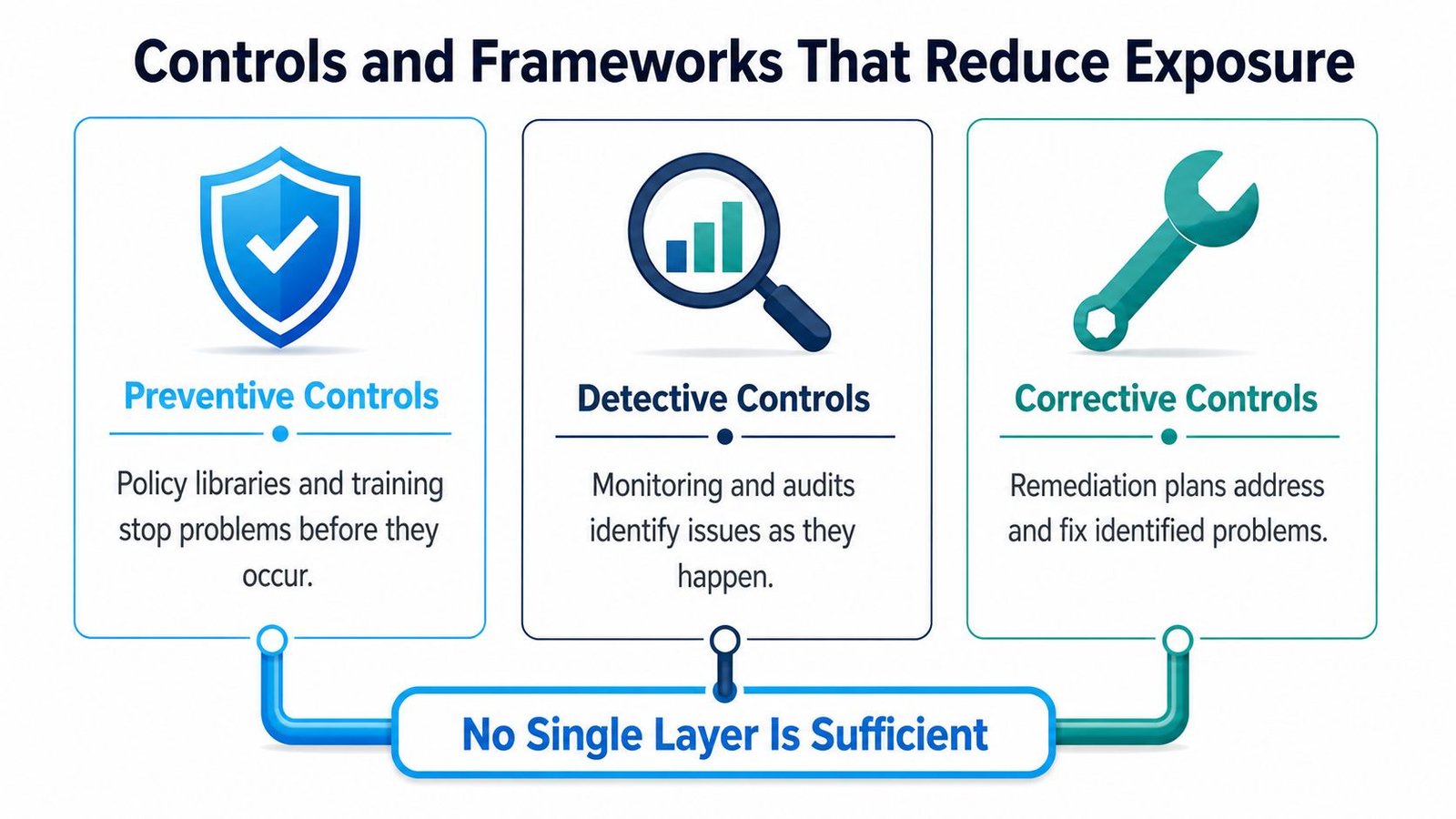
A strong compliance program uses multiple layers of control. No single policy, tool, or committee can reduce compliance risk on its own.
Preventive controls
Preventive controls are designed to stop problems before they happen.
Examples include:
- customer due diligence at onboarding
- sanctions screening before payment execution
- product-approval gates
- access controls and segregation of duties
- mandatory staff training
- disclosure templates and approval workflows
- model approval processes for AI and automated decisions
A simple banking example is a new product committee refusing launch until disclosures, complaints handling, monitoring rules, and jurisdiction-specific obligations are documented.
Detective controls
Detective controls identify problems that have happened or are beginning to happen.
Examples include:
- transaction monitoring
- surveillance and exception reporting
- compliance testing
- monitoring of complaints and escalations
- internal audit reviews
- horizon scanning for regulatory change
- monitoring of vendor performance and incidents
A sanctions-screening alert queue is a detective control. It only works if alerts are meaningful, analysts are trained, and escalation routes are clear.
Corrective controls
Corrective controls address known weaknesses and reduce the chance of recurrence.
Examples include:
- root-cause analysis
- customer remediation
- system fixes and rule tuning
- policy updates
- disciplinary action where appropriate
- validation testing after remediation
If a bank clears an alert backlog but does not fix the rule logic, staffing model, or governance gap that caused it, the risk remains.
Governance controls
Governance controls make the other control layers durable.
Examples include:
- an independent compliance function
- board and committee reporting
- documented escalation standards
- issue-management workflows
- evidence retention
- compliance risk appetite statements
- formal ownership for policies, controls, and remediation actions
Why governance and the three lines model matter
The three lines model helps banks assign responsibility clearly:
- First line: Business and operations own day-to-day compliance within their processes and products.
- Second line: Compliance and risk functions provide oversight, guidance, challenge, and monitoring.
- Third line: Internal audit provides independent assurance on whether the framework is designed and operating effectively.
Without this structure, banks often create duplicated testing, unclear ownership, or gaps between legal interpretation and operational execution.
Frameworks can also help organize the program. The Basel Committee's compliance guidance remains central for banks, while COSO is often used to structure internal control thinking more broadly. For compliance-management systems outside strict banking guidance, ISO 19600 has been superseded by ISO 37301, which many organizations use as a reference point.
Technology can support this model, but it cannot replace accountability. A GRC platform may help track obligations, controls, evidence, and issues. AI may help classify regulatory text or prioritize alerts. But management still needs human review, access controls, model governance, and a defensible audit trail.
For institutions connecting compliance with broader cybersecurity in banking, the control design should link identity management, incident response, third-party oversight, data protection, and regulatory reporting.
A Practical Five-Step Framework for Managing Compliance Risk
Banks and fintechs often understand the theory of compliance risk better than the implementation. A practical framework helps turn principles into operating discipline.
1. Identify the regulatory inventory
Start by identifying the obligations that apply to the institution's products, services, customers, jurisdictions, and channels.
Do not try to document every rule at the same level of depth on day one. Begin with high-impact areas such as:
- AML and KYC
- sanctions
- consumer protection
- privacy and data governance
- tax reporting
- outsourcing and third-party oversight
- AI and model governance
Output: a prioritized inventory of obligations linked to business activities.
2. Map obligations to owners, processes, systems, and evidence
Each priority obligation should connect to:
- the business process it affects
- the key control or controls
- the system or workflow where it operates
- the accountable executive
- the operational owner
- the testing approach
- the evidence location
This is where many banks discover ownership gaps. If compliance assumes operations owns the control, and operations assumes technology owns it, the mapping exercise has already exposed risk.
Output: an obligation-to-control map with named accountability.
3. Define risk-based priorities and thresholds
Not every obligation carries the same impact. Rank them using criteria such as:
- legal and regulatory severity
- customer impact
- financial and remediation cost
- cross-border complexity
- reliance on third parties
- data sensitivity
- degree of automation
- speed of detection
- likelihood of repeat failure
Set thresholds for escalation. For example, if KYC backlogs exceed a defined level in high-risk customer segments, management review should be automatic.
Output: a risk-ranked view of exposure, with trigger points for escalation.
4. Automate repeatable controls, then test them
Automation can help with sanctions screening, case routing, evidence collection, regulatory change tracking, attestations, and workflow enforcement. But automation only helps when the logic is governed and tested.
Key implementation questions include:
- Does the workflow block incomplete mandatory steps?
- Are overrides logged and reviewed?
- Is model or rule change approval documented?
- Can the bank evidence who did what, when, and why?
- Are control outputs tested for completeness and accuracy?
The AI risk management software guide is relevant to teams evaluating how technology can support oversight, especially where AI-assisted controls require validation and accountability.
Output: repeatable controls supported by evidence and periodic testing.
5. Monitor, escalate, remediate, and learn
Reporting should not only describe exposure. It should drive decisions.
Management information should show:
- open issues and ageing
- failed control tests
- KRIs and KCIs against thresholds
- vendor dependencies
- complaint trends
- emerging regulatory changes
- overdue remediation actions
- decisions required from leadership
After incidents, perform root-cause analysis. Ask whether the problem came from legal interpretation, weak design, lack of training, system failure, poor governance, or third-party dependency.
Output: a live compliance-risk-management cycle, not a static documentation set.
A practical next-quarter checklist could look like this:
- Refresh the inventory: confirm the highest-impact obligations and the products or processes they affect.
- Review ownership: assign one accountable executive and one operational owner for each priority area.
- Test critical controls: focus on controls where failure could affect customers, payments, disclosures, sanctions, or regulatory reporting.
- Assess third parties: trace important data and control dependencies beyond the bank's own perimeter.
- Set deadlines and escalations: move overdue issues to the right governance forum quickly.
FAQ: Compliance Risk in Banking
What is compliance risk in banking?
Compliance risk in banking is the risk that a bank will face legal or regulatory sanctions, financial loss, or reputational damage because it fails to comply with applicable laws, regulations, rules, standards, or codes of conduct.
What are examples of compliance risk?
Common examples include incomplete KYC files, missed sanctions alerts, misleading product disclosures, privacy failures involving customer data, weak third-party oversight, and unfair outcomes from automated lending systems.
What is the difference between compliance risk and operational risk?
Operational risk focuses on failures in people, processes, systems, or external events. Compliance risk focuses on failure to meet applicable obligations. The two often overlap because an operational failure can cause a compliance failure.
What are the main types of compliance risk?
The main types include AML and KYC risk, sanctions risk, conduct and market-abuse risk, consumer-protection risk, data-privacy risk, FATCA/CRS reporting risk, third-party and outsourcing risk, and AI or technology-governance risk.
How do banks measure compliance risk?
Banks measure compliance risk using inherent-risk assessments, control testing, KRIs, KCIs, issue ageing, customer complaints, KYC backlogs, transaction-monitoring alerts, sanctions exceptions, third-party oversight metrics, and independent assurance.
How can banks reduce compliance risk?
Banks reduce compliance risk by identifying obligations clearly, assigning ownership, designing preventive and detective controls, testing those controls, tracking remediation, training staff, governing third parties, and escalating issues through the right committees.
Who is responsible for compliance risk in a bank?
Responsibility is shared across the three lines model. Business teams own day-to-day compliance, compliance and risk functions provide oversight and challenge, internal audit provides independent assurance, and the board oversees the overall framework.
How does AI create compliance risk for banks?
AI creates compliance risk when banks cannot explain decisions, validate data sources, monitor outcomes, control model changes, prevent biased results, or document human oversight. In some cases, such as creditworthiness assessment in the EU, AI can also trigger specific regulatory obligations under the EU AI Act.
Conclusion
Compliance risk in banking is no longer a narrow legal topic. It is a practical enterprise risk that sits inside onboarding, payments, lending, surveillance, outsourcing, data governance, and AI-enabled decision-making.
The banks that manage it well do not rely only on long policy libraries. They build clear ownership, strong controls, reliable data, escalation thresholds, and evidence that shows the framework works in practice.
That is the real goal of compliance risk in banking: not just to avoid fines, but to run products, processes, and technology in a way that is defensible, consistent, and trustworthy across jurisdictions.
A useful next step is to review your highest-impact obligations, map them to control owners, and test whether the controls actually work under real operating conditions.
Vaira's View publishes practical, research-driven analysis on AI, banking, finance, fintech, careers, and professional technology. Visit Vaira's View for clear guides on risk and compliance technology, AI in financial services, cybersecurity, and the skills professionals need as banking controls evolve.
Pingback: What Is Nostro? the Banking Account Powering Global Payments