
A nostro account is a domestic bank's current account held at a foreign correspondent bank, usually in the foreign bank's local currency, to settle cross-border payments and manage foreign-currency liquidity. It's the account a bank uses when it needs to move money internationally without maintaining a branch in every market.
A new banking analyst often encounters the term while reviewing a payment investigation, a correspondent statement, or a reconciliation break. The account may look like an ordinary cash account, but its role is more specialized. It connects a bank's internal payment operations to another institution's clearing access, foreign-currency liquidity, and settlement processes.
The central question behind what is nostro isn't only “where is the account?” It's also “whose account is it, which bank controls the balance, and how does the balance support a payment?” Those distinctions explain why nostro accounts remain important, why they create operational work, and why changes in correspondent banking are reshaping global payment infrastructure.
Table of Contents
- Understanding Nostro Accounts in Global Banking
- Nostro vs Vostro Accounts Explained
- How Cross-Border Payments Flow Through Nostro Accounts
- Liquidity Management and Cost Trade-Offs
- The Decline of Correspondent Banking Relationships
- Reconciliation Challenges in Nostro Operations
- The Future of Nostro Accounts in Modern Payments
Understanding Nostro Accounts in Global Banking
A mid-sized corporate in Germany needs to pay a supplier in Japan in yen. The German company's bank may serve the customer well in its domestic market, yet it might not maintain a branch or direct clearing operation in Tokyo. To complete the payment, the German bank can hold a yen nostro account with a Japanese correspondent bank.
The Japanese correspondent maintains the account on its books, but the German bank owns the funds. When the German bank receives the customer's payment instruction, it can use the yen balance to settle the supplier payment through the relevant local banking channels. The arrangement lets the German bank provide international payment and trade-finance services without constructing its own overseas branch network.
The European Central Bank's explanation of nostro and vostro reporting reinforces the accounting perspective. A nostro account is the respondent bank's current account at a correspondent bank in a foreign market. The respondent bank uses it for customer payments and liquidity management, while the correspondent bank provides and administers the account.
Why the owner's viewpoint matters
“Nostro” comes from the Latin word for ours. In operational language, it means “our account with you.” The phrase is relative, so the bank that owns the money calls the account nostro even though another institution physically holds the account and processes entries.
That viewpoint determines the account's economic meaning. For the owner bank, the balance is an asset, representing foreign-currency liquidity that can support client payments, foreign-exchange settlements, and trade-finance obligations. The balance isn't the correspondent's money just because it sits on the correspondent's ledger.
Practical rule: Identify the bank that owns the balance before labeling an account nostro or vostro.
Nostro accounts became the core operating mechanism behind correspondent banking for cross-border payments and trade finance. The arrangement is bilateral and ongoing, rather than a one-time transfer between unrelated institutions. That continuing relationship supports payment instructions, account statements, liquidity planning, and settlement controls.
The term therefore describes more than a foreign bank account. It describes the owner bank's position inside a correspondent network. The same relationship receives a different name when the correspondent bank records it from its own perspective.
Nostro vs Vostro Accounts Explained
Nostro and vostro are two descriptions of the same underlying account. The difference comes from the speaker's position. Bank A calls its account at Bank B a nostro account. Bank B calls the account it holds for Bank A a vostro account.
Suppose HSBC London holds a USD account at JPMorgan New York. HSBC London refers to that balance as its USD nostro account, meaning its money held with JPMorgan. JPMorgan refers to the same account as a vostro account, meaning the account belonging to another bank that JPMorgan holds on its books.
| Attribute | Nostro, Account-Holding Bank's View | Vostro, Correspondent Bank's View |
|---|---|---|
| Meaning | “Our account with you” | “Your account with us” |
| Account owner | The bank that owns and deploys the balance | The foreign bank whose funds are being held |
| Ledger treatment | An asset, generally cash or a claim on the correspondent | A liability owed to the respondent bank |
| Operational use | Foreign-currency payments, liquidity, and settlement | Maintaining the respondent bank's account and recording movements |
| Example | HSBC London's USD account at JPMorgan New York | JPMorgan's record of HSBC London's USD funds |
The IMF's correspondent-banking framework describes the arrangement as a current account provided by one bank to another. The respondent bank uses the account for customer payments and liquidity management, while the correspondent bank provides the account. That division of roles is why the same balance appears differently in each institution's accounting records.
Why analysts need both labels
The distinction matters during payment investigations. A statement from the correspondent may describe a credit to a vostro account, while the respondent's internal ledger records a debit or credit on its nostro. Analysts must map both labels to the same bilateral relationship before deciding whether a payment is missing, delayed, or misposted.
The same discipline applies when interpreting SWIFT payment messages and reconciling correspondent statements such as MT940 or MT950. A third bank referring to an account may use loro, meaning “theirs,” because the account belongs to another institution and is held by the correspondent. These terms aren't different pools of money. They're viewpoints used to describe ownership and custody.
The nostro and vostro accounting overview also highlights the balance-sheet relationship. The owning bank treats the balance as an asset, while the holding bank records the corresponding obligation. Accurate mapping protects reconciliation, settlement reporting, and dispute resolution.
How Cross-Border Payments Flow Through Nostro Accounts
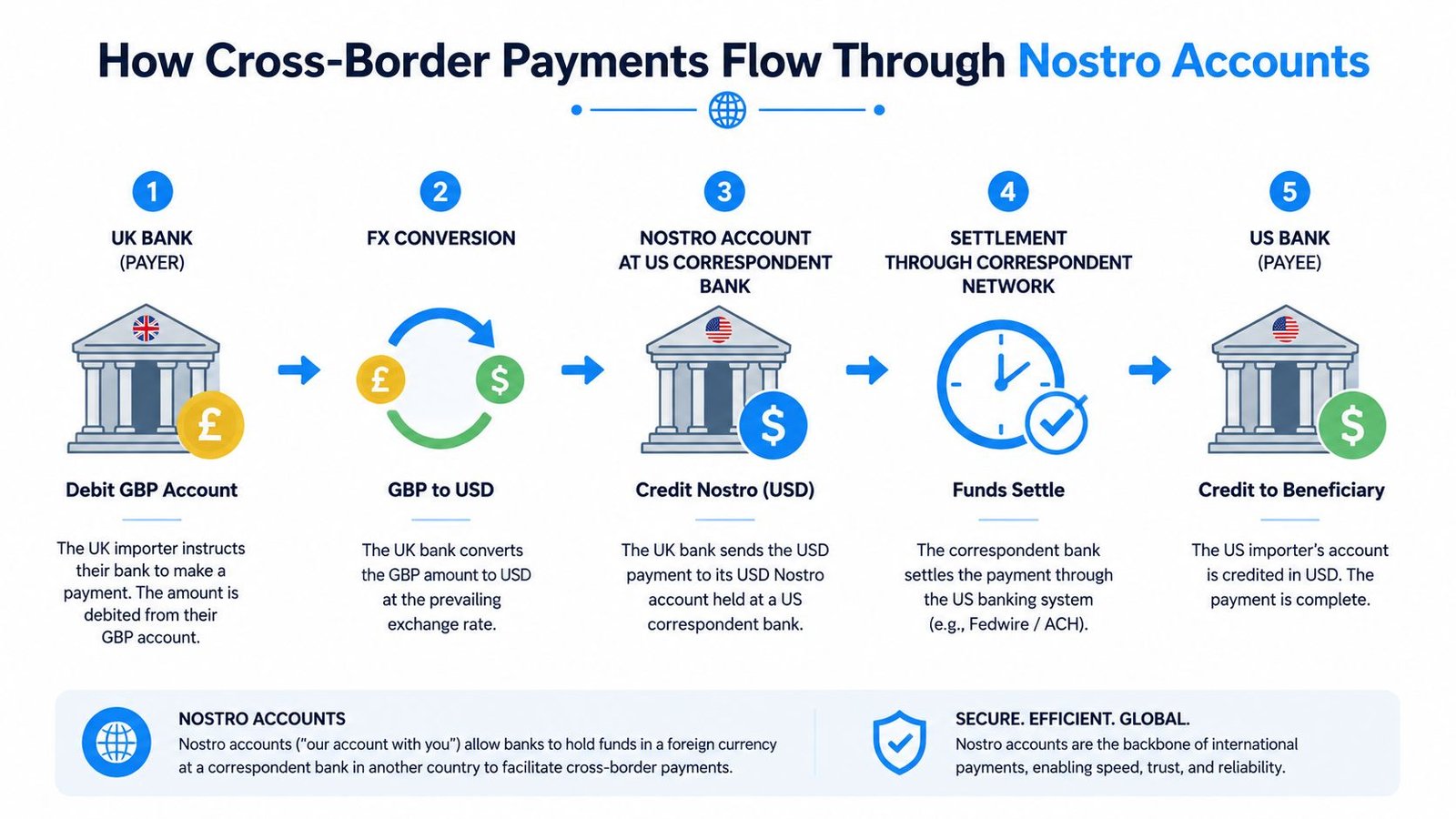
A cross-border payment begins with a customer instruction, but settlement depends on the banks' account relationships. Consider a UK exporter receiving a USD payment from a US importer. The UK exporter's bank needs access to USD settlement, so it maintains a USD nostro account with a US correspondent bank.
The customer-facing bank first debits the relevant client account and completes the required currency conversion. It then sends payment instructions through the banking network to the US correspondent. The message describes the beneficiary, amount, routing information, and payment purpose. The message instructs banks what to do, but it isn't itself the transfer of account value.
The settlement sequence
The correspondent uses the payment instruction to debit the UK bank's USD nostro balance. It then sends the funds through the appropriate US clearing channel and credits the importer's bank or beneficiary account according to the payment route.
The process can be simplified into these operational stages:
- Client debit: The sending bank records the customer's outgoing payment and applies the required foreign-exchange conversion.
- Payment instruction: The sending bank transmits the payment message to its correspondent and identifies the account relationship used for settlement.
- Nostro debit: The correspondent debits the sending bank's USD balance. The sending bank's available liquidity falls even though the account remains on the correspondent's books.
- Local settlement: The correspondent routes the payment through the relevant domestic clearing or settlement system.
- Beneficiary credit: The importer's bank posts the incoming value to the beneficiary's account after completing its own controls.
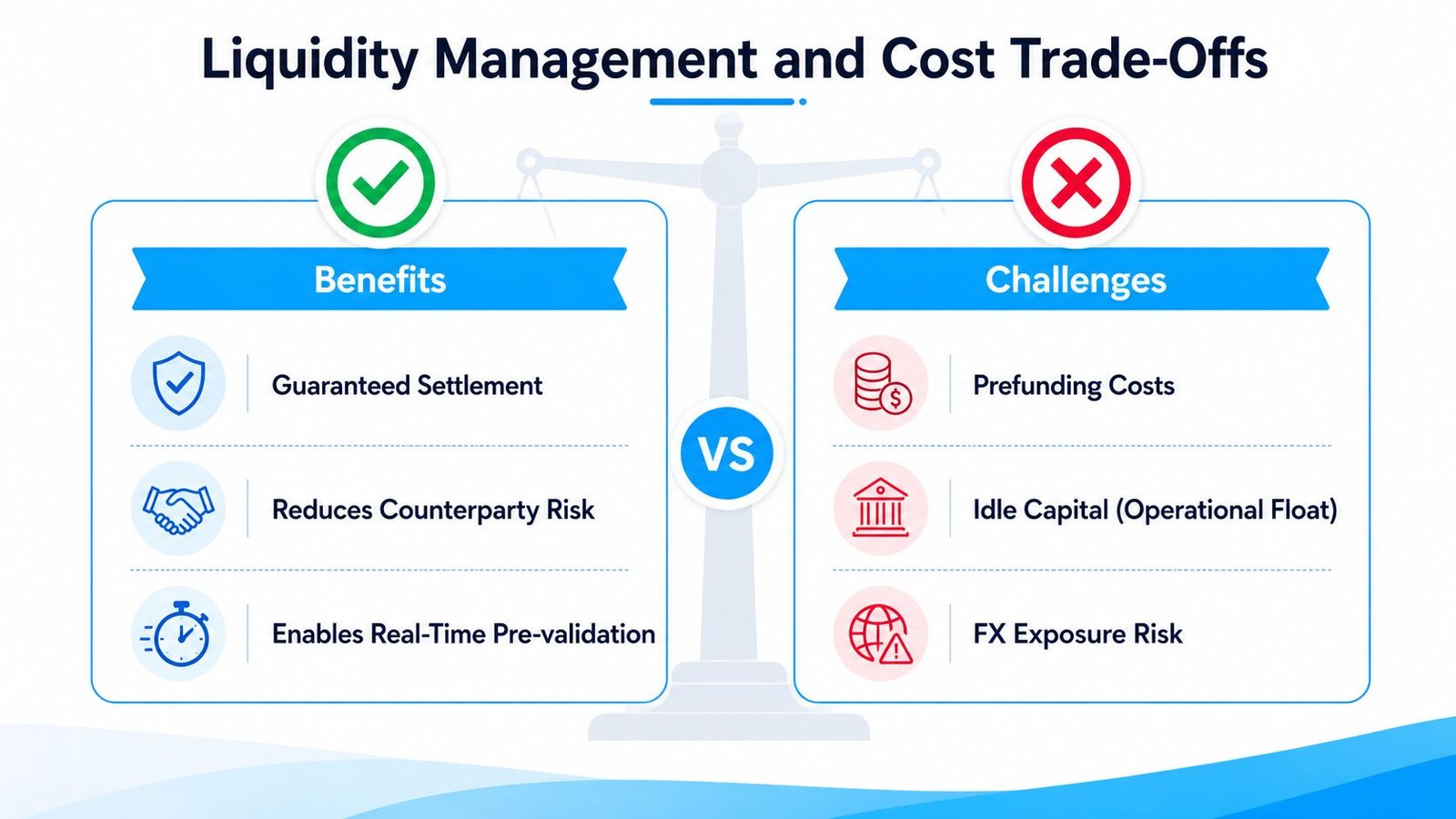
The UK bank must maintain enough USD in the nostro account before initiating payments. That prefunding requirement ties up foreign currency ahead of actual customer demand. A bank may therefore have to balance service reliability against the cost of keeping liquidity distributed across correspondent accounts.
Where delays enter the chain
A SWIFT message can transmit quickly, but the final movement of value depends on correspondent cut-off times, operating schedules, and local clearing windows. A payment submitted after a correspondent's cut-off may wait for the next processing window even when the instruction itself has already reached the bank.
A direct relationship produces a shorter route. If no direct correspondent link exists, intermediary banks may create a multi-hop chain. Each additional institution can introduce another account entry, fee, screening review, and reconciliation point. Teams investigating a delayed payment should therefore trace both the message path and the value path, rather than assuming that message delivery means settlement has completed.
For broader controls around payment routing, sanctions screening, and transaction review, banking teams can also consult Vaira's View's guide to compliance risk in banking.
Liquidity Management and Cost Trade-Offs
Nostro accounts function as foreign-currency liquidity pools. A bank needs enough available balance to meet expected payment obligations, but excessive balances can leave capital idle in accounts that exist mainly to support settlement.
Treasury and operations teams typically forecast expected inflows and outflows by currency, corridor, correspondent, and processing window. They can then set internal target balances and escalation thresholds. A shortfall may cause a payment to queue or fail. An excessive balance may reduce the bank's flexibility because funds are positioned abroad instead of being deployed elsewhere.
The cost of certainty
Prefunding gives the correspondent a clear source of settlement value. That can reduce uncertainty at the moment a payment is processed, particularly where the bank needs dependable access to a foreign clearing system. It also lets the respondent bank honor payment obligations without waiting for an incoming payment to arrive first.
The trade-off is the opportunity cost of distributed liquidity. A bank may hold balances across several currencies and correspondent relationships, each requiring forecasting, monitoring, funding, statement review, and control ownership. Account maintenance fees, intermediary charges, and unfavorable funding conditions in particular currencies can add to the expense.
A nostro balance is operationally useful only when its availability justifies the cost of keeping money positioned in that corridor.
The American Banker glossary discussion of nostro and vostro accounts identifies prefunded foreign-currency holdings, correspondent fees, liquidity constraints, and reconciliation overhead as central practical concerns. Those pressures make the choice of payment rail a treasury decision, not only a technology decision.
Choosing between rails
A bank may compare traditional bilateral prefunding with newer real-time rails, fintech liquidity networks, or central-bank-supported settlement arrangements. The right choice depends on corridor coverage, currency availability, transaction predictability, regulatory controls, settlement certainty, and integration effort.
A newer rail may reduce the need to place funds in multiple nostro accounts, but it may not cover every currency or institutional use case. Traditional accounts remain valuable where a bank already has strong correspondent access and predictable payment demand. The decision should be based on total operating cost and settlement performance, not on the label “modern” or “traditional.”
The Decline of Correspondent Banking Relationships
Correspondent banking networks have contracted as banks reassess risk, compliance expense, sanctions exposure, and the commercial value of maintaining certain corridors. The BIS paper on cross-border payment technologies places this infrastructure within a broader discussion of payment innovation, while the IMF framework explains how nostro accounts support international payments and how banks must track identifiers, currencies, and aggregate transaction volumes for each account.
A widely cited industry summary referencing BIS data reports that active correspondent banking relationships fell by about 25% between 2011 and 2022. That figure describes a structural reduction in the links available for international settlement, not a simple decline in the use of one account type.
What fewer relationships change
When banks close correspondent relationships, the affected corridor loses a direct settlement connection. A smaller bank may need to route payments through another institution, creating more intermediaries between the originator and beneficiary. That route can increase the number of parties involved in screening, account posting, fee deduction, and payment investigation.
The effect is especially important for institutions that depend on access to major clearing currencies. Fewer links can concentrate payment activity in the remaining relationships, increasing operational pressure and making corridor access more commercially selective.
| Structural change | Operational consequence |
|---|---|
| Fewer active correspondent links | Reduced direct corridor coverage |
| More reliance on intermediary chains | Additional routing and reconciliation points |
| Higher compliance and monitoring demands | Greater cost of maintaining each relationship |
| Consolidated banking networks | Less access for some smaller institutions and markets |
This contraction doesn't mean nostro accounts have become obsolete. The IMF framework shows that banks still manage detailed account data and transaction volumes for nostro relationships, which demonstrates their continuing role in bank operations.
The strategic question has shifted. Banks now need to decide which correspondent relationships justify their liquidity, compliance, technology, and operational costs, while payment providers and financial institutions seek alternative mechanisms for corridors that no longer offer efficient bilateral access.
Reconciliation Challenges in Nostro Operations
The balance shown by a correspondent rarely becomes a simple “matched” result without investigation. Operations teams compare the correspondent's statement with internal payment records, expected settlements, foreign-exchange entries, and charges. Timing differences can make a correct transaction appear missing, while a genuine posting error can look like an ordinary delay.
A correspondent in one time zone may close its processing window before the respondent bank completes its local end-of-day routines. Incoming credits, outgoing debits, intermediary charges, and value dates may therefore appear in different reporting periods. The ECB's nostro and vostro reporting guidance is useful for the foundational account classification, but daily operations require a separate reconciliation discipline.
A practical reconciliation cycle
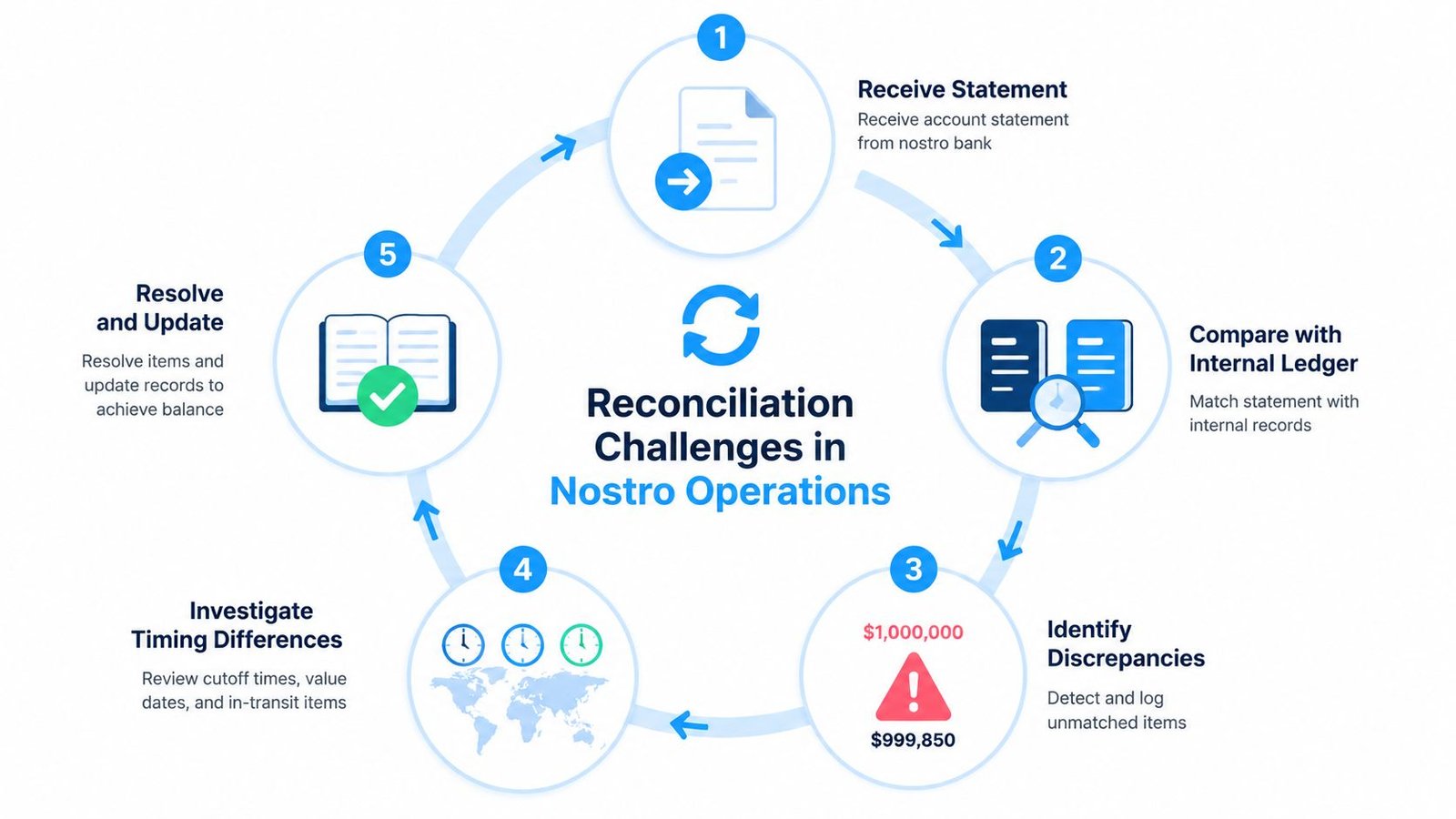
A controlled process usually starts when the bank receives a correspondent statement, then moves through comparison, exception identification, investigation, and resolution.
- Statement intake: The team receives the correspondent statement and confirms the account, currency, statement period, and reporting format.
- Ledger comparison: An automated matching engine or analyst compares statement entries with internal payment and treasury records.
- Exception classification: The team separates timing differences from possible duplicate entries, unapplied credits, incorrect values, foreign-exchange discrepancies, and unexpected charges.
- Investigation: Analysts trace the payment message, value date, correspondent reference, intermediary deductions, and local clearing status.
- Resolution: The bank posts corrections, requests clarification, updates the exception record, and escalates aged breaks under its operating procedures.
Many institutions still rely on line-by-line review of formats such as MT940 or camt.053, especially when reference data is incomplete or payment activity falls outside expected patterns. Automated matching can reduce repetitive review, but it doesn't eliminate the need for human judgment when an account entry lacks a usable reference or conflicts with settlement evidence.
Controls that reduce breakage
Tolerance thresholds can clear minor differences without sending every small variance to an investigation queue. Larger or older exceptions need stronger controls, including ownership, deadlines, documented evidence, and escalation to treasury, payments, or the correspondent relationship team.
ISO 20022's richer structured payment data can improve matching when banks preserve and pass through remittance and transaction details. Better data helps an analyst connect a statement entry with the original instruction, beneficiary, currency conversion, and expected amount. It doesn't solve a missing or incorrect entry by itself, but it gives the reconciliation process more usable evidence.
For adjacent workflows that depend on accurate matching and exception handling, teams can review the guide to reconciling accounts payable.
The Future of Nostro Accounts in Modern Payments
Nostro accounts will remain part of cross-border settlement, but banks are adding other layers around them. Real-time payment rails, fintech-led liquidity networks, central bank digital currency pilots, and distributed-ledger experiments may reduce reliance on bilateral prefunding in selected corridors. None automatically replaces the correspondent account where a currency, clearing system, or institutional settlement requirement still depends on established banking access.
The BIS analysis of cross-border payment technologies helps frame this as an architecture question. Banks are evaluating how payment messages, liquidity, settlement finality, and interoperability fit together rather than treating the nostro account as an isolated product.
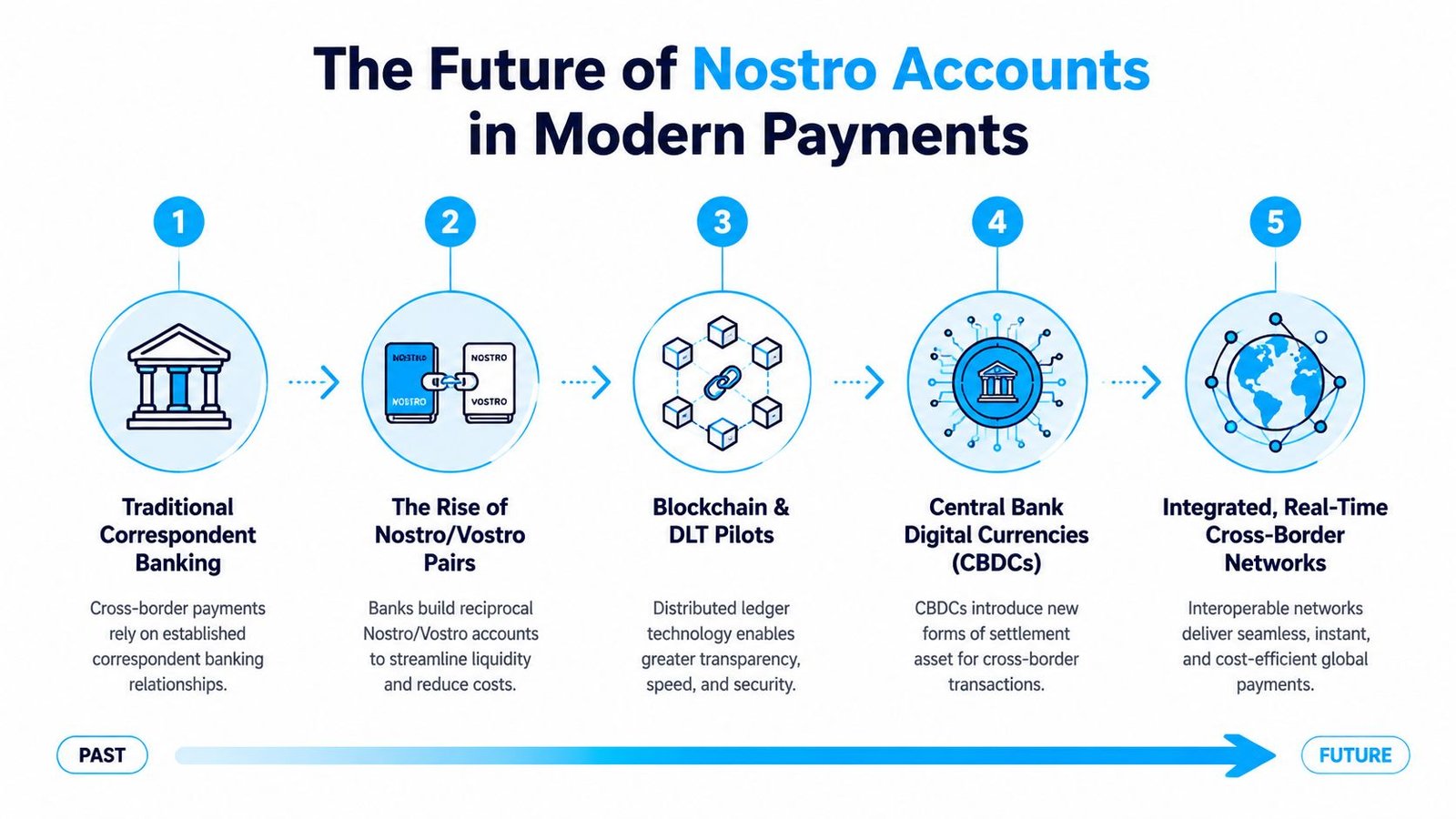
Finance professionals should watch three developments in particular:
- Structured messaging: ISO 20022 can make payment data more consistent and useful for reconciliation.
- Payment-versus-payment settlement: Coordinated settlement models may reduce the need to pre-position liquidity for certain foreign-exchange transactions.
- Tokenized bank money: Tokenized deposits could change how participating banks represent and transfer foreign-currency balances, although adoption and interoperability remain practical questions.
The embedded finance landscape offers relevant context for how financial capabilities are being integrated into technology platforms. Nostro accounts aren't disappearing. Banks that forecast liquidity accurately, automate matching, and govern correspondent relationships carefully will be better positioned to operate efficiently as payment networks evolve.
Vaira's View publishes practical analysis on AI, banking technology, fintech operations, risk, compliance, and the skills finance professionals need as infrastructure changes. Visit Vaira's View to explore research-driven guides that connect banking mechanics with technology and professional development.