
Cybersecurity in banking has moved far beyond a perimeter problem. The IMF's April 2024 Global Financial Stability Report says cyber incidents have caused about $12 billion in direct losses across the global financial sector over the last two decades, with banks the most frequent targets and extreme losses rising to $2.5 billion in the largest events IMF Global Financial Stability Report, April 2024. That is not a side issue for IT teams, it is a resilience issue for boards, risk committees, and operations leaders.
The practical shift is simple. Digital banking, payments, APIs, cloud dependencies, and outsourced processing have expanded the attack surface, while the business impact of a single compromise has become wider and faster. A serious incident can now interrupt payments, expose customer data, trigger regulatory scrutiny, and damage confidence at the same time. For banks, cybersecurity is part of balance-sheet protection, not just tool management.
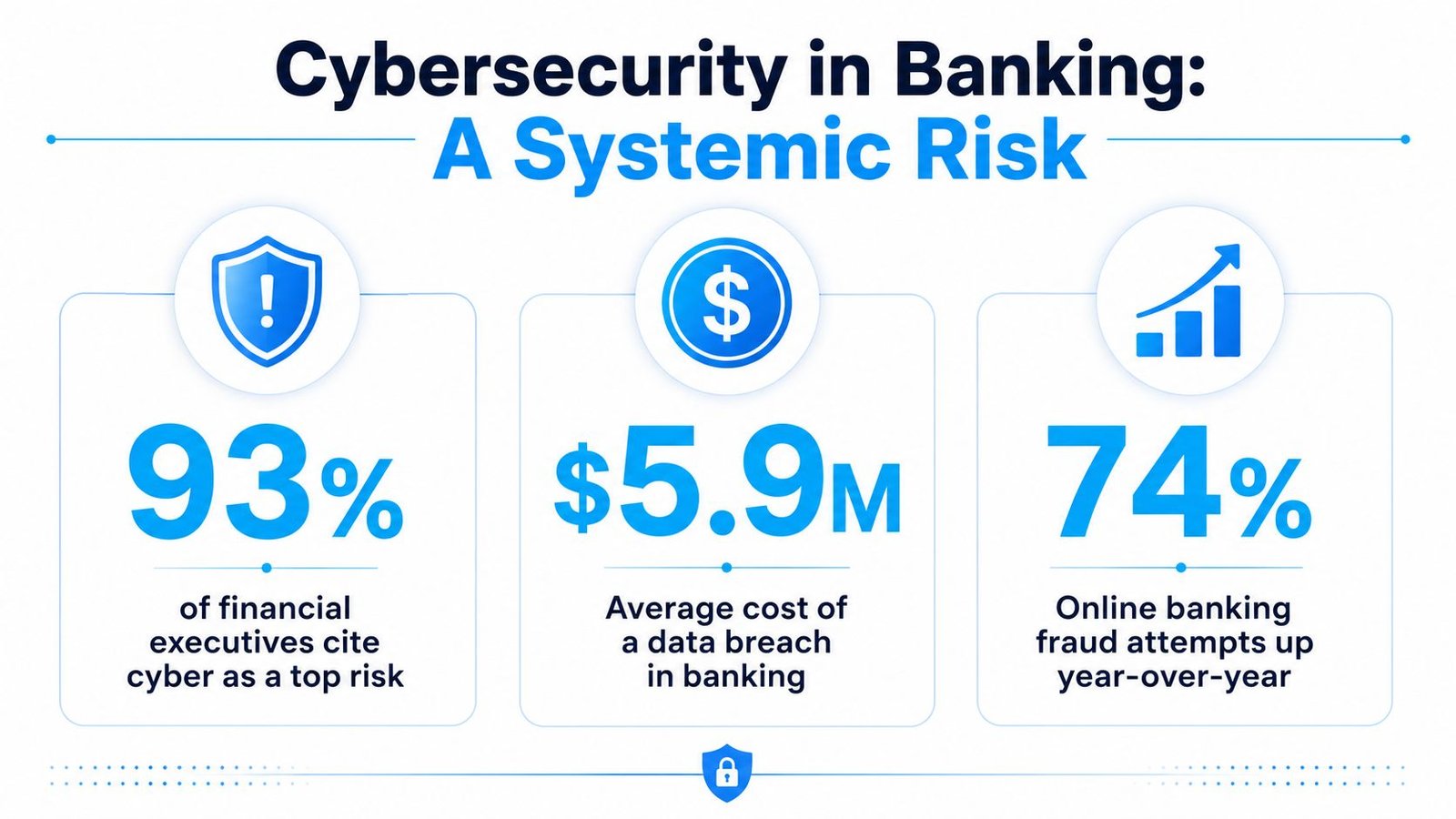
Table of Contents
- Why Cybersecurity in Banking Is Now a Systemic Risk
- The Modern Attack Environment for Banks
- Core Security Controls That Protect Banks
- Cloud and Third-Party Risk in Financial Services
- Building an Effective Incident Response Program
- Regulatory Expectations and Compliance Realities
- Best Practices to Strengthen Cybersecurity in Banking
Why Cybersecurity in Banking Is Now a Systemic Risk
Banks used to talk about cyber risk as a series of isolated incidents. That framing no longer fits the evidence. The IMF's analysis shows that cyber events in finance are not rare shocks, they are part of a long-running pattern of operational disruption, reputational damage, and financial-stability concern IMF Global Financial Stability Report, April 2024. When the biggest institutions are the most frequent targets, the issue stops being local to a security team and becomes material to the institution's resilience model.
Why the risk profile changed
Digitized customer access changed the game. Online banking, payment rails, internal automation, and API-driven services all improved efficiency, but they also multiplied the number of systems that can be abused, misconfigured, or interrupted. A compromise no longer has to reach the mainframe to matter, it can start with identity theft, a supplier account, a cloud permission error, or a help-desk workflow.
The ENISA finance-sector threat report reinforces that scale. From January 2023 through June 2024, analysts reviewed 488 publicly reported incidents, including 432 cyberattacks, 30 campaigns, and 26 warnings about potential activity or new vulnerabilities ENISA Finance Threat Landscape 2024. That volume points to a persistent, high-frequency threat environment, not a handful of exceptional cases.
Practical rule: if cyber reporting only reaches the security function, the bank is already underreacting. Treasury, operations, technology, legal, and business-line leaders need a shared view of the same risk.
The right response is to treat cyber as a core risk domain alongside liquidity, credit, and conduct. That means asking what would stop payments, expose confidential records, or make a digital channel unavailable, then funding controls around those failure points. It also means accepting that resilience is now as important as prevention.
The rest of this guide focuses on what changes outcomes. That includes the current threat mix, the controls that materially reduce exposure, why third-party dependency matters so much, how incident response works under banking timelines, and what regulators usually want to see in practice.
The Modern Attack Environment for Banks
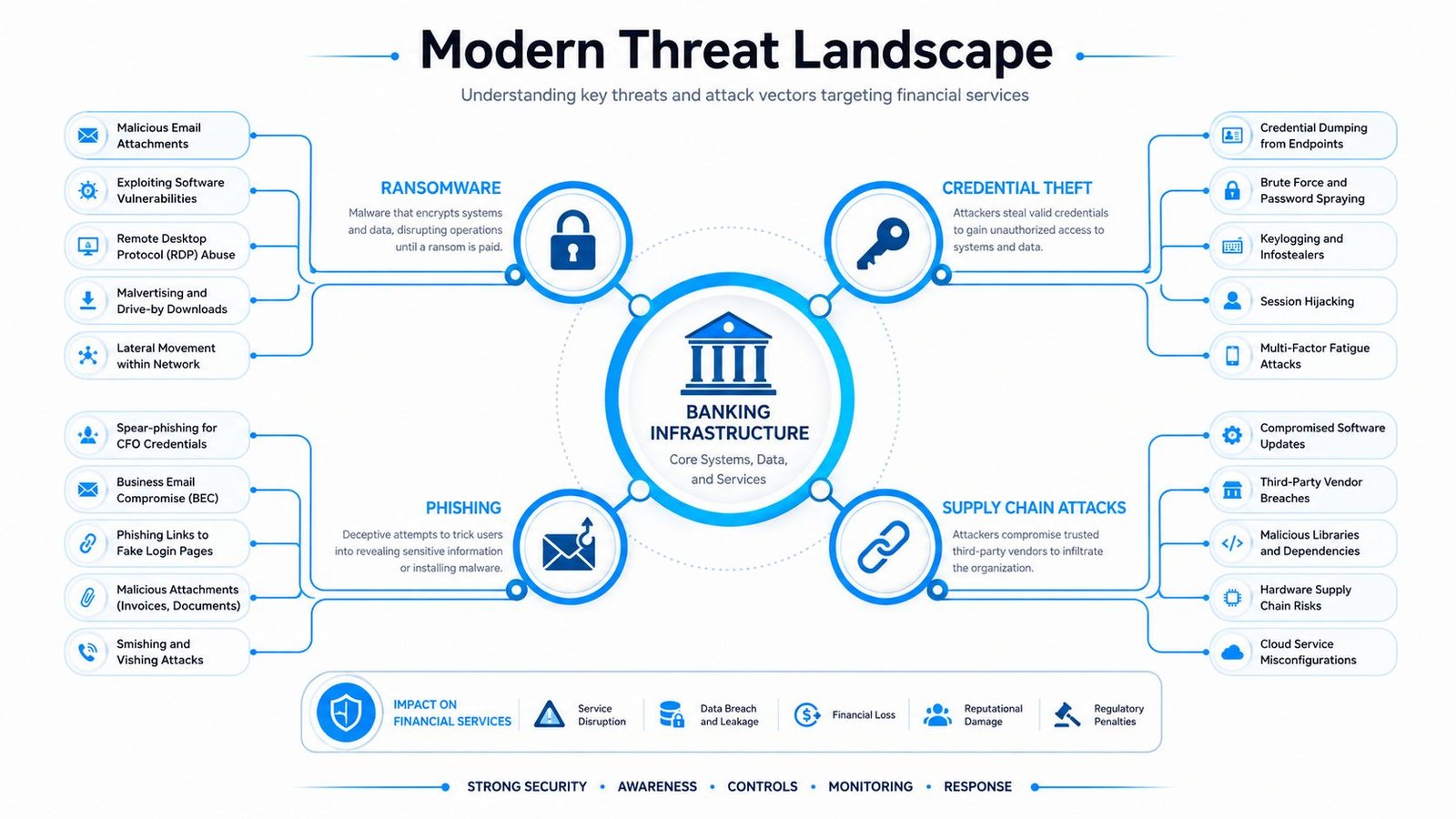
Banks face a threat mix that is more blended than many risk registers admit. Ransomware still matters, but it often starts with credential theft, phishing, or a supplier compromise. That matters because the first visible event is not always the root cause, and the business damage usually comes from what attackers do after they get in.
How attack chains usually unfold
Credential theft remains one of the most efficient paths into financial services. Attackers want valid identities because valid identities bypass many perimeter controls and blend into normal work patterns. Once they have access, they can move toward account takeover, privileged session abuse, data exfiltration, or payment manipulation.
Phishing and business email compromise still work because banking workflows depend on trust, speed, and exception handling. A convincing message aimed at a finance approver, treasury user, or branch employee can trigger a transfer, a password reset, or a document handoff before anyone investigates. AI-assisted social engineering raises the quality of those lures, especially when the attacker studies public material, internal jargon, or executive relationships.
Ransomware remains a serious banking issue, but the damage profile is broader than file encryption. In the finance-sector data set cited earlier, ransomware caused financial loss in 38% of cases, data exposure in 35%, and operational disruption in 20% Black Kite Financial Services Report, 2026. That spread shows why banks cannot treat ransomware as a simple restore-from-backup problem.
Why the impact is amplified in banking
Timing matters in banking more than in many sectors. Settlement windows, payment cutoffs, liquidity operations, and customer trust all compress the reaction time available to security teams. A disruption that would be annoying in another industry can become urgent in banking within minutes.
Retail banks tend to feel credential theft and phishing most directly because of customer-facing volume. Corporate banking is more exposed to payment fraud, treasury workflow abuse, and impersonation. Wealth management teams are often hit through account compromise, sensitive document theft, and social engineering against relationship managers. The attack style changes, but the underlying pattern is the same, identity abuse, then business-process abuse.
The ENISA finance-sector report also shows repeated activity across many forms, not one dominant technique ENISA Finance Threat Landscape 2024. That is why simple anti-malware thinking falls short. Banks need layered detection across email, endpoints, identity, data movement, and transaction workflows.
Core Security Controls That Protect Banks
A bank's security program fails at the points where attackers operate, not where the policy says it should. The controls that reduce loss are identity and access management, encryption, data loss prevention, segmentation, and monitoring, but only when they are applied to privileged users, sensitive data flows, and critical systems. A control that looks good in an audit binder and misses the payment path is not doing real work.
Identity and access management first
Identity and access management is the first control layer to get right because so many incidents start with stolen credentials. In banking, that means least privilege, strong authentication, and tight control over privileged accounts that touch payments, customer records, and infrastructure. If a user can reach critical systems from a standard workstation without step-up verification, the bank has left a high-value path open.
Phishing-resistant MFA matters for workforce access because attackers go after identities before they go after devices. Banks weaken it when they exempt legacy applications, leave dormant accounts active, or allow standing admin privileges without regular review. Those gaps show up in audits because they are the same gaps attackers use.
Encryption and data loss prevention are not interchangeable
Encryption protects data at rest and in transit, but it does not stop a legitimate user from moving sensitive information into the wrong place. Data loss prevention fills that gap by watching for account data, cardholder information, or confidential documents leaving approved channels. Used together, they reduce the chance that a stolen laptop, misrouted file, or unauthorized transfer exposes sensitive records.
The mistake I see most often is treating encryption as the finish line. It helps with storage and transport risk, but a bank still needs controls around export rights, removable media, email forwarding, and cloud sharing. DLP, rights management, and tighter access governance do the practical work.
Segmentation and monitoring close the loop
Network segmentation limits how far an attacker can move after the first foothold. Critical payment systems, administrative tools, and sensitive data stores should not sit in the same trust zone as everyday user devices. Monitoring then has to prove the segmentation works by looking for lateral movement, odd service accounts, and unexpected data transfers.
A control stack only works when the bank tests it against real attack paths, not against policy language.
The weakness most auditors and incident responders see is partial implementation. Teams deploy the right tools but miss the systems that matter, or they grant exceptions so broadly that the control loses force. Strong banks treat control ownership, exception handling, and audit trails as operational disciplines, not just compliance tasks, much like the discipline needed in reconciling accounts payable.
Cloud and Third-Party Risk in Financial Services
The biggest banking cyber problem is often outside the bank. Cloud providers, core banking vendors, payment processors, fintech partners, and managed service firms can all become the weakest link, and a breach at one supplier can ripple across many institutions. That is why third-party exposure is not a procurement issue, it is an operational resilience issue.
Why the ecosystem matters more than the perimeter
The sector's exposure is large enough to be structural. A 2026 financial-services cyber report says 97% of the largest U.S. banks suffered third-party breaches in 2024, while 100% of Europe's top financial firms suffered supplier breaches KnowBe4 report on global financial-sector cyber threats. Those numbers show that supplier trust is no longer a niche concern, it is part of the baseline attack surface.
The right response is not to abandon cloud or partner ecosystems. It is to manage them with better discipline than many banks currently do. That starts with vendor due diligence that goes beyond policy questionnaires, then moves into contract clauses, logging rights, segmentation of third-party access, and ongoing monitoring of supplier posture.
What good oversight looks like
Banks usually get into trouble when they assume the vendor's controls are the bank's controls. Shared responsibility only works when both sides know exactly where the boundaries sit. If a processor, fintech, or SaaS provider can reach customer data or transaction workflows, access should be narrow, logged, time-bound, and reviewed regularly.
A practical oversight model includes three parts. First, assess the vendor's criticality based on the business process it supports. Second, bind the supplier contract to clear security, incident notice, and audit terms. Third, watch for drift after onboarding, because supplier posture changes over time.
Third-party risk becomes systemic when the bank learns about it only after the outage starts.
The cloud layer adds another trade-off. It can strengthen resilience when designed well, but it also increases dependency on configuration quality, identity governance, and telemetry. For banks that are expanding embedded services, the same dependency logic applies in embedded finance, where partners may sit even closer to customer-facing transaction flows.
Building an Effective Incident Response Program
A bank's incident response program should be built for speed, coordination, and uncertainty. Security teams rarely have the luxury of waiting for perfect forensics before they act. They need a process that can decide what to contain, who to notify, and which services to protect while the investigation is still unfolding.
The response sequence that works
Detection comes first, but detection alone does not reduce damage. The bank needs triage that separates noise from a real compromise, then a containment decision that matches the business impact. That could mean disabling a user, isolating a segment, suspending a vendor connection, or freezing a payment workflow.
Recovery is where many banks lose time. Restoration has to include integrity checks, not just system availability, because banking incidents often involve manipulated data or unauthorized access rather than visible destruction. Post-incident review should then map each failure back to an identity control, an access path, a monitoring gap, or a process weakness.
Why response speed is the real constraint
Attackers often move faster than internal escalation. A financial-services study noted that the average response time for data-theft incidents was nearly 24 hours, even though attackers often exfiltrate sensitive data within minutes of access Bridewell financial-services study. That gap is the operational problem. If the bank can't detect, verify, and act quickly, the attacker's head start grows into a broader loss.
AI-enabled detection and automated triage can narrow that gap, but only when the rules are tuned to the bank's environment. Playbooks matter too, because legal, communications, payments, operations, and regulators all need coordinated action under time pressure. A tabletop exercise is useful only if it forces real decisions, especially around system shutdowns, customer messaging, and escalation thresholds.
Incident response should be aligned with business continuity and crisis management. Those teams often overlap in practice, but they are not the same. Cyber response is about stopping unauthorized activity and preserving evidence, while continuity is about keeping critical services functioning safely. Banks that blur the two usually delay the hard calls.
Regulatory Expectations and Compliance Realities
Regulators rarely want a folder full of policies. They want evidence that cyber risk is governed, measured, tested, and escalated by people who understand the business impact. Across major supervisory regimes, the common themes are governance, risk assessment, control testing, third-party oversight, incident reporting, and resilience.
What examiners usually look for
Boards and senior management are expected to understand cyber risk as an enterprise issue, not delegate it entirely to security. That means they need useful reporting, clear accountability, and enough visibility to challenge management when critical controls are weak. Where programs stumble, it is usually not because the bank lacks a framework. It is because reporting is fragmented, metrics are inconsistent, and third-party oversight is uneven.
The inspection focus has also shifted toward whether controls work as intended. A policy that says privileged access is restricted does not help if exceptions are unmanaged or logging is incomplete. A resilience standard does not mean much if the bank has never tested a realistic supplier outage or a corrupted payment process.
How to make the program exam-ready
Good programs connect governance to operational proof. That means control testing, incident drills, evidence of remediation, and a clear map from risk assessment to investment decision. It also means showing how third-party risk is tracked after onboarding, not just during procurement.
Banks that use risk tooling well tend to have cleaner oversight paths. That is one reason some teams now centralize their reporting and workflow evidence in AI risk management software, especially when they need to reconcile security, compliance, and model-driven operations in one place.
The hardest part is consistency. Regulators notice when one business line documents risk rigorously and another relies on informal exception handling. Strong banks close that gap by standardizing evidence, ownership, and escalation rules across the institution.
Best Practices to Strengthen Cybersecurity in Banking
The best banking security programs don't try to do everything at once. They focus on the controls that cut off the most likely attack paths, then tighten the places where attackers can turn one mistake into a larger incident. That usually means prioritizing identity, third-party access, and visibility before adding more tooling.
A practical investment order
Start with phishing-resistant MFA for employees and privileged users, especially around administration, payments, and remote access. Then reduce lateral movement by segmenting critical systems and monitoring privileged activity. After that, harden supplier access with narrow permissions, logging, and contract-backed incident obligations.
Banks should also treat data governance as a security issue, not a recordkeeping issue. If sensitive files, customer records, or payment data can move without traceability, DLP and access reviews need to be tighter. Cloud governance should follow the same rule, with configuration baselines and identity controls that are reviewed continuously.
A short prioritization list helps keep the work grounded:
- Fix identity first: remove standing privileges, review dormant accounts, and upgrade MFA where phishing resistance is still weak.
- Protect critical flows: isolate payment, treasury, and customer-data environments from general user networks.
- Tighten suppliers: reduce third-party access to the minimum needed and monitor for drift after onboarding.
- Measure response speed: test how quickly the bank can detect, triage, and contain a real compromise.
- Tie cyber to enterprise risk: make sure the board sees cyber exposure in the same language used for other material risks.
The main trade-off is legacy complexity. Older applications, fragmented identity stacks, and user friction all slow modernization. That doesn't make the work optional, it just means the sequence has to be deliberate and tied to the riskiest systems first.
Vaira's View publishes practical analysis for professionals working where AI, banking, finance, and technology overlap. If this topic matters to your team, visit Vaira's View for more evidence-based guides on cybersecurity, banking technology, and the controls that reduce risk.
Pingback: Internet and Mobile Banking: Security and UX Trends
Pingback: 10 AI Risk Management Certification Options Compared
Pingback: multi asset trading platforms
Pingback: Customer Experience in Banking Industry: AI Strategy