
If you are exploring fintech careers in 2026, the biggest mistake is assuming the field is only for software engineers. Fintech hiring is broader than that. Companies need people who can build products, manage risk, work with regulators, analyse data, support revenue growth, and turn financial complexity into useful customer experiences.
This guide is for finance professionals, software and data specialists, graduates, product managers, compliance teams, and career switchers who want a realistic view of where opportunities are growing. You will learn which fintech roles are hiring, what skills employers actually value, how different backgrounds translate into fintech, which certifications may help, what interviews really test, and how compensation and progression usually work.
The aim is practical advice, not hype. Fintech remains attractive because it sits where money, technology, regulation, and customer demand meet. That also means employers look for candidates who can operate well under constraints, not just talk about innovation.
Table of Contents
- The Talent Mix Behind Fintech Hiring
- High-Growth Fintech Roles and Where Demand Is Concentrated
- Building the Skills That Fintech Employers Actually Value
- Choosing Your Entry Path Into Fintech
- Navigating Fintech Interviews and Building Your Network
- Salary Expectations and Long-Term Career Progression
- FAQ
- Is fintech a good career in 2026?
- Do I need coding skills for fintech careers?
- Which fintech jobs are growing fastest?
- Can banking professionals move into fintech?
- Which certifications help for fintech jobs?
- Is fintech better than traditional banking?
- What skills do fintech employers value most?
- How do I get my first fintech job?
- Conclusion
The Talent Mix Behind Fintech Hiring
Fintech hiring makes more sense when you stop treating it as a software-only market. The strongest companies hire around business problems such as payments, lending, fraud, onboarding, financial data, compliance, treasury, and customer retention. That creates demand across technical, product, operations, commercial, data, and control functions.
Recent evidence supports that broader view. The World Economic Forum says fintech engineers are among the fastest-growing jobs through 2030, alongside AI and machine learning specialists and big data roles, based on employer survey data covering more than 14 million workers across 55 economies. That matters because it signals continued demand for fintech talent, but not only in pure software positions. It also points to the wider importance of digital product, data, and security capabilities in financial services. Future of Jobs Report 2025 and WEF summary of fastest-growing jobs
Global fintech employment and hiring concentration
In Singapore, the talent mix is equally revealing. The Singapore FinTech Association's 2025 talent report says 84% of hiring needs sit in commercial, technical, and product roles, yet only about half of those needs are being filled. The same report highlights demand for AI/ML, cybersecurity, and data science, while employers place unusually high importance on communication, teamwork, and adaptability. Only a small minority treat formal certifications as crucial. Singapore FinTech Talent Report 2025
This is the core reality of fintech careers. Employers want specialists, but they value people who can work across functions even more.
Best Fintech Careers by Background
The best entry point depends heavily on what you already know. Instead of chasing a title that sounds exciting, it is usually smarter to choose a role that builds on your current strengths.
| Background | Strong Fintech Career Options | Why It Fits | Skills to Add First |
|---|---|---|---|
| Finance professionals | Product manager, lending operations lead, payments analyst, treasury operations, wealth-tech specialist | You already understand financial products, controls, and customer workflows | APIs, SQL, agile product basics, data literacy |
| Software and technology professionals | Software engineer, solutions architect, platform engineer, cybersecurity analyst, engineering manager | You can build systems, integrate services, and improve performance at scale | KYC/AML basics, payments flows, fraud concepts, regulatory context |
| Graduates | Analyst programs, operations, junior product roles, customer success, data analyst roles | Employers can train early-career hires into specialist tracks | Excel, SQL, product thinking, financial services basics |
| Risk and compliance professionals | AML specialist, compliance analyst, fraud operations, model risk, regtech specialist | Regulation-heavy fintechs need people who can operationalise controls | API literacy, data reporting, product lifecycle understanding |
| AI and data professionals | Data scientist, ML engineer, fraud analytics, credit risk modelling, AI governance | Fintech needs stronger decisioning, monitoring, and model oversight | Financial data quality, model risk, explainability, cloud tooling |
| Product and business professionals | Product manager, partnerships manager, growth lead, embedded finance strategist | Fintech needs people who can connect user needs, economics, and delivery | Technical fluency, metrics, risk awareness, financial regulation |
A good rule is simple. Start from your existing edge, then add the missing layer that makes you credible in fintech.
What employers actually build teams around
High-growth fintech firms rarely build teams around job titles alone. They build around outcomes.
A payments company may hire a product manager, a compliance specialist, a fraud analyst, a data engineer, and a partnerships lead because all five are needed to launch and scale the same product. A lending platform may need credit risk analysts, ML engineers, operations specialists, and legal or compliance support to approve customers quickly without weakening controls.
That is why the most valuable people in fintech often sit between disciplines:
- A product manager who understands onboarding friction and regulatory constraints
- A compliance lead who can work with engineering on transaction monitoring logic
- A commercial hire who knows how a bank partner evaluates vendor and regulatory risk
- A data specialist who can explain model outputs to non-technical stakeholders
- An AI governance professional who can support model oversight, documentation, and auditability
| Career Track | What It Focuses On | Typical Employers | What Good Looks Like |
|---|---|---|---|
| Technical | Platforms, APIs, cloud, security, data pipelines | Payments firms, neobanks, infrastructure providers | Reliable systems, strong integrations, scalable controls |
| Product | Roadmaps, user journeys, commercial trade-offs | Digital banks, lenders, wealth-techs, SaaS fintechs | Features that solve customer problems and meet control needs |
| Risk and Compliance | AML, KYC, controls, governance, regulatory operations | Banks, fintechs, regtechs, payments firms | Safe growth with clear operational discipline |
| Commercial | Partnerships, sales, distribution, growth | B2B fintechs, embedded finance players, marketplaces | Revenue growth with strong partner fit |
| AI and Data Governance | Model risk, explainability, monitoring, data quality | Lenders, fraud teams, analytics-heavy firms | Useful AI with defensible controls |
The practical takeaway is that fintech careers reward depth plus range. Employers like specialists, but they promote people who can collaborate across technical, customer, and regulatory boundaries.
High-Growth Fintech Roles and Where Demand Is Concentrated
Demand in fintech is not evenly spread. Hiring tends to cluster around areas with direct product impact, regulatory importance, or revenue leverage. In 2026, that usually means payments infrastructure, digital lending, compliance operations, cybersecurity, data platforms, AI-enabled fraud and risk tools, and embedded finance.
The World Economic Forum's latest employment outlook reinforces the broad direction of travel. It identifies fintech engineers, AI specialists, software developers, and information security analysts among the fastest-growing job categories globally, which supports demand for technical and hybrid roles across financial technology. Future of Jobs Report 2025
In Europe, talent market analysis covering Q1 2024 to Q1 2025 also points to engineering as the most in-demand fintech function, while compliance, risk, and regulatory roles continue gaining importance, particularly in payments and buy now, pay later models. Hiring Pulse in Fintech, Europe Q1 2024-Q1 2025
How We Identified High-Growth Fintech Roles
Fintech hiring surges across global hubs
Not every trending title belongs on a serious career list. For this guide, the strongest roles were identified using six practical criteria:
- Hiring demand: roles that appear repeatedly across fintech employers and talent reports.
- Regulatory importance: roles tied to AML, KYC, cybersecurity, model governance, and financial controls.
- Product growth: roles linked to expanding areas such as digital payments, embedded finance, lending infrastructure, and financial data platforms.
- AI adoption: roles supported by growth in machine learning, analytics, and AI-enabled operations.
- Commercial impact: roles that drive partnerships, revenue, retention, or distribution.
- Skill scarcity: roles where employers consistently report difficulty finding qualified candidates.
This matters because a role can sound modern without offering durable career value. The better fintech careers usually sit where customer demand, regulation, and operational complexity overlap.
The roles hiring managers struggle to fill
Below are the career paths that appear most consistently in fintech hiring discussions. They are not the only good jobs in the sector, but they are among the most practical and durable.
| Role | What the Role Does | Who It Suits | Key Skills | Useful Tools and Technologies | Typical Progression | Main Advantages | Challenges |
|---|---|---|---|---|---|---|---|
| Payments Product Manager | Owns payments features, prioritises roadmap, balances customer needs with risk and compliance | Finance, product, operations, or consulting professionals with strong stakeholder skills | Product strategy, payments flows, analytics, regulatory awareness | SQL, dashboards, ticketing tools, API docs | Product analyst to PM to senior PM to head of product | High visibility, strong mobility across firms | Trade-offs are constant, accountability is high |
| AML or Compliance Specialist | Builds and runs customer due diligence, monitoring, reporting, and controls | Compliance, legal, audit, operations, and banking professionals | AML, KYC, investigations, policy interpretation, communication | Case management tools, transaction monitoring systems, Excel, SQL | Analyst to manager to MLRO or compliance lead | Stable demand, clear regulatory relevance | Can be process-heavy and deadline-driven |
| Software Engineer or Platform Engineer | Builds infrastructure, integrations, reliability, and internal tooling | Engineers from SaaS, cloud, data, or platform backgrounds | Coding, system design, security, APIs, cloud architecture | Python, Java, Go, AWS, Kubernetes, CI/CD | Engineer to senior engineer to staff or engineering manager | Strong demand, technical depth, transferable skills | Must learn financial domain and control expectations |
| Data Scientist or ML Engineer | Improves fraud detection, underwriting, forecasting, and decision systems | Data, analytics, quantitative, and AI professionals | Statistics, ML, feature design, experimentation, communication | Python, SQL, notebooks, cloud ML tools, feature stores | Analyst to data scientist to lead scientist or ML lead | High strategic value when tied to real products | Models need governance, not just accuracy |
| AI Governance or Model Risk Specialist | Oversees model controls, documentation, monitoring, explainability, and risk review | Risk, data, audit, quantitative, or governance professionals | Model risk, control frameworks, documentation, stakeholder management | Model monitoring tools, governance workflows, reporting systems | Analyst to specialist to head of model risk or AI governance | Emerging senior path with strong relevance | Role definitions still vary by employer |
| Embedded Finance or Partnerships Lead | Builds bank, platform, and distribution partnerships | Commercial, strategy, payments, and business development professionals | Negotiation, market knowledge, commercial modelling, partner management | CRM, analytics dashboards, API product material | Manager to director to GM or strategy lead | Direct revenue influence and broad exposure | Results depend on partner timing and execution |
| Cybersecurity Analyst | Protects systems, access, transactions, and customer data | Security, infrastructure, and IT risk professionals | Security operations, controls, incident response, risk assessment | SIEM, IAM, cloud security, monitoring platforms | Analyst to senior analyst to security lead or CISO track | Strong cross-sector demand | Continuous pressure and fast-changing threats |
| Financial Data Product Owner | Owns internal or client-facing data products, taxonomy, quality, and reporting value | Product, analytics, data governance, and operations professionals | Data modelling, stakeholder management, metrics, domain knowledge | SQL, BI tools, data catalogues, workflow tools | Analyst to product owner to principal or head of data product | Strong fit for data-heavy fintechs | Requires both technical fluency and business clarity |
Future fintech skills and H2 2025 demand
Cities such as London, New York, Singapore, Bangalore, and São Paulo still matter because they combine regulation, capital, talent, enterprise customers, and product density. But increasingly, the better question is not where a role is based. It is which problems the company is solving and whether the role sits close to those problems.
For a deeper look at where AI-heavy finance jobs are moving, the role map in AI jobs in finance and where demand is rising is useful context.
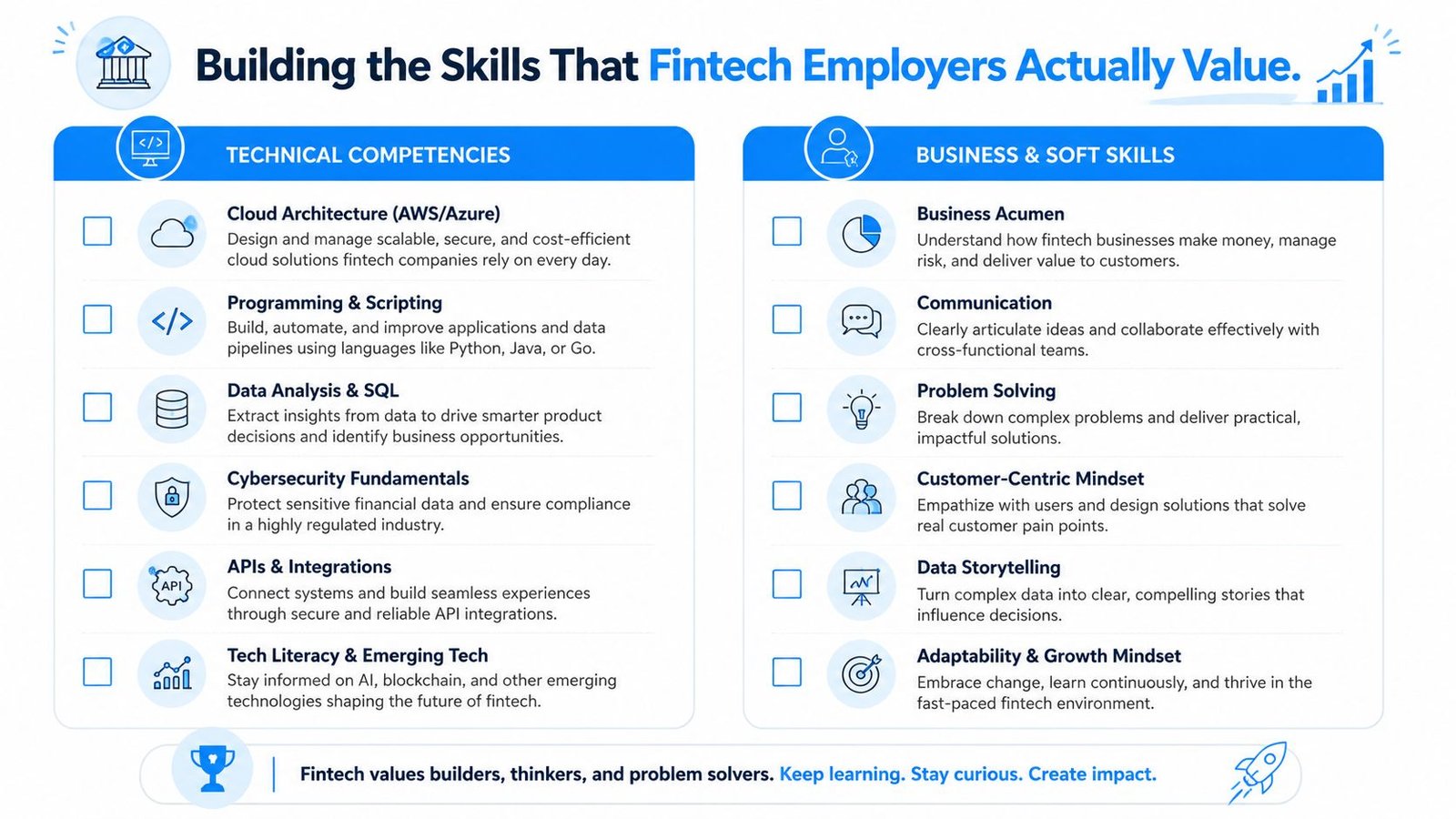
Building the Skills That Fintech Employers Actually Value
The fastest way to waste time in fintech is to collect credentials without proving you can solve real problems. Employers usually hire people who can work with live systems, data, controls, and cross-functional teams.
The good news is that the required skills are often more practical than glamorous. You do not need to master everything. You need enough fluency to be useful in the track you choose.
Start with skills that transfer across roles
Across most fintech careers, a practical foundation includes:
- SQL for querying and validating data
- Python for analytics, automation, or technical problem-solving
- API literacy for understanding how financial systems connect
- Cloud basics for modern infrastructure awareness
- Spreadsheet and dashboard fluency for business and operational analysis
- Written communication for documentation, controls, and stakeholder updates
Then add domain knowledge that fits the product area:
- Payments: card rails, settlement, chargebacks, reconciliation
- Lending: underwriting logic, credit risk, servicing, collections
- Compliance: KYC, AML, sanctions, suspicious activity processes
- Wealth-tech: client onboarding, suitability, portfolio reporting
- Data and AI: model inputs, monitoring, explainability, governance
Candidates who can connect regulation to product design usually stand out. That is especially true in areas shaped by frameworks such as PSD2, open banking, consumer protection rules, AML obligations, and emerging AI governance expectations.
Useful filter: if a skill does not help you ship, analyse, control, sell, or support a financial product, it is probably secondary for now.
The balance of skills also depends on track.
| Career Track | Technical Skills | Non-Technical Skills | Good First Projects |
|---|---|---|---|
| Technical | Coding, APIs, cloud, security, data pipelines | Documentation, prioritisation, teamwork | Build a payments integration or fraud alert workflow |
| Product | Metrics, SQL, experimentation, API understanding | Prioritisation, communication, customer thinking | Write a product brief for onboarding or payments checkout |
| Risk and Compliance | Data review, reporting, case handling, control design | Judgement, escalation, policy interpretation | Map a KYC workflow and identify control gaps |
| Commercial | CRM, analytics, pricing models, product fluency | Negotiation, stakeholder management, messaging | Analyse a partner go-to-market strategy |
| AI and Governance | Python, model monitoring, data quality, explainability | Challenge, documentation, governance, reporting | Create a model risk review template or fraud feature analysis |
Choose credentials that support the job you want
Certifications can help, but only when they support a clear job target. The Singapore FinTech Association's 2025 report found that only a small share of employers view formal certifications as crucial, which is a useful reminder not to overinvest in badges at the expense of practical capability. Singapore FinTech Talent Report 2025
A better approach is to match learning to role intent.
| Career Goal | Useful Learning Paths | What They Signal | Limitations |
|---|---|---|---|
| Product and operations | Product courses, analytics training, payments domain learning | Structured thinking and customer focus | Not enough without real examples or case work |
| Cloud and engineering | AWS, cloud architecture, security, platform training | Technical credibility and systems awareness | Domain knowledge still needs to be built |
| Compliance and risk | ICA-style compliance learning, AML and fraud training | Regulatory seriousness and control awareness | Better when paired with process or investigations experience |
| Investment and wealth-tech adjacent roles | CFA Institute aligned learning, market knowledge, portfolio basics | Strong finance base | Less useful for pure payments or infrastructure roles |
| AI governance and model risk | Model risk, AI controls, explainability, governance programmes | Fit for emerging oversight roles | Standards vary by employer and region |
For readers comparing certifications and AI learning paths, the best AI certifications for banking and finance is a useful companion.
The durable advantage comes from cross-functional fluency. A candidate who can talk to engineers, understand a compliance review, and explain a customer workflow is usually stronger than someone with a long list of disconnected credentials.
Choosing Your Entry Path Into Fintech
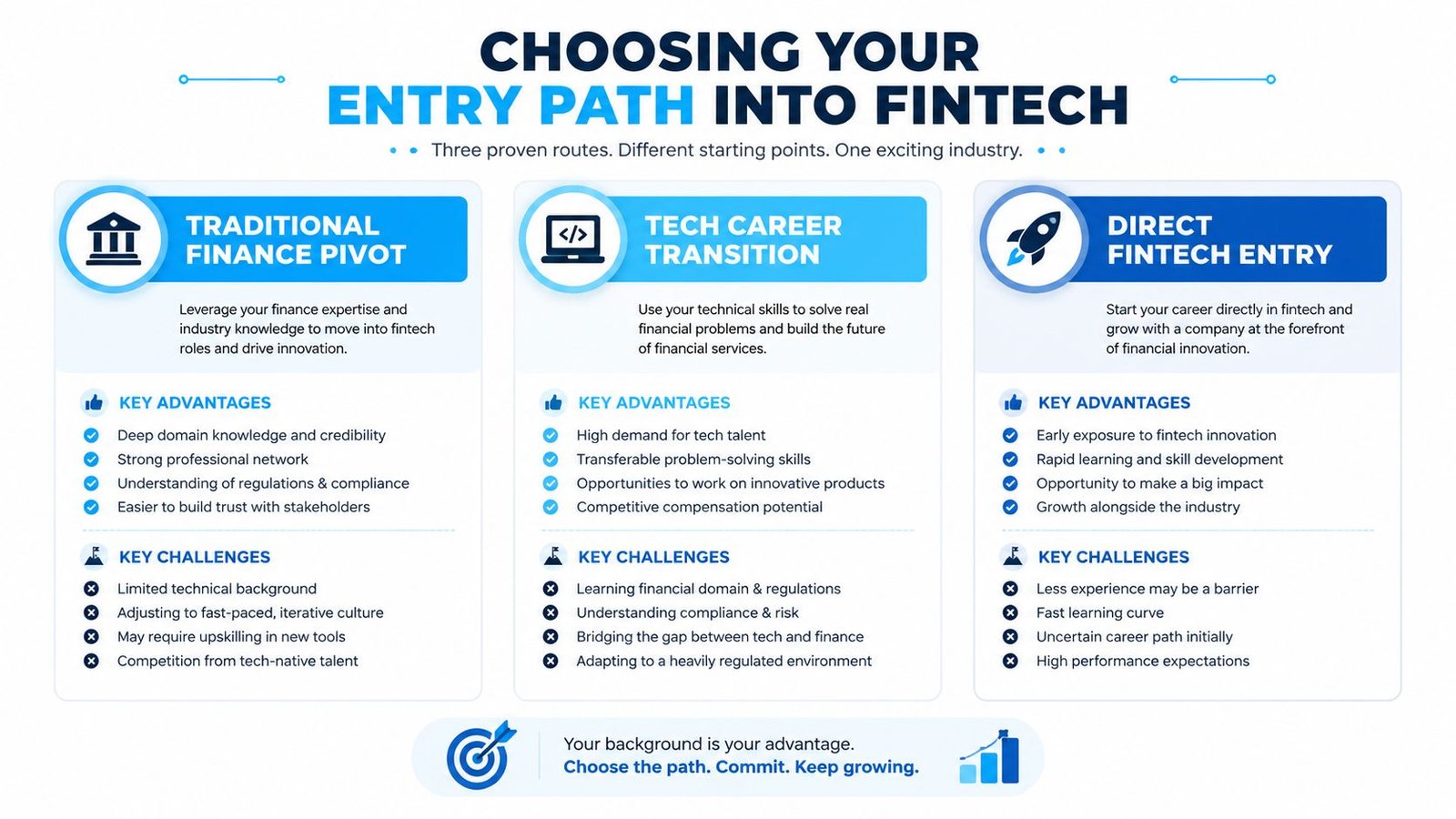
There is no single route into fintech. Most people enter through one of a few repeatable paths, then reposition as they gain domain and product experience.
Traditional finance pivot
Professionals from banking, insurance, asset management, treasury, and payments operations often have an underrated advantage. They already understand how money moves, where controls matter, and why customer, regulatory, and operational mistakes can become expensive.
What it suits:
People with domain knowledge in lending, operations, markets, wealth management, payments, or customer onboarding.
Best target roles:
Product management, operations, compliance, risk, implementation, customer success, and financial data roles.
Key skills to add:
- Product thinking
- API and system flow literacy
- SQL or basic analytics
- Agile delivery language
- Metrics and experimentation
Typical progression:
Banking or finance role to fintech specialist role to senior product, operations, or domain leadership.
Main advantage:
You already understand regulated financial environments.
Main challenge:
You may need to prove speed, adaptability, and comfort with less structured operating models.
A useful tactic is to translate your current work into product or systems language. Loan operations becomes workflow expertise. Reconciliation becomes transaction data quality. Compliance becomes control design and regulatory interpretation.
For professionals weighing a switch from traditional finance, the comparison in wealth management versus investment banking helps clarify which adjacent skill sets transfer best.
Tech-to-fintech transition
Software engineers, technical product managers, data engineers, and security professionals often move into fintech relatively smoothly from a tooling perspective. The main gap is domain and regulatory context.
What it suits:
People from SaaS, cloud, developer tools, e-commerce, cybersecurity, and data platform backgrounds.
Best target roles:
Engineering, solutions architecture, cybersecurity, platform operations, technical product, and infrastructure roles.
Key skills to add:
- KYC and AML basics
- Payments flows and reconciliation logic
- Fraud and financial risk concepts
- Data governance and auditability
- Consumer finance constraints where relevant
Typical progression:
Engineer to senior engineer to staff, architect, or engineering manager. Technical product and platform strategy can also become strong second-stage moves.
Main advantage:
Your systems thinking is immediately valuable.
Main challenge:
Hiring managers will test whether you understand what makes financial products different from ordinary software.
Candidates in this path should be ready to explain concepts such as failed payments, fraud controls, customer verification, access controls, and incident management in a regulated setting.
Risk, compliance, and operations transition
This is one of the strongest and least discussed entry paths into fintech careers. Many fintechs need professionals who can operationalise controls, improve customer onboarding, reduce false positives, manage reporting, and work with product teams before issues become regulatory or operational failures.
What it suits:
Professionals from compliance, financial crime, internal audit, operations, second-line risk, governance, or customer operations.
Best target roles:
AML specialist, fraud operations lead, compliance analyst, regtech implementation, model governance, risk operations, and controls roles.
Key skills to add:
- Data review and reporting
- Workflow tooling
- Product lifecycle awareness
- Escalation and root cause analysis
- Basic SQL or BI literacy
Typical progression:
Analyst to specialist to manager to head of risk, compliance operations, or governance.
Main advantage:
Demand remains durable because regulated growth needs strong controls.
Main challenge:
Some employers may typecast you into support functions unless you show product and systems understanding.
A smart move here is to show how your work improves customer experience, speeds onboarding, reduces operational loss, or helps a product scale safely.
Direct graduate entry
Graduate entry is still viable, but the route is narrower and more competitive. The advantage is that you can build fintech-specific experience early, especially if you join a payments company, neobank, infrastructure provider, or regtech with a structured analyst track.
What it suits:
Graduates in finance, economics, computer science, data, law, business, and related fields.
Best target roles:
Analyst, junior operations, customer success, product analyst, data analyst, implementation support, and early-career risk roles.
Key skills to add:
- Excel and SQL
- Clear written communication
- Commercial awareness
- Basic financial services understanding
- Interview case practice
Typical progression:
Analyst to specialist or associate to manager or product owner over time.
Main advantage:
Early exposure to live systems and real products.
Main challenge:
It can take time to earn breadth and autonomy.
Across all entry routes, the most effective transition plan is usually the same:
- One clear target role
- One practical project or case study
- One credible signal, such as a relevant course or credential
- Consistent networking with people close to the role you want
That is usually more effective than applying broadly without a narrative.
Navigating Fintech Interviews and Building Your Network
Fintech interviews rarely test only one dimension. Even for specialist jobs, hiring managers usually want evidence of four things:
- You understand the product or workflow.
- You can work within regulated or controlled environments.
- You can solve problems with data, systems, or judgement.
- You can communicate clearly with different stakeholders.
A weak candidate says they want to work in fintech because it is innovative. A stronger candidate explains why a specific company, product, customer segment, or infrastructure problem is interesting and where they could contribute.
What the interview process is really checking
Below are common interview patterns across fintech careers.
| Interview Stage | What Employers Test | Example Questions |
|---|---|---|
| Recruiter screen | Motivation, communication, role fit, salary expectations | Why this fintech rather than banking or generic tech? What part of the product interests you most? |
| Hiring manager interview | Domain understanding and practical judgement | How would you improve onboarding without increasing fraud risk? What metrics would you watch after launch? |
| Case study or take-home | Structured thinking and trade-offs | Prioritise these feature requests for a payments product. Investigate why approval rates dropped. |
| Technical or analytical round | Data fluency, systems understanding, execution depth | Write a SQL query, explain an API flow, diagnose a failed control, interpret model results. |
| Cross-functional panel | Collaboration and stakeholder management | How would you explain a compliance constraint to product? How do you handle disagreement with engineering or legal? |
Some realistic examples of what good answers look like:
- For product roles: explain how you would balance conversion, fraud, regulatory checks, engineering cost, and support burden.
- For data or AI roles: explain not only model performance, but also data quality, drift, fairness, monitoring, and escalation paths.
- For compliance roles: show that you can connect policy requirements to operational workflows and customer impact.
- For commercial roles: demonstrate you understand partner economics, onboarding friction, and implementation risk.
- For engineering roles: show how you think about reliability, security, observability, and failure scenarios in financial systems.
Networking also works differently in fintech than many people expect. Random outreach gets ignored. Informed and specific outreach performs much better.
Good networking channels include:
- fintech Slack and community groups
- open banking or payments meetups
- industry body events
- regulatory sandbox events
- focused LinkedIn outreach based on product or function
- alumni networks and operator communities
Outreach rule: messages that reference a product, customer segment, regulation, or implementation problem usually get more replies than generic career messages.
A strong outreach note is brief and informed. It references a specific challenge the company seems to face, then connects that to your experience. That is much more effective than asking for a general coffee chat.
Salary Expectations and Long-Term Career Progression
Compensation in fintech varies widely. Geography, role type, seniority, company stage, product economics, and equity structure all matter. A product manager in London, a compliance lead in Singapore, and a software engineer in New York may all be in fintech, but their compensation mix can look very different.
That is why it is better to think in compensation structures rather than unsupported universal salary numbers.
| Role Category | Early-Stage Firms | Growth-Stage Firms | Late-Stage or Public Firms |
|---|---|---|---|
| Product | Moderate cash, meaningful equity upside | Stronger base, equity still relevant | Higher base, bonus or RSUs more common |
| Engineering | Equity may offset lower cash | Balanced cash and equity | Strong cash, structured equity, clearer bands |
| Risk and Compliance | Steadier cash, lower equity upside | Better pay as control complexity grows | More formal salary and bonus structure |
| Data and AI | Can command premium where role is strategic | Strong demand in analytics and fraud teams | Competitive cash, more standardised equity |
| Commercial | Base plus variable incentive | Better upside if revenue scales | Formal bonus or commission plans |
A few principles matter more than headline pay:
- Company stage changes the trade-off: early-stage firms may offer more upside and less certainty.
- Regulatory exposure affects compensation: roles tied to material risk or control accountability can command strong packages.
- Technical scarcity matters: engineering, cybersecurity, ML, and high-quality product talent usually stay in demand.
- Location still matters: salary bands are shaped by local markets and cost structures.
- Equity is not a guaranteed outcome: candidates should understand vesting, dilution, refresh grants, and liquidity scenarios.
Career progression is also becoming more specialised. Many professionals still move from individual contributor to manager, then to director. But fintech increasingly rewards senior experts too.
Common long-term paths include:
- Management track: team lead to head of function to director or VP
- Expert track: senior specialist to principal to domain leader
- Hybrid leadership track: product, risk, data, or AI governance roles that operate across functions
The medium-term demand picture remains supportive. The UK's 2026 financial services sector assessment projects the ten priority occupations to grow by 130,000 jobs, or 22.5%, between 2025 and 2035, with 185,000 replacement hires needed over the same period. That implies total demand of roughly 315,000 workers across those occupations, much of it requiring higher-level skills. UK financial services sector skills assessment
That matters because fintech careers are not only shaped by new roles. They are also shaped by replacement demand, regulation, AI adoption, and the need for experienced operators who can help firms scale safely.
FAQ
Is fintech a good career in 2026?
Yes, for many professionals it is. Fintech continues to create demand across engineering, product, compliance, data, cybersecurity, and commercial roles. The best opportunities tend to be in functions tied to product delivery, controls, revenue, and infrastructure rather than generic hype.
Do I need coding skills for fintech careers?
No. Coding helps for engineering, data, analytics, and some product roles, but many fintech careers sit in risk, compliance, operations, partnerships, customer success, and product management. What matters more is whether you understand the product, customer, and regulatory environment.
Which fintech jobs are growing fastest?
Technical and hybrid roles remain strong, especially fintech engineering, AI and machine learning, cybersecurity, data, payments product, and control-heavy roles. The World Economic Forum lists fintech engineers among the fastest-growing job categories globally. WEF jobs outlook
Can banking professionals move into fintech?
Yes. Banking professionals often move successfully into product, operations, compliance, risk, implementation, and partnerships roles. The key is translating traditional experience into systems, workflow, customer, and product language.
Which certifications help for fintech jobs?
Useful certifications depend on the role. Cloud and security credentials can help technical candidates. AML and compliance programmes can support risk roles. Analytics and product learning can help product candidates. Certifications help most when paired with real examples of practical work.
Is fintech better than traditional banking?
It depends on what you want. Fintech can offer broader scope, faster decision-making, and earlier responsibility. Traditional banking may offer more structure, brand recognition, and defined progression. Many strong fintech candidates actually come from banking and use that domain base as an advantage.
What skills do fintech employers value most?
Across functions, employers value problem-solving, communication, adaptability, data fluency, product understanding, and regulatory awareness. In technical tracks, they also value APIs, cloud skills, coding, security, and analytics.
UK financial services skills demand outlook
How do I get my first fintech job?
Pick one target role, build evidence that you can do it, and network with precision. That usually means learning the product area, creating one relevant project or case study, tailoring your CV to fintech workflows, and speaking to people in the function you want to enter.
Conclusion
The strongest fintech careers in 2026 are not defined only by coding or by job titles that happen to be fashionable. They sit where technology, finance, regulation, and customer experience intersect.
For most readers, the smartest next step is not to chase the broad category of fintech. It is to choose one track, such as product, engineering, risk and compliance, commercial, or AI and data governance, then build clear evidence that you can solve problems in that track.
If you already work in banking, software, data, operations, or compliance, you may be closer to a fintech move than you think. Focus on transferable skills, strengthen the missing layer, and build a credible story around the role you want.
That is how fintech careers usually start well, and how they keep compounding over time.
For professionals who want a sharper view of the skills and roles moving fastest, Vaira's View publishes practical guides on AI in banking, fintech careers, certifications, and the hiring signals behind financial technology.
Pingback: 7 Best Cloud Certifications in 2026 for High-Demand Careers
wugpgdxsygtkmjhemoxtllwxvemioo