
The loudest banking CX advice still says to fix the app, polish the interface, and lift satisfaction scores. That sounds sensible until the customer needs help with a frozen payment, a disputed card charge, or a messy onboarding step, and the app stops being the point of delight and becomes the point of failure.
In customer experience in banking industry, the true test isn't whether routine transactions feel smooth. It's whether the bank can reduce friction when the situation is critical, the customer is anxious, and the issue needs judgment, context, and fast escalation. That's where many banks still struggle, even when their digital scores look healthy on the surface.
Table of Contents
- Why Rising Satisfaction Scores Hide Banking CX Problems
- The Core Dimensions of Banking Customer Experience
- Measuring What Matters With NPS CES and CSAT
- Designing AI-Assisted Banking Interactions That Build Trust
- Orchestrating Channels Around Customer Life Moments
- Real-World Examples of Banking CX Transformation
- Your Banking CX Implementation Roadmap
Why Rising Satisfaction Scores Hide Banking CX Problems
Higher satisfaction scores can make banking leaders feel safer than they should. The problem is that a score often reflects the easiest part of the journey, not the moments when customers are trying to recover from loss, prevent a fee, or resolve a dispute. In the 2026 J.D. Power study, overall U.S. retail banking satisfaction rose 2 points to 657 on a 1,000-point scale, yet satisfaction fell across phone, branch, online, and automated touchpoints, which is exactly where customers expect help when something goes wrong (J.D. Power).
Why the smooth path is misleading
A bank can make routine app tasks feel effortless and still fail customers during stressful moments. A customer who can check balances quickly may still get stuck when a transfer fails or a fraud alert arrives at the worst possible time. That gap matters more than a polished interface, because money problems don't feel like ordinary service issues to the customer.
The customer experience in banking industry is therefore not a single digital score. It is a sequence of moments, some ordinary and some loaded with anxiety, where the quality of resolution matters more than channel convenience. If the bank can't preserve context and reach a real answer quickly, the customer remembers the frustration, not the app rating.
Practical rule: Treat satisfaction scores as a signal, not a verdict. If complaint handling, escalation, and recovery flows are weak, the score is telling only part of the story.
High-stakes moments expose the real gaps
Onboarding, overdraft recovery, fraud disputes, and savings nudges are where the CX model gets tested. Those are not cosmetic moments. They require coordination across systems, clear communication, and a human path when automation can't settle the issue cleanly.
The strongest banks don't confuse convenience with confidence. They design for recovery, not just speed, because a customer who feels heard during a problem is far more likely to stay than one who enjoyed a frictionless balance check and then got stranded during a dispute.
The Core Dimensions of Banking Customer Experience
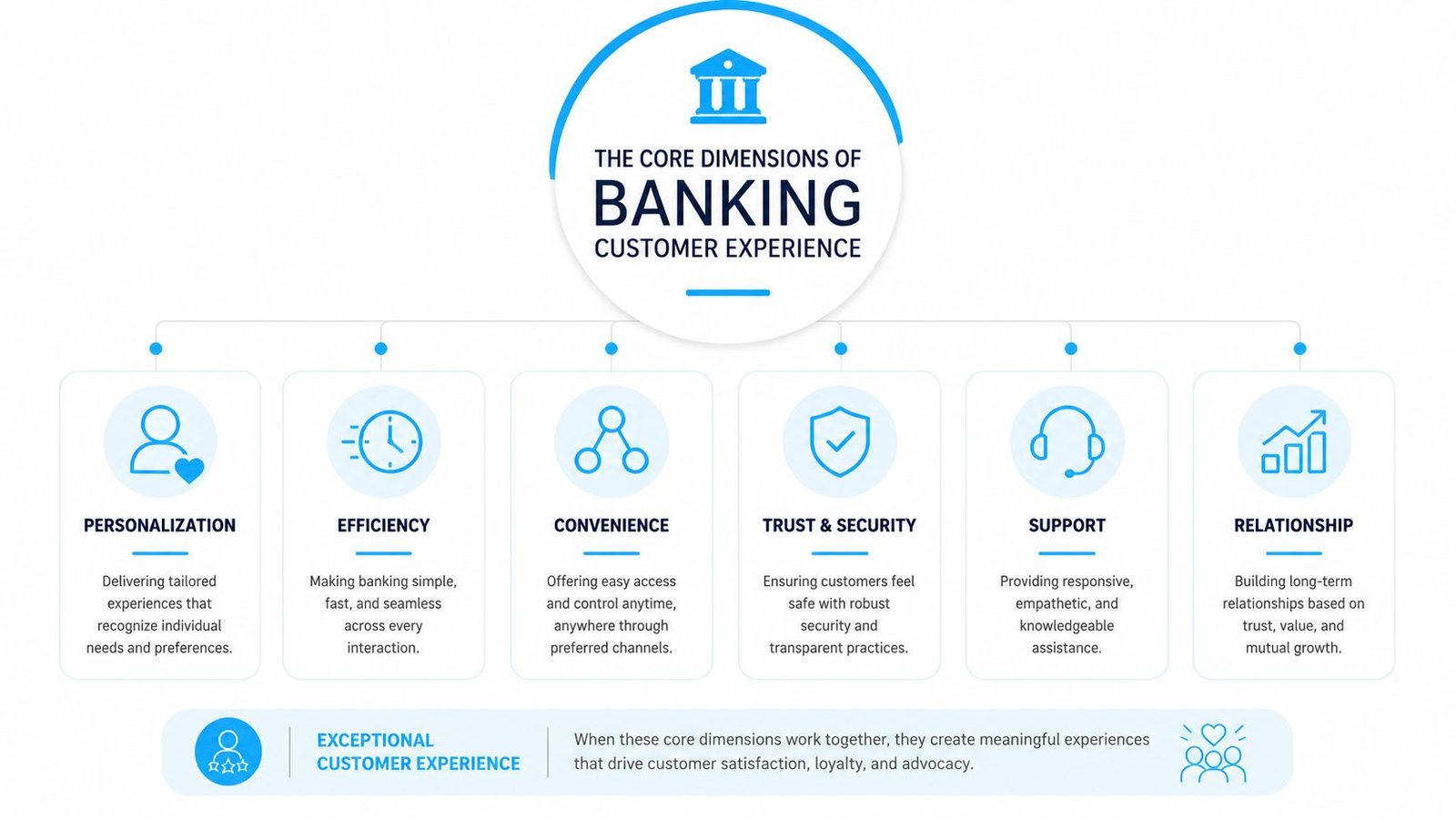
The banking CX stack is wider than many dashboards admit. A worldwide survey of more than 75,000 consumers across 33 markets found that bank customers rated overall satisfaction at just above 4.0 out of 5, while customer service scored 3.97 out of 5. The same research showed that customer service was the fourth most important banking attribute, while trustworthiness and digital services ranked among the most satisfying parts of bank relationships (Statista).
Trust, service, and digital capability work together
Customers judge the bank as one relationship, even when the bank splits work across channels, products, and back-office teams. A strong app cannot fully cover for a weak complaint process, and a helpful branch cannot undo poor digital handoffs.
The core dimensions of banking CX connect in practice:
- Trustworthiness, because customers expect their money and data to be handled carefully.
- Digital services, because convenience now shapes daily usage.
- Support quality, because unresolved issues drive the sharpest dissatisfaction.
- Communication clarity, because customers need to understand what is happening and why.
- Convenience, because access still matters.
- Relationships, because financial life is personal, not transactional.
High-stakes moments reveal where the CX model breaks
A bank can get routine service right and still lose credibility when complaints are mishandled. Customers may tolerate a delayed feature rollout or a clunky screen. They are far less forgiving when a failed transfer, card dispute, or account review leads to vague updates and repeated explanations.
That is why customer experience in banking industry should be measured by the ease of getting help as much as by the ease of using the product. Banking CX should therefore be measured by the ease of getting help, the clarity of explanations, and the speed of escalation when automation cannot settle the issue cleanly. When service is treated as a side function, the bank optimizes for the wrong part of the journey. When service is built into the product experience, loyalty is easier to defend.
Measuring What Matters With NPS CES and CSAT
NPS, CES, and CSAT are often used as if they mean the same thing. They don't. Each one captures a different layer of experience, and in banking that distinction matters because customers can like the bank overall while still hating a specific process.
| Metric | Best Use Case | What It Reveals | Common Pitfalls |
|---|---|---|---|
| NPS | Relationship health and advocacy | Whether customers would recommend the bank | Can hide frustration if customers feel stuck switching |
| CES | Service and problem resolution | How hard it was to complete a task or solve an issue | Can miss emotional trust issues if used alone |
| CSAT | Specific interactions | Whether a particular touchpoint met expectations | Can be too narrow if the survey is attached to easy moments only |
Why NPS can flatter weak experiences
NPS is useful for seeing broad sentiment, but banking customers don't always behave like free-choice shoppers. Switching costs, mortgage ties, salary deposits, or long-standing account relationships can keep a dissatisfied customer in place. That means a decent NPS doesn't guarantee the bank is removing friction.
CES is more useful when the question is operational. Did the customer have to repeat information? Did they need multiple handoffs? Did the bank resolve the matter in one flow or several? In banking, those questions often predict retention better than a generic advocacy score.
How to use the three measures together
CSAT works best for a specific event, such as a card dispute or onboarding step. NPS works best for relationship health over time. CES works best for the friction points that customers remember most. Used together, they create a clearer picture than any single survey.
The practical mistake is measuring all three but acting on none. A bank can collect scores after a complaint and still miss the operational issue if it never joins survey data to case data, channel data, and resolution times. The better pattern is simple, look for low-effort journeys that also produce positive CSAT, then compare them with high-effort journeys that trigger callbacks or escalation. That's where the redesign opportunities usually live.
Designing AI-Assisted Banking Interactions That Build Trust
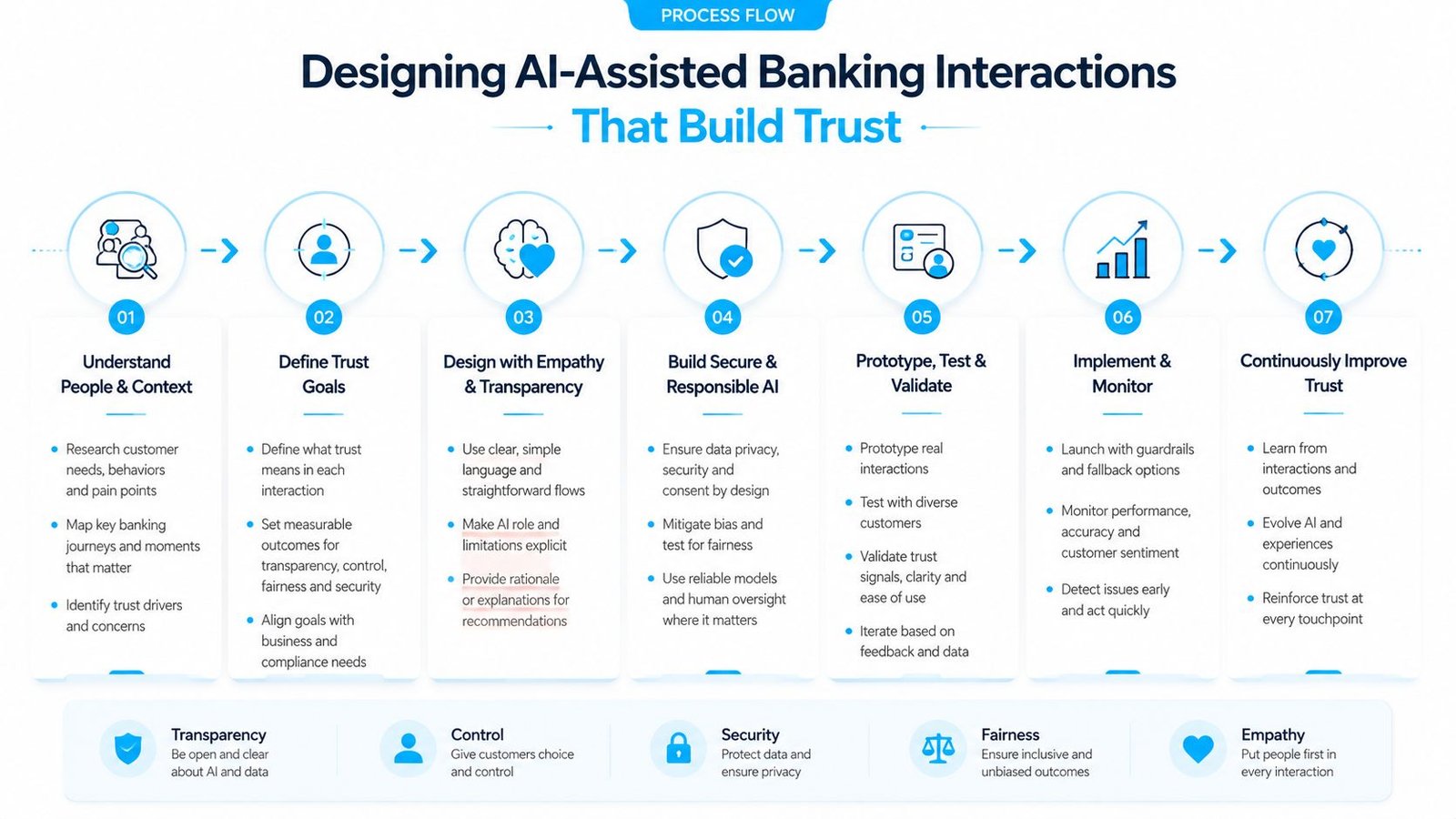
AI in banking CX is most effective when it reduces confusion without hiding the decision path. That matters because Qualtrics' 2025 consumer trends research found trust in financial institutions at 73% across 23 countries, while poor communication was the second-leading cause of negative experiences across industries, cited in 45% of cases (Deloitte).
Start with explainability, not automation volume
The temptation is to measure success by chatbot deflection or automation rate. That's the wrong target. Customers facing a fraud alert or lending decision don't just want a fast answer, they want to understand what the system saw, what it decided, and what they can do next.
A useful AI-assisted banking interaction should do three things well. It should explain the outcome in plain language, preserve the customer's context, and route to a human fast when the case is ambiguous or high stakes. If any of those three steps fails, the automation is creating friction rather than removing it.
Build escalation into the design
A chatbot that traps a customer in loops damages trust quickly. A good design makes the human fallback visible early, not hidden behind repeated prompts. That matters especially for fraud disputes, account freezes, and credit questions, where customers often need reassurance more than speed.
Banks also need to make sure AI-generated responses don't sound overly confident when the system is uncertain. Clear language like “Here's what we can confirm” is safer than false certainty. The customer should always know whether a reply is based on policy, account data, or a recommended next step.
Practical rule: If the AI can't solve the issue cleanly, it should shorten the path to a person, not stretch the conversation out.
For teams working on the technical and risk side, the internal guide at cybersecurity in banking is relevant because trust breaks fastest when service, security, and identity checks clash. AI in banking CX works best when it is transparent, controlled, and designed for handoff, not when it tries to replace judgment in situations that need it most.
Orchestrating Channels Around Customer Life Moments
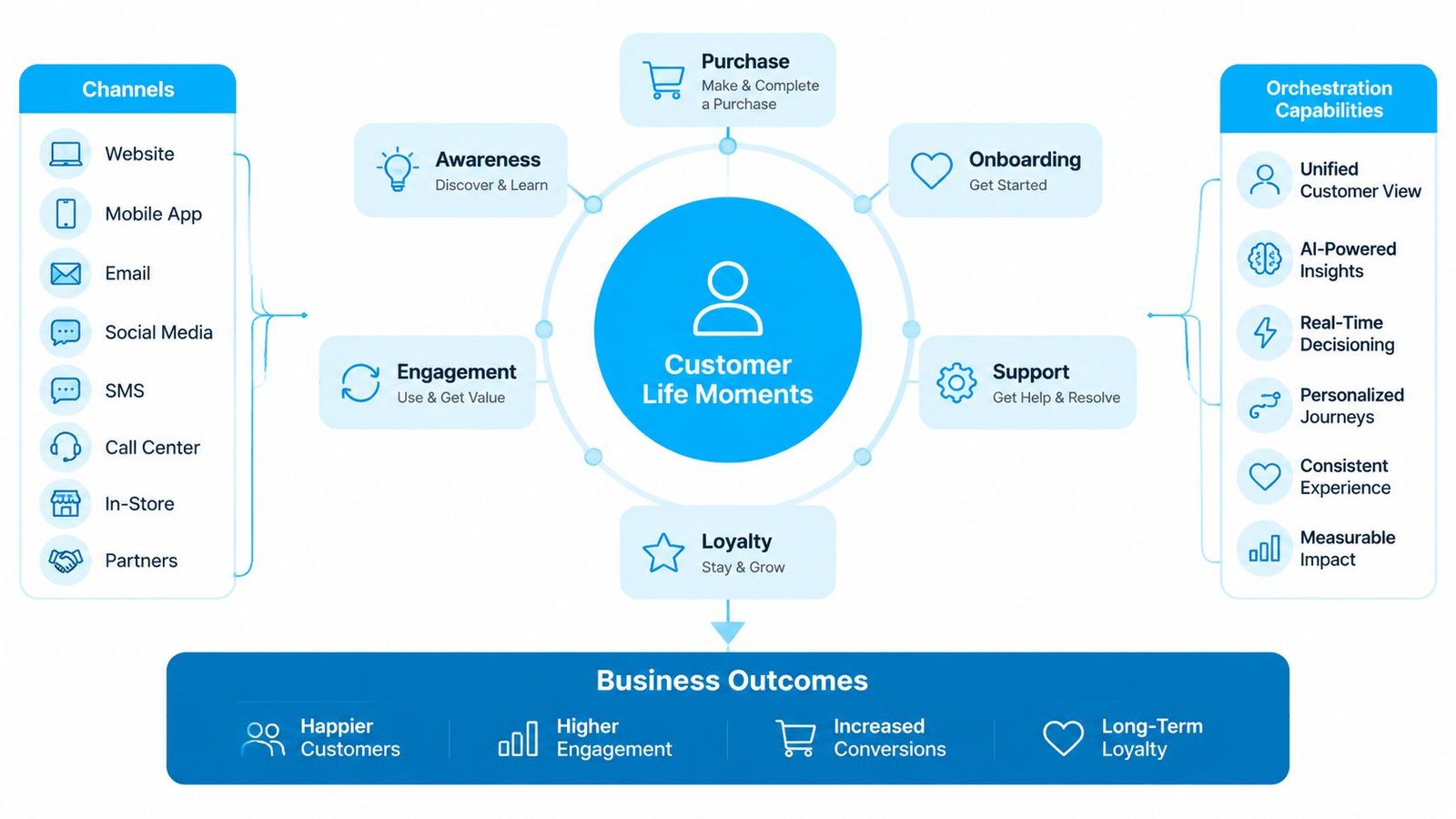
Channel strategy fails when it treats digital, phone, and branch as separate worlds. Customers don't think that way. A TP survey on digital banking found that 14% of consumers use only a digital bank, another 32% use both a traditional bank and a digital bank, for a total of 47% using a digital bank in some form (TP). That mix means orchestration matters as much as channel availability.
Match the channel to the moment
Not every banking moment belongs in the same channel. Simple balance checks and quick transfers fit app-first journeys. Onboarding, dispute handling, and account recovery need a richer design because the customer is carrying uncertainty from one step to the next.
Intelligent routing matters. The bank should know when to keep the customer in self-service, when to switch to live chat, and when to hand off to a phone specialist or branch colleague without making the customer repeat the story. Continuity is the point, not the channel label.
Preserve context across the handoff
The main failure in multi-channel banking is not lack of choice. It's the reset. Customers don't want to re-enter identity details, explain the issue again, or discover that one team can't see what another team already captured. The orchestration layer has to carry the conversation forward.
That's also why the internal guide on internet and mobile banking fits this topic. Digital access only becomes a true CX advantage when the bank connects it to conversation memory, case history, and escalation paths.
A bank that offers many channels but no shared context is still making the customer do the work.
The strongest orchestration models connect the app, service desk, and branch into one customer story. That's especially important during high-stakes financial moments, when the customer doesn't care which team owns the issue. The customer cares whether the bank can finish it.
Real-World Examples of Banking CX Transformation
The most useful transformation stories are rarely about one magic platform. They're about banks changing the way support is delivered around customer need. A current signal comes from EY's May 2026 report, which found that 55% of Indian banking customers want improved digital support across the app, web, and chatbot channels, while about 70% feel financially understood by their banks (EY).
What digital-first banks tend to get right
Digital-first banks usually win on speed, clarity, and low-friction everyday tasks. Their advantage isn't just a cleaner interface. It's the way they design fewer dead ends into the journey. Customers can move faster because the experience is built around quick action and direct support access.
That said, digital-first strength can become a weakness if the bank over-relies on self-service. When a case becomes complex, the customer needs a fast path to a human with context already attached. Banks that fail there create the impression of efficiency without real help.
What traditional banks get right when they modernize well
Traditional banks often have stronger service instincts in branch or relationship-led environments. Their challenge is to bring that responsiveness into the app, call center, and complaint journey. The institutions that do this well usually stop thinking in product silos and start thinking in customer episodes.
The common pattern is not full replacement of old channels. It's selective modernization. Banks preserve the trust value of human support while making digital channels more useful, especially for routine but time-sensitive needs. That combination fits customers who feel financially understood but still want better digital support when the issue becomes urgent.
The weak examples are predictable. A bank launches a chatbot, but escalation is opaque. A branch team solves the issue, but the app has no memory of the case. A complaint is logged, but the customer gets status updates that don't clarify the next action. None of those failures is about technology alone. They're orchestration failures.
Your Banking CX Implementation Roadmap
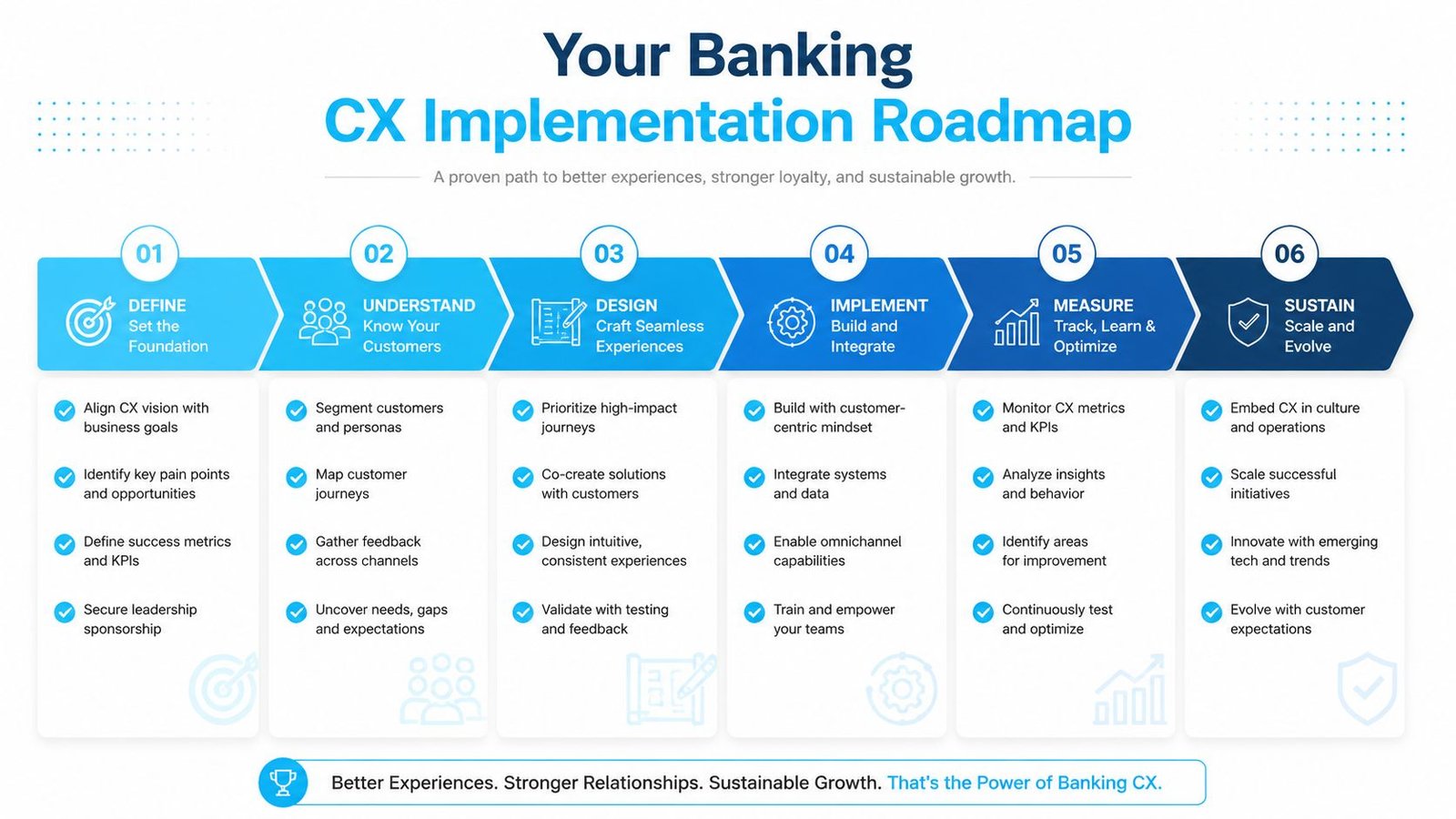
A useful CX roadmap starts with one uncomfortable question, where do customers get stuck when the issue matters most? That answer should drive priorities, not whatever feature is easiest for technology teams to ship. Without that discipline, the bank ends up with more tools and the same frustration.
Step one through three
- Map the stressful journeys first. Onboarding, fraud, overdraft recovery, and complaint handling usually reveal the biggest gaps.
- Join survey data to case data. NPS or CSAT alone won't show where the process breaks, but together with contact reasons and escalation patterns, they usually will.
- Design a human fallback path. If the customer can't reach a person fast, automation has just moved the pain around.
Step four through six
- Modernize context transfer. Make sure the next agent sees what the previous channel captured.
- Set AI guardrails. Use automation where it can summarize, route, and explain, but not where it needs to improvise policy.
- Measure recovery, not just adoption. Track whether fewer customers abandon, repeat themselves, or complain after contact.
The internal guide on AI risk management software is relevant here because CX programs often fail when governance arrives too late. Banking leaders need a control model that supports experimentation without letting opaque automation create service or compliance risk.
The fastest route to better banking CX is usually not a bigger feature list. It's fewer broken handoffs, clearer explanations, and a shorter path to resolution.
Banks that succeed usually start with one journey, prove the operating model, and then scale. That is slower than a marketing launch, but it's how CX becomes durable instead of decorative.
Vaira's View covers practical AI, banking, and finance strategy with the kind of detail that helps leaders make better decisions, not just chase trends. If this perspective on banking CX, AI-assisted service, and high-stakes customer journeys is useful, visit Vaira's View for more research-driven analysis and career-focused coverage.