
A customer reaches checkout and sees an instalment option without leaving the retailer's app. A passenger receives a virtual card inside a ride-hailing platform. A small business is offered working capital in the same software it uses to manage invoices and cash flow. In each case, the financial service appears at the point of need, inside a workflow the user already trusts.
That is the core of embedded finance. Instead of sending customers to a separate bank, lender, insurer, or payments provider, platforms integrate financial services directly into non-financial digital products. The technology may involve APIs and Banking-as-a-Service, but the bigger question is commercial: who controls the customer journey, and who captures the value when finance becomes part of it?
Table of Contents
- What Embedded Finance Looks Like in Everyday Apps
- The Four-Layer Stack Behind Every Embedded Finance Product
- Comparing BNPL, Payments-as-a-Service, and Banking-as-a-Service
- API Integration Patterns and the Architecture That Holds It Together
- Regulatory Considerations That Reshape the Product
- Where Growth Is Actually Concentrating by Region and Product
- How to Evaluate an Embedded Finance Opportunity
- What Embedded Finance Means for Banks, Platforms, and Professionals
What Embedded Finance Looks Like in Everyday Apps
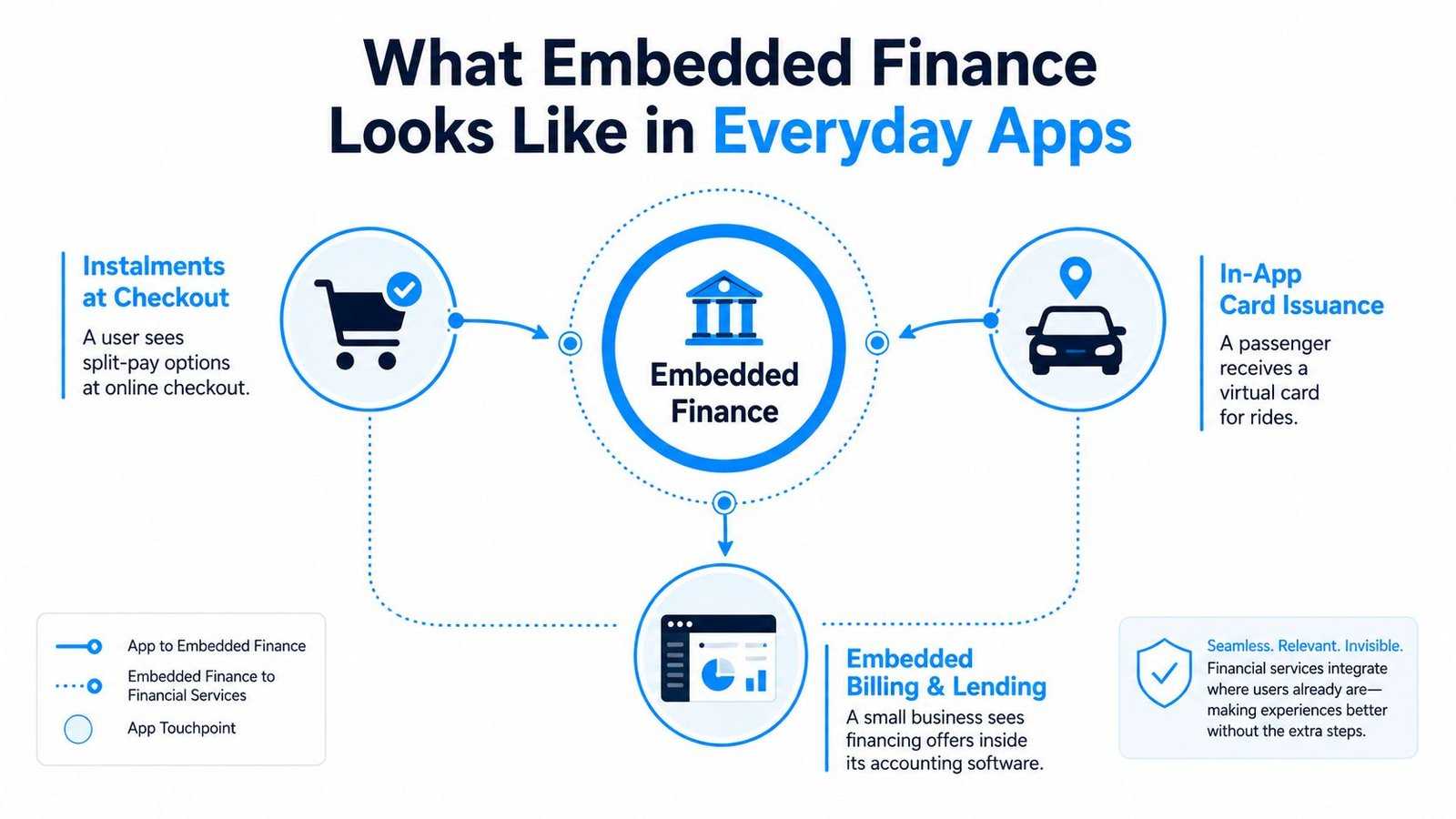
Consider an online retailer. The customer selects a product, enters delivery details, and chooses whether to pay immediately or split the purchase into instalments. The financial decision appears beside the product and payment fields, not in a separate lender portal. The retailer owns the context, while a financial provider may supply the underwriting, funding, and regulated process.
A ride-hailing application shows a second pattern. The passenger already uses the app for transport, so a virtual card or stored payment account can appear as part of the mobility experience. The user does not need to treat that card as a separate banking relationship. It works as a tool inside an existing workflow.
The B2B version is often less visible but commercially important. Accounting or operations software can surface an invoice-financing or working-capital offer when a business reviews receivables. The platform understands the customer's activity, so the offer appears when a cash-flow problem becomes clear.
The commercial shift
Traditional finance usually asks the customer to visit a bank, lender, insurer, or payment provider. Embedded finance reverses that sequence. A non-bank platform becomes the distribution point, while specialist providers supply the regulated and technical infrastructure underneath.
This matters because distribution can be as valuable as the balance sheet. A software platform may know when a merchant needs financing, when a marketplace seller needs faster settlement, or when a customer is ready to pay. Banks still provide critical capabilities, but the platform often controls the interaction that makes the product relevant.
Market estimates show why banking and fintech professionals take this seriously. One 2025 estimate placed the global embedded-finance market at about USD 148.38 billion, with a projection of roughly USD 1.73 trillion by 2034 and a 31.53% compound annual growth rate from 2025 to 2034, as reported by Precedence Research's embedded finance market analysis. A separate estimate placed the sector at USD 149.1 billion in 2025, projecting USD 1.3 trillion by 2035 at a 24.2% CAGR, which indicates that different methodologies still point toward rapid expansion.
For professionals tracking AI in banking, the key point is that embedded finance is a distribution model, not a single product. The same model can support a checkout payment, a business account, a card programme, or a credit offer.
The Four-Layer Stack Behind Every Embedded Finance Product
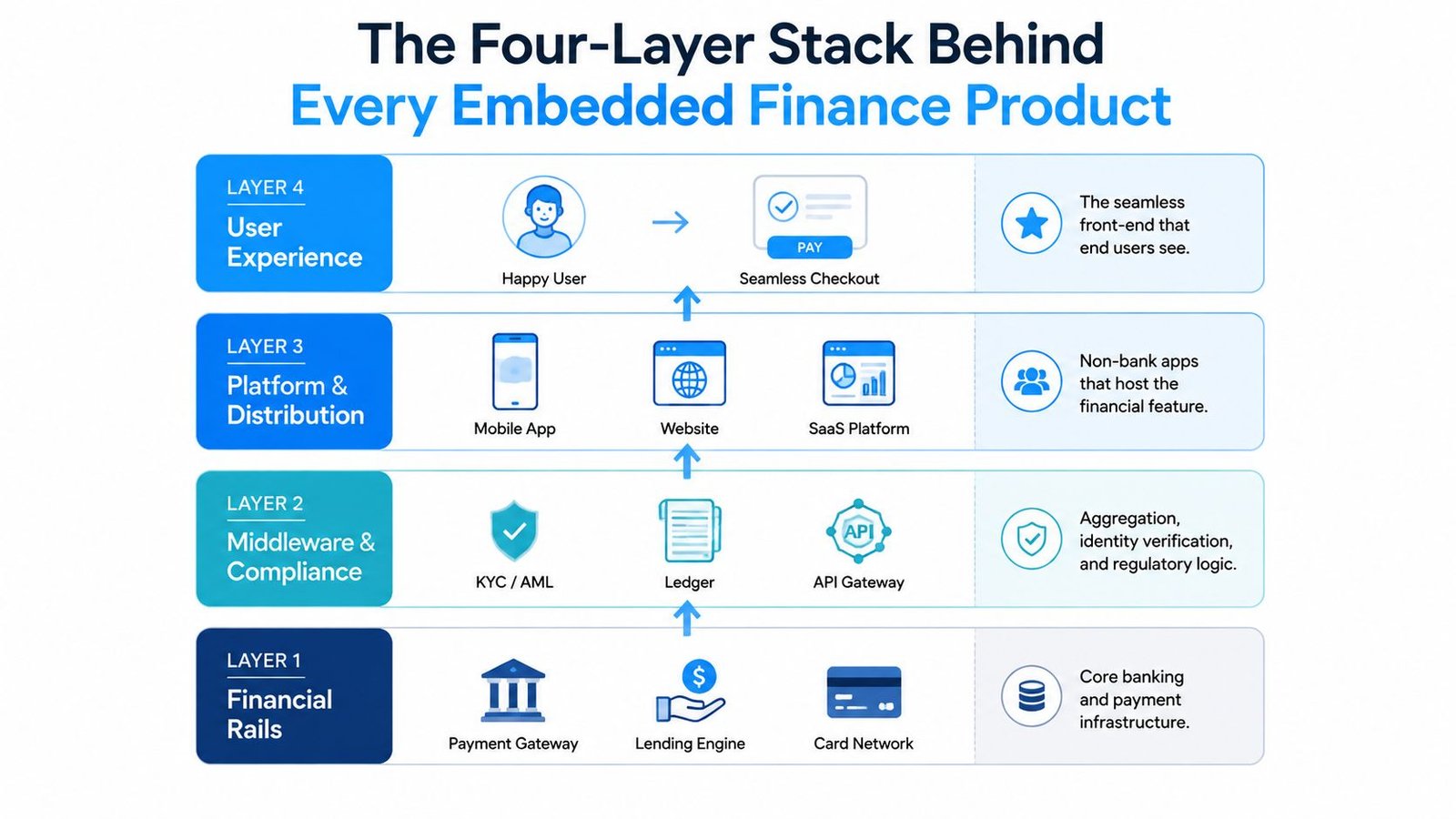
A useful way to assess any embedded-finance proposal is to separate the product into four layers. This helps clarify what the customer sees, what the platform integrates, and where risk and margin sit.
Distribution
Distribution is the non-financial surface where the user already works. It might be an e-commerce checkout, a payroll platform, a marketplace, a mobility app, or an enterprise dashboard.
A marketplace that adds seller payouts has a distribution advantage because it already sees orders, fulfilment events, and settlement needs. The trade-off is that the platform becomes responsible for a financial experience it may not fully control. Poor disclosures, confusing statuses, or failed payments can damage trust in the core software as well as the financial feature.
Financial rails
The rails provide the underlying financial action. They can include payment processing, lending, accounts, card issuing, or insurance. A card programme, for example, may require connections to an issuer, a card network, authorisation services, and settlement processes.
The benefit is speed to capability. A platform can offer a financial feature without building every underlying rail. The trade-off is dependence. Changes in a provider's coverage, pricing, risk policy, or availability can affect the platform's product roadmap.
Orchestration
Orchestration coordinates the steps between the user interface and the financial rails. It can route transactions, transform data, manage consent, connect identity checks, update ledgers, and handle events such as settlement or refunds.
This layer is often underestimated because it is not always visible in a product demo. Yet it determines whether multiple providers can operate as one coherent experience. A platform might use one partner for identity, another for payments, and another for lending. Without orchestration, each connection creates separate state management, reconciliation, and operational work.
Compliance
Compliance governs who may provide the service, which customer checks apply, how funds move, and which disclosures the user receives. Depending on the product and market, this can involve licensing, sponsor-bank relationships, KYC and AML controls, credit rules, fraud monitoring, and record keeping.
Practical rule: A vendor pitch should identify the owner of every layer, not merely show an attractive API.
The stack also explains margin allocation. The distributor owns customer context, the rails provide regulated capability, the orchestrator reduces operational complexity, and the compliance model determines who carries obligations. A proposal that looks inexpensive at the API layer may still impose substantial costs in monitoring, support, reconciliation, and governance.
Comparing BNPL, Payments-as-a-Service, and Banking-as-a-Service
These three models are often grouped together because all can appear inside a non-bank product. They do not occupy the same position in the stack, however. BNPL generally adds a credit decision and repayment flow to a purchase. Payments-as-a-Service exposes payment acceptance and related processing capabilities. Banking-as-a-Service, or BaaS, reaches deeper into regulated account and card infrastructure.
| Business Model | Layers of the Stack Used | Licensing Burden | Typical Merchant | Main Revenue Source |
|---|---|---|---|---|
| BNPL | Distribution, lending rails, payment orchestration, compliance | Usually shared with or carried by the lending and regulated partners, but the platform still manages customer-facing obligations | Retailers, marketplaces, and platforms with a purchase flow | Merchant fees, financing economics, or revenue sharing |
| Payments-as-a-Service | Distribution, payment rails, orchestration, reconciliation, compliance | Often handled through payment partners, with responsibilities allocated by the operating model | SaaS platforms, marketplaces, and merchants that want branded payment acceptance | Processing, platform, and transaction-related fees |
| Banking-as-a-Service | Distribution, account and card rails, orchestration, ledgering, compliance | Heavier dependence on licensed banks, sponsor arrangements, and regulated operating controls | Fintechs, software platforms, and businesses offering accounts or cards | Programme, interchange, account, and service economics |
BNPL sits close to the transaction
A retailer chooses BNPL when the commercial objective is to give the buyer another way to complete a purchase. The merchant integrates eligibility, offer presentation, acceptance, repayment information, and settlement. The lender or credit partner may handle underwriting and funding, but the retailer still owns much of the customer-facing experience.
The model's strength is contextual relevance. Its weakness is that credit rules, affordability decisions, complaints, and disclosure requirements can alter the checkout design. BNPL is not just a payment button with a different label.
Payments-as-a-Service exposes the transaction layer
Payments-as-a-Service is broader than a single instalment product. A platform may use it to onboard merchants, accept cards or bank payments, manage payouts, handle refunds, and reconcile balances. The provider supplies infrastructure and orchestration so the merchant can present a branded payment experience without building the full acquiring and operational stack.
This model fits software businesses whose customers already process transactions inside the product. The key buying questions concern geographic coverage, settlement design, dispute handling, reporting, and the division of operational responsibility.
BaaS reaches into account infrastructure
BaaS allows a platform to expose account, deposit, card, or other banking functions through APIs and a licensed partner. The end user may see a branded account or card, but the platform is not automatically a bank. The arrangement depends on the sponsor bank, programme controls, customer checks, ledgering, and ongoing oversight.
BaaS creates more product surface area than a payment integration, which can support deeper customer relationships. It also creates a heavier operating model. A platform must understand balance accuracy, access controls, transaction monitoring, support escalation, and partner continuity before it treats account infrastructure as a simple feature.
API Integration Patterns and the Architecture That Holds It Together
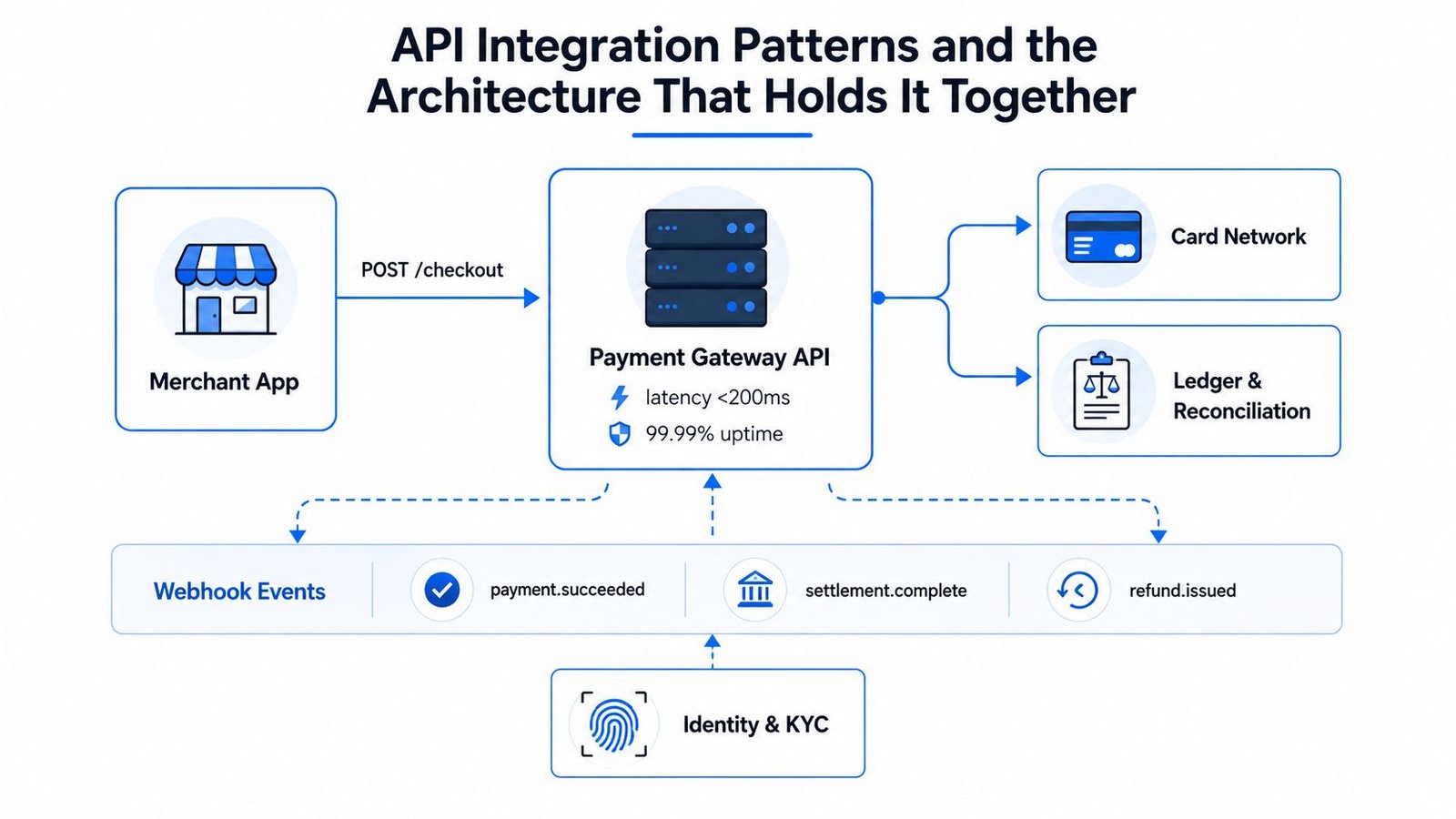
An embedded-finance integration rarely consists of one API call. A platform usually connects a user action to identity checks, risk decisions, payment or account rails, ledger updates, notifications, and reconciliation.
A SaaS platform issuing cards illustrates the sequence. The user requests a card in the dashboard. The platform sends customer and business information to an identity or KYC service, receives a decision, creates or updates a ledger record, calls the issuing API, and stores the card status. Later, authorisation events arrive through webhooks, while settlement and reconciliation systems update the platform's internal view.
The main building blocks
APIs handle synchronous requests, such as creating a payment intent or requesting a card. SDKs can simplify front-end integration, but they do not remove the need for secure server-side controls. Webhooks communicate events that happen after the original request, including successful payments, refunds, disputes, and settlement.
A dependable implementation also needs:
- An internal ledger: The platform needs a reliable record of balances, holds, fees, refunds, and adjustments.
- Reconciliation workflows: Internal records must be compared with provider statements and settlement files.
- Identity services: KYC, KYB, authentication, consent, and access controls must work together.
- Idempotency and retries: Failed network calls should not create duplicate charges or duplicate financial records.
- Observability: Teams need transaction tracing across the platform, provider, ledger, and support systems.
Reliability becomes part of the product
In ordinary software, a delayed third-party response may frustrate a user. In finance, the same delay can create duplicate submissions, an incorrect balance, or a support dispute. Latency, uptime, authentication, and event ordering become product concerns, not merely infrastructure metrics.
The scale of the opportunity explains the need for disciplined architecture. Bain estimated that embedded finance represented $2.6 trillion in US transaction value in 2021, nearly 5% of total financial transactions, and projected that it would exceed $7 trillion by 2026, more than 10% of US transaction value. The same Bain analysis of embedded finance estimated platform-and-enabler revenue at $22 billion in 2021, rising to $51 billion by 2026, implying a 19% CAGR.
A separate industry summary reported $228 billion in total embedded-finance transaction value in 2024 across measures such as platform revenue, users, transaction volume, and transaction value, as described in Mordor Intelligence's embedded finance market overview. Because these sources use different definitions and scopes, the figures should not be combined mechanically. Together, they show why integration reliability and transaction operations deserve executive attention.
Regulatory Considerations That Reshape the Product
Regulation changes the product before launch. A platform cannot decide the user interface, data flow, or commercial model first and attach compliance controls later. The legal structure determines which partner must hold a licence, which customer checks apply, who monitors activity, and how the platform handles complaints.
A sponsor bank may provide regulated infrastructure for accounts or cards, but the software platform still needs clear responsibility boundaries. KYC and KYB data must be collected, verified, stored, and refreshed according to the operating model. AML monitoring, fraud controls, sanctions screening, transaction records, and suspicious activity escalation also require defined ownership.
A BNPL expansion example
A BNPL product that works in the United Kingdom may need material changes before entering Germany. The product team cannot assume that the same eligibility logic, disclosures, affordability process, repayment presentation, data handling, and complaints route will transfer unchanged.
A responsible expansion process would ask:
- Which entity provides or arranges the credit?
- Which permissions and regulated partners are required in the target market?
- What information must the customer receive before accepting the offer?
- How must affordability, identity, fraud, and repayment risk be assessed?
- Where may customer and transaction data be processed?
- Which team handles complaints, missed payments, and regulatory reporting?
The result may be a different checkout flow, a different underwriting sequence, or a decision not to launch the product in that market. Regulatory geography is a design constraint, not a final approval gate.
Compliance should be treated as an architecture input. If a requirement changes data access or decision timing, it changes the customer journey too.
Teams evaluating automated controls can also review AI risk management software as part of a broader governance discussion. Technology can support monitoring and decision workflows, but it does not transfer accountability away from the regulated entity or the platform's leadership.
Data residency and open-banking arrangements add further complexity. A provider may have strong APIs but limited coverage in a target region, while a local payment rail may require different authentication, settlement, or consent patterns. The right partner is therefore the one whose licensing, infrastructure, controls, and operating model fit the market, not just the one with the most attractive developer documentation.
Where Growth Is Actually Concentrating by Region and Product
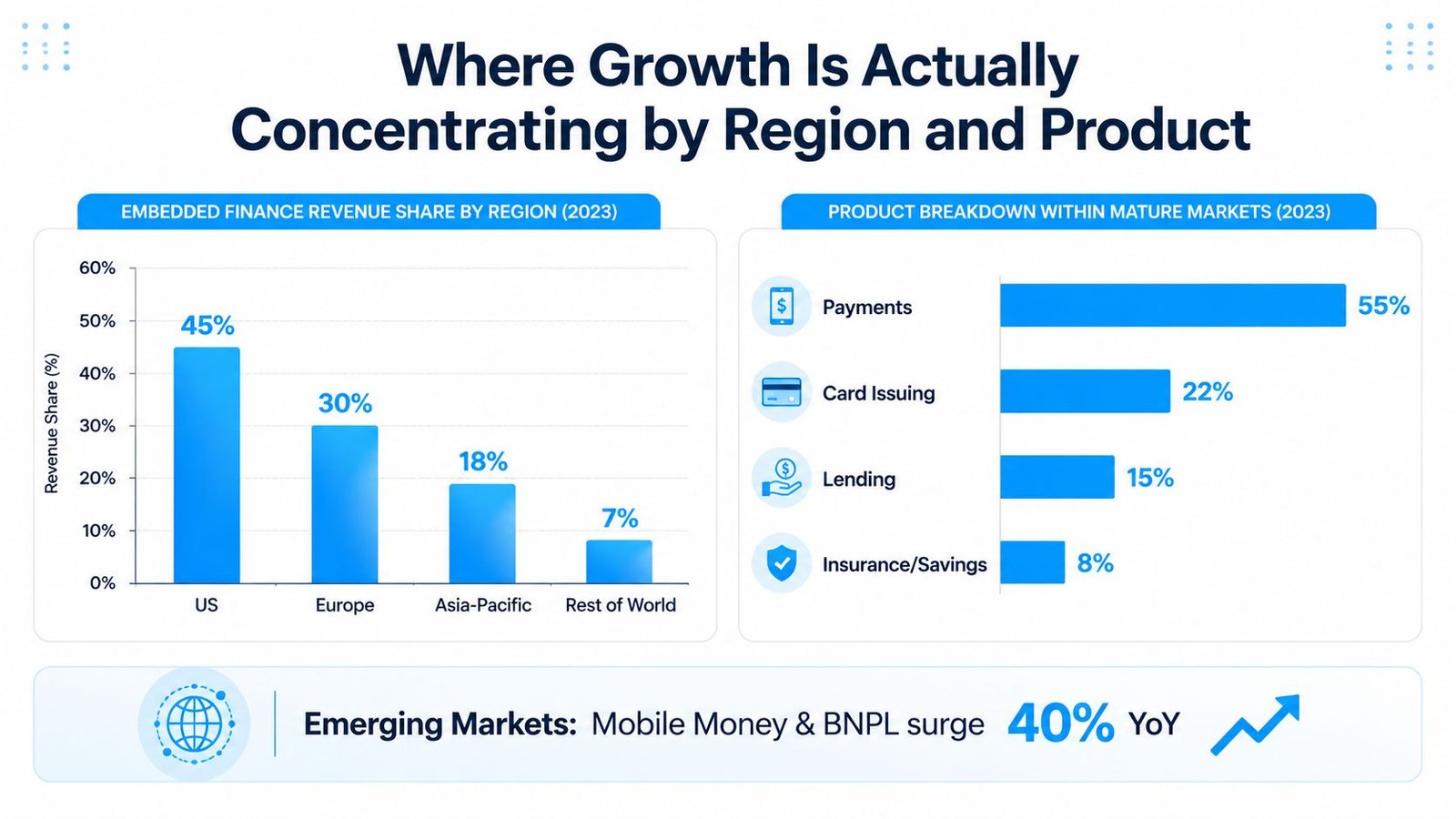
Embedded-finance forecasts describe a large opportunity, but that opportunity is not evenly distributed across regions or product categories. Mature markets tend to support clearer monetisation in payments, accounts, and card issuing because platforms already have established digital workflows and partner infrastructure.
BCG estimated the total addressable market for embedded finance in North America and Europe at about USD 185 billion in 2025 across payments, capital solutions, accounts, and card issuing, while current penetration was around USD 32 billion. The gap indicates substantial room for expansion, but it also shows where the most measurable opportunity is concentrated. The BCG analysis of embedded finance moving from promise to practice frames the category around specific monetisation pools rather than a single undifferentiated fintech market.
Region changes the stack
North American and European platforms often build around card networks, account infrastructure, payment facilitation, and lending partnerships. Asia-Pacific may require a different combination of wallets, domestic payment rails, mobile-first interfaces, and local identity or licensing arrangements. The core idea remains the same, but the rails and compliance layer can change substantially.
The regional outlook is also not uniform. Polaris expects Asia-Pacific to be the fastest-growing region, while other market estimates place North America at roughly one-third of global revenue, as summarised in Global Market Insights' embedded finance analysis. Those estimates use different methodologies, so the regional proportions should not be treated as a single definitive market map.
The MENA region illustrates why local analysis matters. The World Economic Forum cited a projection that the region's embedded-finance market would grow from $11.2 billion in 2024 to $37.7 billion by 2029, within a broader projection of $7.2 trillion globally by 2030, based on a Dealroom and ABN AMRO Ventures report discussed in the World Economic Forum's embedded finance coverage.
Product categories don't mature together
Payments usually have a direct transaction event, making fees and performance easier to measure. Cards can deepen a platform relationship when spending controls or payouts fit the user's workflow. Lending can be valuable where the platform has useful operational data, but credit losses, funding, affordability, and collections make the model more demanding.
Embedded insurance and wealth products are harder to scale consistently because the customer need, advice boundary, underwriting, suitability, distribution economics, and servicing model can vary by market. Their frequent appearance in trend lists should not be confused with equivalent commercial maturity.
How to Evaluate an Embedded Finance Opportunity
A product, strategy, or risk team can test a proposal against six questions. Each maps back to the stack and exposes a different failure mode.
-
Distribution fit: Does the financial action occur naturally inside the platform's workflow? If users rarely need the service in context, the integration may add complexity without meaningful adoption.
-
Regulatory burden: Which entity holds the relevant permissions, performs customer checks, monitors activity, and handles complaints? An unclear answer is a go or no-go issue.
-
Integration cost: Can the platform support APIs, webhooks, ledgering, reconciliation, retries, reporting, and operational support? A product estimate that includes only front-end development is incomplete.
-
Unit economics: Which party receives transaction, programme, servicing, or revenue-share income, and which party absorbs losses, disputes, refunds, and support costs? The commercial model should reflect the full operating burden.
-
Vendor concentration: What happens if a provider changes its risk appetite, pricing, coverage, or access? Teams should identify replacement paths before the first customer depends on the service.
-
Exit optionality: Can the platform migrate accounts, cards, payment tokens, customer records, and transaction history without breaking the user experience? Exit design protects the business from becoming permanently locked into one partner.
Decision test: A strong opportunity has clear user context, defined regulatory ownership, manageable integration work, credible economics, and a realistic partner-continuity plan.
What Embedded Finance Means for Banks, Platforms, and Professionals
For banks, embedded finance turns distribution into a service that can be exposed through BaaS and partnerships, rather than defended only through traditional channels. For platforms, the advantage comes from user context, workflow ownership, and reliable integration. For professionals, the strongest opportunities sit at the intersection of product, APIs, compliance, data, and platform economics.
Revenue will likely remain concentrated in established product lines while regional rails and regulatory models diverge. Embedded wealth and insurance may develop more selectively than broad market narratives suggest. Professionals can follow the operating model, technology, and career implications through banking and finance coverage.
Vaira's View publishes practical, research-driven analysis on AI, banking, finance, fintech, professional technology, and future careers. Visit Vaira's View for clear guides on banking technology, risk and compliance, AI tools, certifications, and the skills professionals need as financial services become more software-led.
Pingback: Compliance Risk in Banking: Types, Examples & Controls
Pingback: What Is Nostro? the Banking Account Powering Global Payments