
Wolters Kluwer AI Risk and Governance Index
Only a minority of organizations appear to have fully operational AI governance in place, even as awareness of AI regulation continues to rise. That gap matters for banks and financial institutions, because software selection is not just about model performance. Governance also requires identifying models and shadow tools, assigning accountable owners, validating controls, monitoring change, and producing defensible evidence for auditors or regulators.
AI risk management software addresses that operational burden. Strong platforms can connect model inventories, validation, policy workflows, monitoring, third-party assessments, incident management, and audit evidence. They can also help surface unregistered AI use that inventory-led governance misses.
Weaker products stop at compliance dashboards. They can display status without showing that controls actually operated, exceptions were resolved, or evidence remained traceable over time. That distinction matters under supervisory review.
Table of Contents
- Why AI Risk Management Software Became an Enterprise Priority
- The 2026 Regulatory Framework for AI in Financial Services
- Three Categories of AI Risk Management Software
- Leading Vendors and Deployment Models
- The Shadow AI Problem Most Vendors Ignore
- Selection Checklist Mapped to Regulatory Requirements
- Situational Recommendations by Organization Type
Why AI Risk Management Software Became an Enterprise Priority
Forecasts place the AI risk management market at USD 6.03 billion in 2025, rising to USD 14.74 billion by 2032, according to a 360iResearch market estimate. The same source projects a 13.62% CAGR for 2026 to 2032. Market forecasts should not be treated as precise fact, but they do support a narrower conclusion: AI risk management software is emerging as a distinct enterprise category rather than a minor feature inside broader analytics platforms.
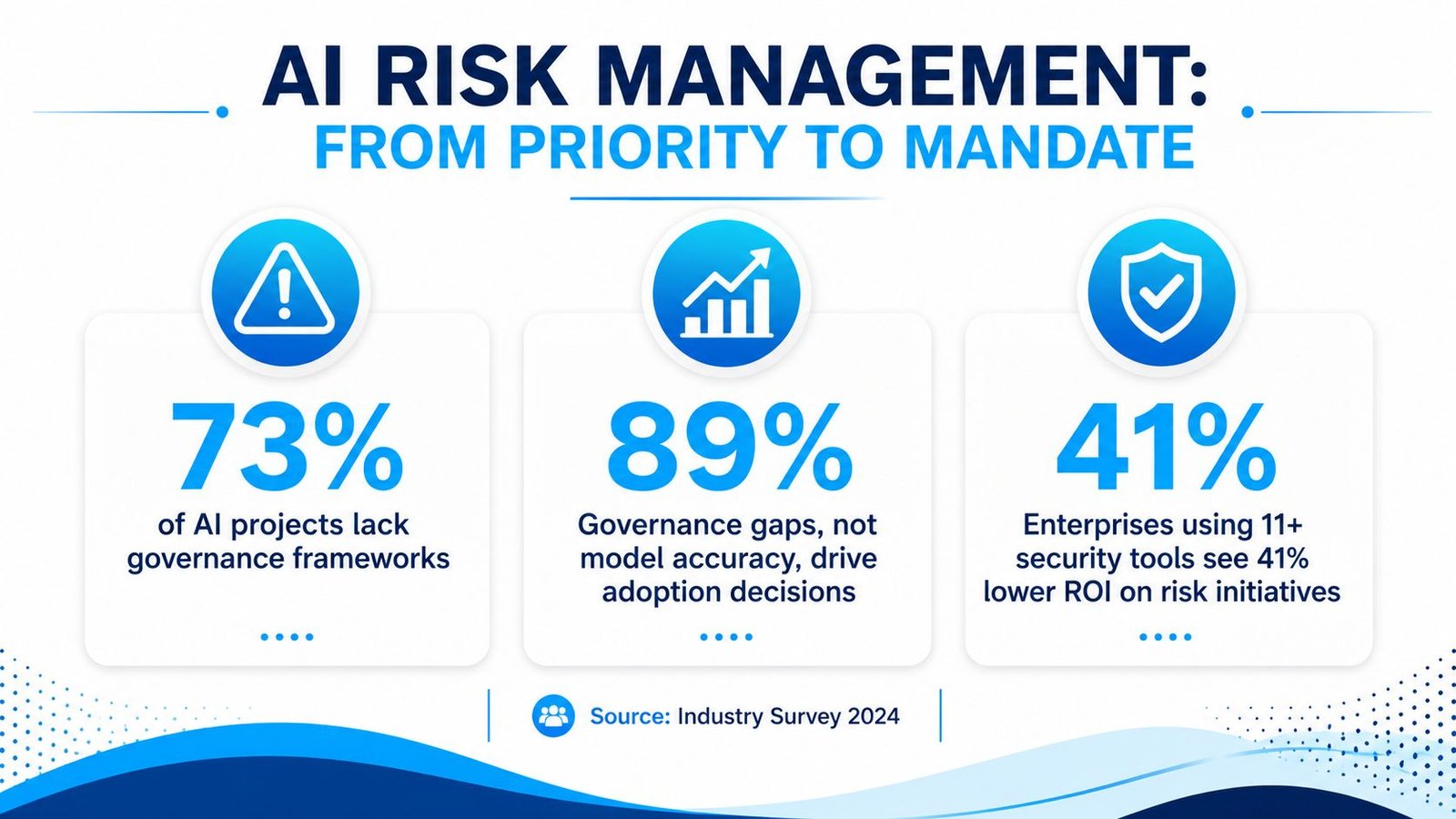
Demand is driven by the gap between AI adoption and operational control. Financial institutions may recognize risks such as explainability, fairness, third-party dependence, and undocumented model use, but recognition alone does not create a repeatable control process. For regulated organizations, that execution gap is what turns governance software from a reporting tool into operating infrastructure.
From documentation to operating infrastructure
Many institutions still rely on spreadsheets, shared folders, email approvals, and manually assembled validation packs. Those methods may support a limited portfolio. They become fragile as models change, vendors introduce opaque components, and business teams adopt generative AI outside formal technology channels.
A capable platform should create a controlled record for every in-scope AI system, including shadow AI discovered through access, procurement, endpoint, or data-flow signals. Each record needs an owner, purpose, risk classification, affected processes, data dependencies, approval status, validation history, monitoring results, incidents, and retirement decision. The platform should preserve the evidence supporting those fields and record changes, rather than allowing users to overwrite history without traceability.
Practical rule: A governance platform earns its place when it reduces the distance between a control requirement and the evidence proving that the control operated.
Why performance alone isn't enough
A model can meet its development objective and still create governance exposure. A credit model may be accurate but poorly documented. A fraud model may perform effectively while lacking a defined escalation route for data shifts. A generative AI assistant may produce useful output while sending confidential information to an unapproved service.
The commercial case therefore rests on control continuity. Banks need an operating layer that follows an AI system from intake and development through deployment, monitoring, material change, incident response, and retirement. In practice, the test is whether controls remain assigned, observable, and auditable across that lifecycle. Software becomes strategic when it connects the model inventory to real evidence, including exceptions, approvals, monitoring results, and shadow-use findings.
The 2026 Regulatory Framework for AI in Financial Services
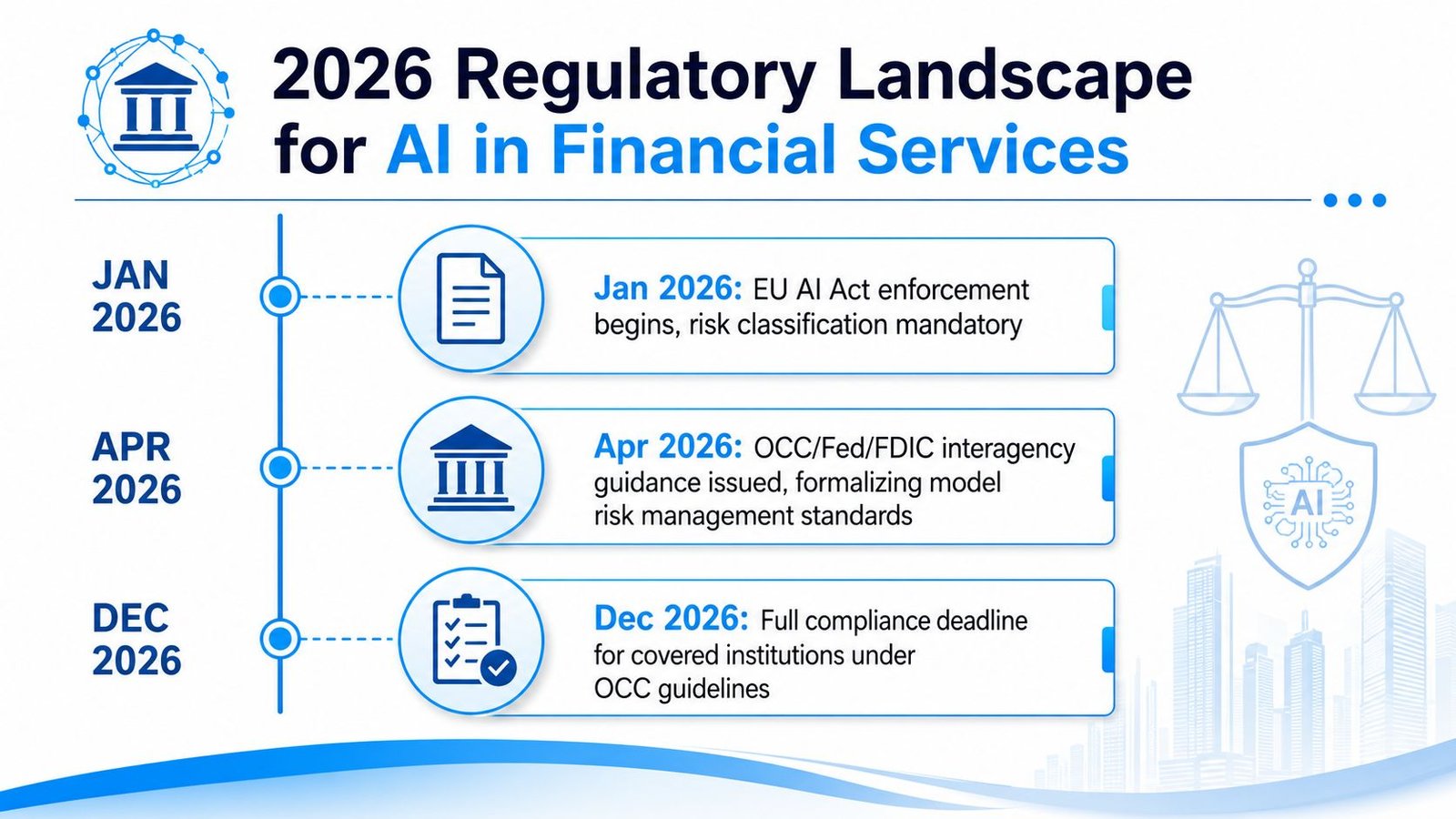
The Office of the Comptroller of the Currency, Federal Reserve, and Federal Deposit Insurance Corporation issued revised interagency model risk management guidance on April 17, 2026. The OCC published it as OCC Bulletin 2026-13. For banks evaluating AI risk management software, the guidance is useful as a practical benchmark for model governance, validation, monitoring, documentation, and oversight.
That said, the guidance should be described carefully. It is revised model risk management guidance, not a sector-wide AI rulebook. The OCC states that generative AI and agentic AI models are novel, rapidly evolving, and not within the scope of this guidance. Buyers should therefore avoid overstating it as a complete framework for all AI governance decisions.
The guidance defines a model as a complex quantitative method, system, or approach that applies statistical, economic, or financial theories to transform input data into quantitative estimates. Simple spreadsheet arithmetic and deterministic rule-based software that does not use those theories fall outside that definition. That distinction should shape inventory design. A bank should not place every automated workflow in the same model governance queue, but a narrow definition should not exclude consequential AI systems from oversight elsewhere in the control framework.
The evidence architecture banks need
The revised interagency guidance remains useful for software evaluation because it emphasizes governance as an operating system rather than a static document set. The article's software checklist should therefore focus on whether a platform can tie oversight, inventory, documentation, validation, monitoring, change management, third-party review, and audit support to retained evidence.
The guidance highlights core areas such as:
- Board and senior management oversight
- Personnel
- Policies and procedures
- Planning
- Risk assessment
- Model inventory
- Documentation
- Data management
- Model development, implementation, and validation
- Third-party risk management
- Internal audit
A useful platform should connect each area to accountable tasks, approval records, testing results, exceptions, remediation, and a preserved activity history. That is the practical dividing line between a model inventory and an auditable control system.
Treasury added a broader sector-specific layer on February 19, 2026, announcing the AI Lexicon and Financial Services AI Risk Management Framework in an official U.S. Treasury announcement. Treasury says the FS AI RMF adapts the NIST AI Risk Management Framework to financial services use cases and risk concerns. It is best understood as voluntary, sector-specific guidance rather than a binding regulation.
Some secondary analyses describe the framework as including 230 control objectives. Because that figure is not stated in the Treasury press release itself, it is safer to treat it as commentary on the framework rather than as an official Treasury claim. For buyers, the more practical question is simpler: can the platform map controls to owners, systems, evidence, exceptions, and remediation status?
Banks assessing the wider AI in banking context should treat regulatory mapping as a data model, not a marketing label. That model should also expose unapproved AI use, connect shadow AI findings to the inventory, and preserve evidence that controls operated.
Three Categories of AI Risk Management Software
Buyers can assess the market more clearly by separating model risk management platforms, AI governance suites, and MLOps platforms with governance features. These categories overlap, but each addresses a different operating problem. The useful test is whether a product can connect model records, ownership, workflow, and auditable controls rather than just provide policy templates.
| Category | Primary Strength | Regulatory Fit | Best For | Common Limitation |
|---|---|---|---|---|
| Dedicated model risk management platforms | Validation, inventory, model lifecycle control | Strong for banking model governance | Banks with complex portfolios and formal validation teams | Can require extensive implementation and specialist configuration |
| AI governance suites | Policy, use-case intake, risk classification, compliance workflows | Broad coverage, with variable technical depth | Enterprises governing many AI use cases across functions | May offer lighter technical validation and monitoring depth |
| MLOps platforms with governance features | Developer workflow, deployment, monitoring, model operations | Useful when linked to formal control processes | Engineering-led teams with mature data and machine learning operations | Business accountability and audit evidence may be less developed |
Dedicated model risk management platforms
These products are closest to established banking control practices. They generally support model inventories, validation plans, approval gates, performance monitoring, documentation, findings, and remediation. Their main advantage is depth. Banks can align workflows with existing model risk committees and validation teams instead of creating a separate governance language.
The trade-off is implementation effort. A platform built for formal model risk management may require connections to data warehouses, model development environments, document repositories, identity systems, issue-management tools, and enterprise governance systems. It may also be less accessible to business teams registering low-code automation or a generative AI assistant. That gap matters for shadow AI, because informal tools can remain outside the controlled inventory unless intake is simple and broadly available.
AI governance suites
AI governance suites usually begin with use-case intake. They help organizations identify proposed AI activity, classify risk, assign owners, document policies, collect assessments, and coordinate approvals. This breadth suits enterprises where AI adoption spans marketing, human resources, customer service, software development, and financial decisioning.
Their limitation becomes visible when a regulator or validation team requests technical evidence. Buyers should verify whether the suite can retain test methodology, data lineage, validation conclusions, monitoring thresholds, change history, third-party documentation, and exception decisions. Recording that an assessment was completed is not equivalent to preserving evidence that a control operated.
MLOps with governance features
MLOps platforms are strongest inside engineering workflows. They can connect code, data, experiments, deployment pipelines, model versions, performance metrics, and production monitoring. This connection helps developers detect drift and manage operational change.
The weakness is often accountability beyond engineering. A platform may identify the model version in production without showing which business process depends on it, who approved its risk, or whether internal audit can retrieve the supporting evidence. Organizations comparing these categories should also review the broader AI and technology context before selecting a platform that serves only one team. The strongest design links engineering records to business ownership, inventory status, and control evidence.
Leading Vendors and Deployment Models
Vendor evaluation should focus less on the length of a feature list and more on the platform's operating center of gravity. Representative providers commonly considered in this market include model governance and risk platforms such as IBM OpenPages, SAS, FIS, Moody's, and ModelOp, governance-focused providers such as OneTrust and Credo AI, and engineering-oriented platforms such as Databricks, Google Vertex AI, Amazon SageMaker, and Microsoft Azure Machine Learning.
That grouping is not a recommendation, and categories can overlap. It reflects the different problems each vendor group tends to prioritize. A bank with a mature validation function may value controlled approvals, findings management, and audit evidence more than an engineering team does. A fintech building rapidly may value API access, workflow flexibility, and cloud integration, while accepting that deeper regulatory evidence may require additional configuration or complementary tooling.
Deployment choices
Cloud-native deployment can accelerate implementation and simplify access to managed updates. It can also raise questions about data residency, privileged administrator access, encryption responsibilities, subcontractors, tenant isolation, and the treatment of prompts, logs, model artifacts, and validation records.
On-premises deployment offers greater control over infrastructure and may fit institutions with strict data handling requirements. It can increase the organization's responsibility for patching, availability, scalability, disaster recovery, and platform upgrades.
Hybrid deployment often fits financial institutions when sensitive model artifacts or regulated records must remain in controlled environments while workflow services integrate with cloud development and analytics. The design should make the system of record explicit. If evidence is distributed across cloud and internal repositories, the platform needs reliable synchronization and a clear history of changes.
Integration is the differentiator
A platform becomes useful when it connects to the systems where risk is created. Relevant integrations include model registries, code repositories, data catalogs, cloud machine learning services, identity providers, ticketing platforms, governance repositories, security tools, and third-party risk systems.
Buyers should request a process demonstration rather than a slide presentation. A vendor should show how a new model enters inventory, how its owner is assigned, how validation evidence is attached, how a material change triggers review, how an issue becomes a remediation task, and how an auditor retrieves the complete history. Vendor maturity is best judged by that chain of custody and by references from institutions with comparable regulatory exposure.
A platform that supports every control in theory but requires manual exports between systems may create the same fragmentation it was purchased to remove.
The Shadow AI Problem Most Vendors Ignore
Even with a governance platform in place, many banks lack a reliable view of their AI estate because teams adopt tools outside formal channels. Public assistants, embedded productivity features, code-generation tools, spreadsheet add-ins, and vendor-hosted copilots may never enter an intake process. The result is an incomplete inventory, which makes it harder to assess data access, decision impact, vendor dependency, and retention.
The ArmorCode State of AI Risk Management 2026 report points to persistent challenges around shadow AI, AI inventory, AI-generated code detection, and fragmented tooling. It also reports that 51% of enterprises use 11 or more security scanning and vulnerability management tools. That matters because fragmentation can reduce prioritization quality and visibility across systems.
Discovery must precede governance
Inventory management cannot rely entirely on employee declarations. Effective discovery combines procurement records, identity and access data, cloud service inventories, endpoint telemetry, data loss prevention signals, application repositories, and vendor questionnaires. The platform should reconcile these inputs, identify duplicate or conflicting records, and preserve the source context needed for review.
A detected tool does not automatically require blocking. A practical workflow can classify services as approved, conditionally approved, restricted, or under review. Each status should specify an owner, permitted data classes, user population, review date, and escalation path.
One platform won't solve tool fragmentation
AI risk management software can centralize decisions, but it cannot create visibility when source systems provide incomplete data. Procurement controls, employee training, access governance, data classification, and security monitoring remain separate responsibilities.
A dashboard that lists shadow AI without changing permissions, workflows, or accountability is an inventory of exposure, not a control.
The relevant buying test is whether the platform can ingest fragmented signals, normalize them, preserve source context, and trigger action. A bank should test whether a newly discovered AI service creates a review task, whether its data access can be assessed, and whether the final decision remains auditable under the bank's control framework.
Selection Checklist Mapped to Regulatory Requirements
A governance platform is only as useful as the controls it can verify. The supervisory themes in the 2026 interagency model risk guidance provide a practical vendor scorecard when tested against four questions: What workflow does the platform support? What evidence does it retain? Who owns the decision? What happens when the control fails?
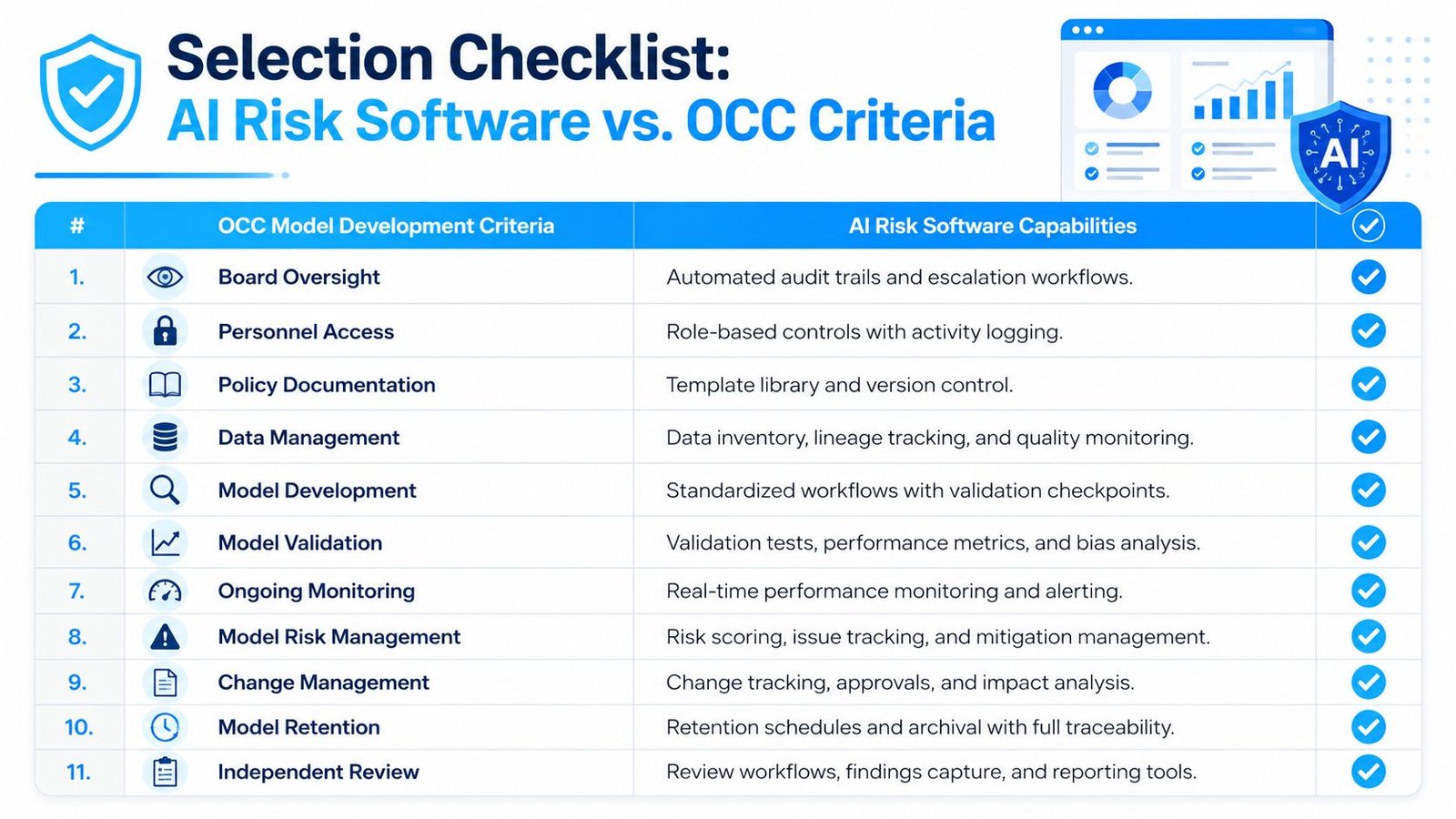
| Regulatory Criterion | Required Software Capability | Evidence to Collect | Audit Trail Requirements |
|---|---|---|---|
| Board and senior management oversight | Approval dashboards, escalations, committee workflows | Decisions, meeting records, risk reports | Timestamped approvals and changes |
| Personnel | Role-based access and responsibility assignment | Training, qualifications, ownership records | User activity and permission history |
| Policies and procedures | Version-controlled policy library | Approved policies and exceptions | Prior versions and approval chain |
| Planning | Intake, milestones, dependencies, release gates | Project plans and readiness reviews | Status changes and sign-offs |
| Risk assessment | Configurable assessment methodology | Risk ratings, rationale, mitigations | Assessment history and reassessment triggers |
| Model inventory | Searchable inventory with lifecycle states | Model records, owners, status, use case | Creation, modification, and retirement history |
| Documentation | Structured documentation templates | Development, use, limitations, and assumptions | Version comparison and reviewer records |
| Data management | Lineage, quality records, access references | Sources, transformations, quality issues | Changes to data mappings and approvals |
| Model development, implementation, and validation | Testing, validation, deployment, and monitoring workflows | Test results, validation reports, release decisions | Model version and environment history |
| Third-party risk management | Vendor assessments and contract evidence | Supplier reviews, controls, attestations | Review dates, findings, and remediation |
| Internal audit | Evidence export, sampling, issue management | Audit requests, findings, corrective actions | Complete retrieval history and closure records |
The table is most useful when treated as an operating test, not a checklist label. Software should connect each criterion to an owner, workflow, evidence set, and failure response. That distinction matters for shadow AI too: a discovered application should be traceable to its data access, accountable owner, review status, and remediation record.
How to score a vendor
A procurement committee can rate each capability as demonstrated, configurable, dependent on integration, or absent. That distinction separates a feature shown in a demonstration from a control proven in a realistic workflow.
Use a representative model and a material-change scenario. The vendor should demonstrate intake, inventory creation, risk assessment, validation evidence, exception approval, monitoring results, issue escalation, third-party documentation, and internal audit export. The exercise should also test whether records remain connected when information enters through different systems.
A platform that cannot preserve those relationships may leave the bank assembling evidence manually. Integration quality therefore belongs in the score, alongside native functionality.
Evidence beats assurance: The decisive demo is not a dashboard tour. It is the retrieval of a complete, time-ordered control record.
Situational Recommendations by Organization Type
A large bank should not select the same platform as a fast-growing fintech simply because both use machine learning. The right architecture depends on model portfolio complexity, regulatory exposure, internal validation capacity, technology stack, and the degree of shadow AI already present.
Large banks
Large banks generally need a dedicated model risk management platform, potentially combined with a broader AI governance layer. The priority should be a dependable system of record for model inventory, validation, findings, third-party dependencies, committee approvals, and audit evidence.
A cloud-native deployment may work for workflow data, while sensitive artifacts remain in controlled repositories. Hybrid architecture deserves close attention where the bank operates across jurisdictions or uses several cloud providers. Implementation should begin with inventory reconciliation and integration design, not with a broad policy rollout that leaves technical records disconnected.
Fintechs
Fintechs often need speed without creating an evidence deficit. An AI governance suite with strong APIs and configurable intake can provide a practical starting point, especially when the organization has a smaller risk function and relies heavily on cloud services.
The platform should still support model ownership, data-use decisions, vendor review, change management, and incident escalation. A lightweight interface is valuable only if it creates durable records. Fintech leaders should avoid buying a tool that engineers bypass because registration takes longer than deployment.
Asset managers
Asset managers should emphasize validation depth, investment-process accountability, data lineage, and monitoring of models that influence research, portfolio construction, client communications, or operational decisions. The platform should distinguish experimental models from production systems and preserve the rationale behind approval decisions.
The broader banking and finance technology coverage provides useful context for organizations comparing governance investment with wider modernization priorities.
Insurance companies
Insurers need workflows that accommodate actuarial models, underwriting automation, claims applications, pricing systems, and third-party data. The platform should support different model types without forcing every use case into an identical assessment path. Third-party risk and documentation deserve particular scrutiny where external data, hosted models, or vendor decision engines influence customer outcomes.
Across all organization types, change management determines whether the platform becomes operational. Each business unit needs a clear intake route, model owners need defined responsibilities, and internal audit needs access to evidence without depending on a specialist administrator. The strongest recommendation is therefore situational: choose the category that matches the organization’s control problem, then verify it through a realistic end-to-end evidence test.
Vaira’s View provides practical, research-driven analysis of AI, banking, finance, fintech, careers, and professional technology, including the governance decisions shaping financial services. Visit Vaira’s View for further guidance on evaluating AI platforms, banking technology, risk controls, and career-relevant technology skills.
Pingback: Reconciling Accounts Payable: 7 Essential Control Steps
Pingback: Internet and Mobile Banking: Security and UX Trends
Pingback: 10 AI Risk Management Certification Options Compared